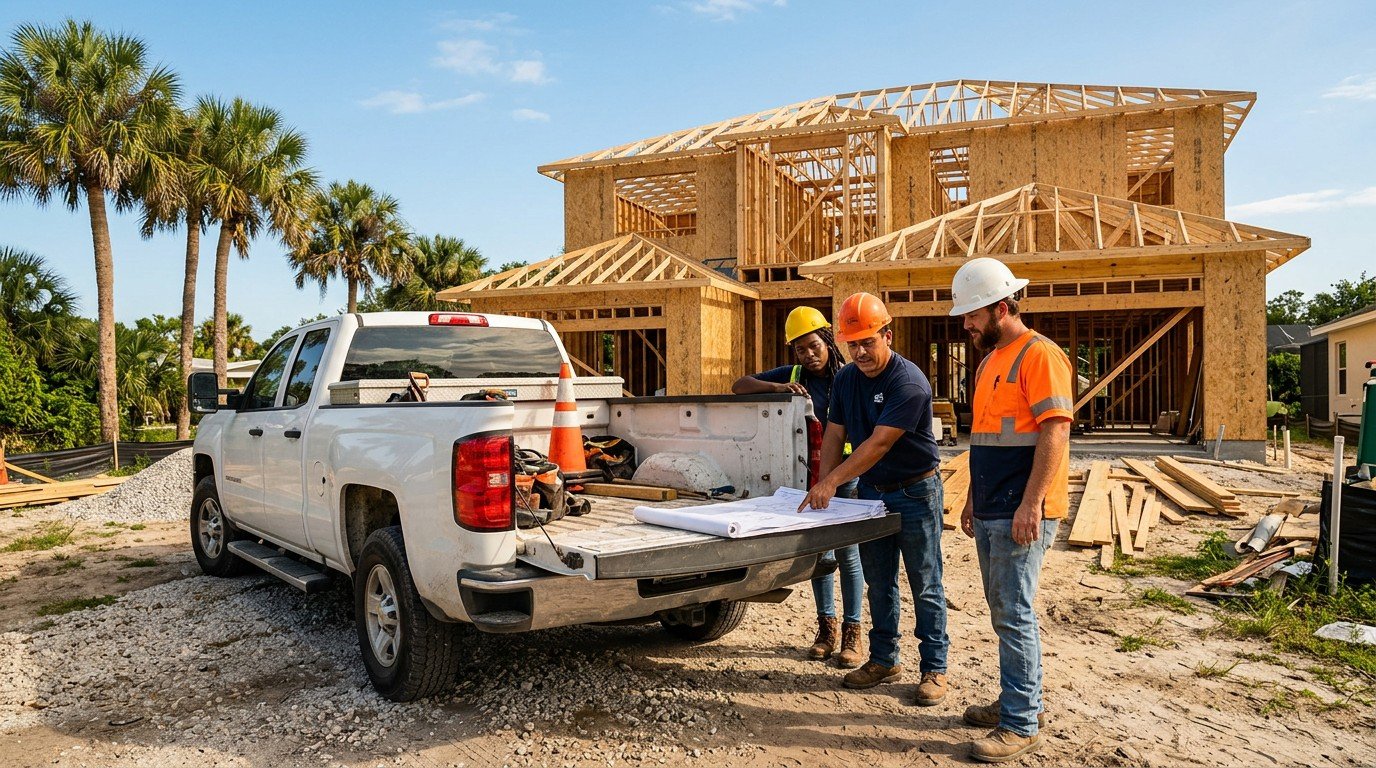
Florida contractor license types split into two divisions under Florida Statute 489.105: Division I covers general, building and residential contractors, while Division II covers twelve trade categories plus a specialty contractor catch all with 21 narrower trades in its own rule. Electrical licensing sits under a separate board entirely.
Listen to this article, about 11 minutes. A synthetic voice reads the article and announces each section title as it begins; tables are read row by row and the questions at the end are left out.
Recorded 1 October 2026 from the article as published that day. Press a chapter to jump there; the highlighted line is what is playing. A play button sits beside every section heading, and once you scroll past this player a bar at the bottom of the screen keeps the controls in reach. Tap or click any sentence to hear the reading start from there.
On this page: the full Division I and Division II category tables cited to the statute, the 2024 rule that actually sets the specialty contractor count, and why electrical sits under a different board entirely.
Think you already know this? Five questions, one minute.
Every answer is on this page. Answer from what you know now; the page fills in the rest.
-
1. Which of these is a Division I license?
Residential, along with general and building, is one of the three Division I licenses under Florida Statutes 489.105. Roofing and plumbing are both Division II trade categories. Read the section
-
2. A registered contractor’s license lets you legally work…
A registered license is tied to the local jurisdiction that issued it; only a certified license lets a contractor work statewide without meeting local competency requirements. Florida Statutes 489.105 Read the section
-
3. Which Division II category has not accepted a new applicant since 1988?
Class C air conditioning closed to new certifications on October 1, 1988, and remains valid only for contractors who already held it. Florida Statutes 489.105 Read the section
-
4. How many specialty categories does the current board rule list?
Rule 61G4-15.100, effective August 28, 2024, lists 21 lettered specialty categories after consolidating about a dozen older separate rules; the 22 figure some pages still repeat does not match the current rule. Rule 61G4-15.100, Florida Administrative Code Read the section
-
5. Which board licenses electrical and alarm system contractors in Florida?
Electrical and alarm contracting is licensed under Chapter 489, Part II by the Electrical Contractors’ Licensing Board, a separate board from the CILB that issues every license named earlier on this page. Florida Statutes, Chapter 489 Part II Read the section
What are the two divisions in Florida contractor licensing?
Every contractor license the Construction Industry Licensing Board (CILB) issues falls into one of two divisions written into Florida Statutes 489.105. Division I is the three licenses unlimited by trade: general, building and residential. Division II is everything defined by a single trade or scope of work, from sheet metal to pollutant storage tanks, fourteen named categories in all, the last of which is itself a catch all for board rule specialty licenses.
| License | Scope | Statute |
|---|---|---|
| General Contractor (CGC) | Unlimited as to the type of work | s. 489.105(3)(a), F.S. |
| Building Contractor (CBC) | Commercial buildings and residential buildings up to three stories | s. 489.105(3)(b), F.S. |
| Residential Contractor (CRC) | One, two or three family residences up to two habitable stories | s. 489.105(3)(c), F.S. |
The three Division I licenses sit the same three exams and pay close to the same fees, so the real decision is scope, not difficulty. If you only ever build houses, our full breakdown of the residential contractor license (CRC) goes through the experience rules and the fee math in detail, and our guide to getting a general contractors license in Florida covers the CGC and CBC side. The papers are not identical, though: the department’s candidate booklet gives general contractors 60 scored questions on Contract Administration and on Project Management, building contractors 50 and residential contractors 45, all in 4.5 hours, and our breakdown of the Florida contractor exam format sets that out part by part.
What is the difference between a certified and a registered license?
Division and trade decide what you can build. Certified against registered decides where. A certified contractor holds a state issued certificate of competency and can work in any jurisdiction in Florida without meeting that county or city’s own competency requirements. A registered contractor is tied to the specific local jurisdiction where the registration was issued, and has to register again, or hold a local competency card, to work somewhere else. Both routes exist at every license type in this article, Division I and Division II alike.
This split matters more than most applicants expect, because it decides whether a single license travels with you across county lines or stops at one. Our dedicated comparison of registered against certified in Florida covers the geographic scope, the exam difference and the conversion path between the two in full; this page only needs the distinction to make sense of the table below it.

What are the Division II trade categories?
Division II covers a trade or a scope of work rather than a type of building. Fourteen categories are named directly in the statute, and the last one, the generic “specialty contractor,” is explained in the next section because it works differently from the other thirteen.
| Category | Scope | Statute |
|---|---|---|
| Sheet metal | Metal fabrication, air handling systems, duct cleaning that requires disassembly | (3)(d) |
| Roofing | Roof installation, waterproofing, skylights, fascia and roof to wall connections during reroofing | (3)(e) |
| Air conditioning, Class A | Unlimited HVAC scope, including piping and low voltage controls | (3)(f) |
| Air conditioning, Class B | HVAC systems under 25 tons cooling or 500,000 BTU heating | (3)(g) |
| Air conditioning, Class C | Servicing existing systems only; closed to new applicants since October 1, 1988 | (3)(h) |
| Mechanical | Unlimited HVAC, boilers, lift stations, fuel and medical gas piping | (3)(i) |
| Swimming pool/spa, commercial | Public and private pool construction and equipment installation | (3)(j) |
| Swimming pool/spa, residential | Residential pool construction and equipment installation | (3)(k) |
| Swimming pool/spa servicing | Repair and servicing only, including draining for renovation | (3)(l) |
| Plumbing | Sanitary and storm drainage, water supply, gas lines, fire protection piping | (3)(m) |
| Underground utility and excavation | Sewer, water and storm systems by open cut or trenchless methods | (3)(n) |
| Solar | Solar water heating and photovoltaic system installation and repair | (3)(o) |
| Pollutant storage systems | Installing and maintaining regulated storage tanks | (3)(p) |
| Specialty contractor | One particular phase of construction, defined individually by board rule | (3)(q) |
Electrical is not in this table on purpose. The next section explains why. Air conditioning is also the one trade with a visible generation gap built into the law: Class C has not accepted a new applicant since 1988, so every Class C holder working today has carried that license for well over three decades.

What is a specialty contractor license, and how many categories exist?
The fourteenth Division II category, “specialty contractor,” does not name a trade itself. It hands the CILB rulemaking authority, under 489.105(3)(q) and 489.113(6), to define narrower specialty categories by rule as the trades come up. That is why the count of “specialty licenses” is the number prep pages disagree on most, and why several still quote a figure that is simply out of date.
A specialty contractor means a contractor whose scope of work is limited to a particular phase of construction through which the specialty contractor qualifies.
Section 489.105(3)(q), Florida Statutes
On August 28, 2024, the CILB consolidated roughly a dozen separate specialty rules, including the ones that used to certify residential pool and spa servicing, industrial facility work and irrigation on their own, into a single rule. Rule 61G4-15.100, Certified Specialty Contractors, now lists 21 lettered categories, among them structural aluminum or screen enclosures, marine construction, structural masonry, structural steel, structural pre-stressed precast concrete, structural carpentry, window and door installation, garage door installation, plaster and lath, gypsum drywall, glass and glazing, building demolition, irrigation, tower construction, gas line work and residential swimming pool/spa servicing. Two older categories under their own separate rules, solar water heating and pollutant storage tank testing, sit outside this consolidated rule because they implement different letters of the statute, (3)(o) and (3)(p), not the (3)(q) catch all.
So when a page says Florida has “22” specialty contractor licenses without naming a rule or a date, treat it as an estimate rather than a citation. The current, dated count under the rule that actually defines the catch all category is 21, not 22, and it changed inside the last two years.
The confusion this creates is not just academic. One contractor with 35 years in the sign industry described on the trade forum Contractor Talk in May 2024 being told he would need either a General Contractor license or a Specialty Structure certification to install certain signage statewide, and that his decades of sign industry experience would not count toward either because the board wants that experience to come from work performed under a general contractor. It is one account, not a rule, but it shows how a trade that straddles two categories can leave an experienced tradesperson qualified for the work and still short of the license the board recognizes for it.
Why isn’t electrical contracting regulated by the same board?
Electrical and alarm system contracting are licensed under an entirely different part of the same chapter, Chapter 489, Part II, sections 489.501 through 489.538, by the Electrical Contractors’ Licensing Board (ECLB) rather than the CILB. The ECLB operates under its own administrative code chapter, 61G6, not the 61G4 chapter that governs every category above. The two boards appoint a joint committee that meets at least twice a year, and a contractor who already holds a current certified CILB license is not required to retake the Business and Finance exam to add an ECLB license, but the two credentials remain separate applications under separate boards, not one license covering both. Our guide to the Florida electrical contractor license covers that board’s own categories in full.
Which license should you actually apply for?
passcontractorexam.com is an independent study resource. It is not affiliated with, and does not speak for, the Florida DBPR, the CILB or the ECLB; the categories above are summarized from the statute and the board’s own rules so you can read the primary source yourself before you decide. Pick by the broadest work you actually plan to do, not the narrowest job on your schedule this month, because moving to a broader category later means qualifying and testing again rather than filing a form.
Once you know which category fits, the full Florida contractor license requirements checklist covers the experience, credit, insurance and background check steps that apply whichever license you choose, and how to look up a Florida contractor license explains how to decode the specific license type code, CGC, CBC, CRC or a Division II abbreviation, on an existing record.
Whichever category you hold, the board enforces the category, not the quality of the work. Building or contracting outside your license’s statutory scope is treated as unlicensed activity for that job even when the license itself is genuine and current.
Which license category fits your work?
Pick the description closest to what you actually do. This reads the statute’s own category tests; it does not assess your experience, your finances or your eligibility to apply.
This chooser reads the statute’s own category definitions. It does not predict approval or promise eligibility.
Frequently asked questions
How many contractor license types does Florida have?
It depends what is being counted. Florida Statutes 489.105(3) names 17 letters, three Division I licenses and fourteen Division II categories, the last of which is a specialty contractor catch all. That catch all is further divided by board rule into 21 specialty categories as of August 28, 2024, under Rule 61G4-15.100.
What is the difference between a certified and a registered contractor in Florida?
A certified contractor can work anywhere in the state on a single state issued license. A registered contractor is tied to the specific local jurisdiction where the registration was issued and needs a separate registration or a local competency card to work elsewhere.
Can an electrical contractor get a CILB license?
No. Electrical and alarm system contracting is licensed under Chapter 489, Part II by the Electrical Contractors’ Licensing Board, a separate board operating under its own administrative code chapter, not the Construction Industry Licensing Board that issues the categories in this article.
Is a Class C air conditioning license still available in Florida?
No new Class C certifications have been issued since October 1, 1988. It remains a valid, grandfathered category limited to servicing existing systems for contractors who already held it before that date.
Does passcontractorexam.com decide which license category I need?
No. This site is independent of the Florida DBPR and does not make that determination. The categories here are summarized from the statute and board rules so you can confirm the fit against your own work before applying.
What happens if I hold the wrong license type for a job?
Working outside your license’s statutory scope is treated as unlicensed activity for that specific job, even though the license itself is genuine and current, and it carries the same enforcement exposure as having no license at all for that piece of work.
Finished the page? The same five questions from the top, to see what stuck.
Rules and fees change without notice. This page was verified on the date shown and is rechecked on the weekly refresh. If you hit something different, tell us in the comments.

Leave a Reply