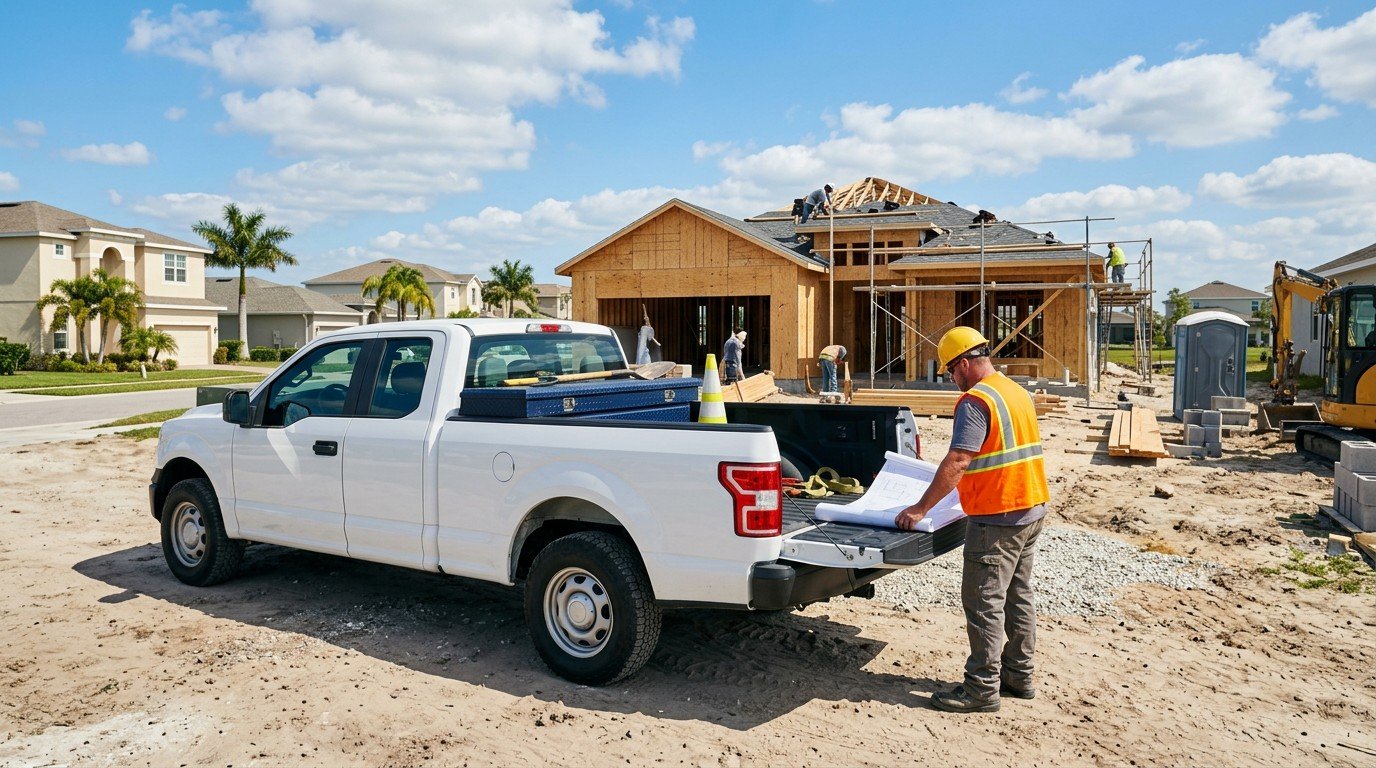
The Florida contractor license credit score threshold is 660, FICO derived, on a current credit report showing no unsatisfied judgments or liens. Below 660, construction board applicants no longer post a bond. Since an April 2022 rule amendment they complete a 14 hour board approved financial responsibility course instead. Liens and judgments must still be satisfied.
Listen to this article, about 15 minutes. A synthetic voice reads the article and announces each section title as it begins; tables are read row by row and the questions at the end are left out.
Recorded 1 November 2026 from the article as published that day. Press a chapter to jump there; the highlighted line is what is playing. A play button sits beside every section heading, and once you scroll past this player a bar at the bottom of the screen keeps the controls in reach. Tap or click any sentence to hear the reading start from there.
On this page: the rule text behind the 660 figure, the 14 hour course that replaced the bond, four approved course prices as listed on 1 November 2026, and the Palm Beach County rules that cut off at 580 where the state rule has no floor.
Think you already know this? Five questions, one minute.
Every answer is on this page. Answer from what you know now; the page fills in the rest.
-
1. What score does rule 61G4-15.006 name for financial stability?
Rule 61G4-15.006(2)(a) lets the board refuse an applicant who cannot show a credit score, FICO derived, of 660 or higher. It names no FICO version. Read the section
-
2. Under the rule as it reads today, what does a construction board applicant below 660 do?
Rule 61G4-15.006(2)(b) sends a sub 660 applicant to the 14 hour course and carries no bond language. Section 489.115(7) only caps what the board may require. Read the section
-
3. What do rules 61G6-5.004 and 61G6-5.005 ask of a business applicant?
The electrical board’s chapter 61G6-5 uses no FICO number; it asks for the financial statement, the net worth figure and a business credit report dated within 12 months. Read the section
-
4. What do the Palm Beach County contractor rules say about a score of 579?
Section 6 of the Palm Beach County rules denies below 580 or with no credit history, with leave to reapply at 580 or above; the county FAQ repeats the three bands. Read the section
-
5. What must the report include under rule 61G4-12.011?
Rule 61G4-12.011(10) defines the report by its contents, and (11) requires the agency to obtain reports from at least two credit bureaus. Read the section
What credit score do you need for a Florida contractor license?
660, and it has to be a FICO derived score. Rule 61G4-15.006 of the Florida Administrative Code, the Construction Industry Licensing Board’s rule on financial responsibility, splits the test in two. Financial responsibility is the clean record part: the board refuses an applicant whose current credit report discloses unsatisfied judgments or liens, against you or against any business you qualified before. Financial stability is the number: a FICO derived score of 660 or higher. One report that clears both halves satisfies both.
For scale, 660 sits just under the 670 to 739 band that myFICO describes as good. The board is not asking for excellent credit, only evidence that you pay people, which is fair for someone about to hold a customer’s deposit. Our full checklist of Florida contractor license requirements shows where this step falls.
What happens if your credit score is under 660?
You take a course. The current rule says an applicant unable to provide a FICO derived score of 660 or higher shall meet the financial stability requirement by completing a 14 hour financial responsibility course approved by the board. That is the whole of it. There is no bond in the rule as published today. If the course will not be finished by the time your exams are, the licence application also offers an inactive type that skips the credit section altogether, and filing inactive after you pass explains what that saves now and what it costs when you switch the licence on.
That is a change, and a lot of what you will read online has not caught up. The department’s own July 2021 application form told a sub 660 applicant to post a bond or an irrevocable letter of credit from a Florida bank: $20,000 for Division I (general, building and residential contractors) or $10,000 for Division II (every other construction board category). The 14 hour course halved it, to $10,000 or $5,000, and the bond stayed in force until you could show a 660 score.
The rule history shows amendments effective 13 April 2022 and 5 May 2024. Licensing service sites date the end of the bond to April 2022, which matches, and the current text has no bond or letter of credit language. The 2024 change arrived inside a package the board announced in the Florida Register on 15 March 2024, volume 50, number 53, whose stated purpose was to update the rules for clarity, to comply with legislative changes and to consolidate the specialty license rules. The 660 figure and the 14 hour course came through it untouched, which is how the rule still read at Cornell’s Legal Information Institute when we reread it on 1 November 2026.

One nuance the ranking pages miss. Section 489.115 of the Florida Statutes still authorises the board to require a bond, capped at $20,000 for Division I and $10,000 for Division II, with half coverable by the 14 hour course. The statute sets the ceiling on what the board may ask for. The rule is what the board actually asks for, and right now it asks for the course.
Search results today still surface surety companies selling a Florida “sub 660” construction license bond. If someone quotes you one for a construction board application, ask which current rule requires it. The answer should be a rule number, not a sales pitch.
Credit route finder
Pick the board, your score band and whether the report shows anything unsatisfied. It reads the rule text back to you for that combination. It does not predict what a board will decide.
Rule 61G4-15.006 and rule 61G4-12.011 for the construction board; rules 61G6-5.004 and 61G6-5.005 for the electrical board; all as read on 1 November 2026. Worked in your browser, nothing is stored or sent.
How do the credit routes compare by license type?
Each route, its figures and the text it comes from, checked on 14 September 2026 and reread against the current rule, the 2026 Florida Statutes and the Palm Beach County rules on 1 November 2026.
| Applicant | Score 660 or higher, no unsatisfied liens or judgments | Score below 660 | Source |
|---|---|---|---|
| Construction board, Division I, today | Credit report meets both requirements | 14 hour approved financial responsibility course | r. 61G4-15.006, F.A.C., amended 5 May 2024 |
| Construction board, Division II, today | Credit report meets both requirements | 14 hour approved financial responsibility course | r. 61G4-15.006, F.A.C. |
| Construction board, Division I, before April 2022 | Credit report meets both | $20,000 bond or letter of credit, or $10,000 with the course | DBPR CILB 10 form, July 2021 |
| Construction board, Division II, before April 2022 | Credit report meets both | $10,000 bond or letter of credit, or $5,000 with the course | DBPR CILB 10 form, July 2021 |
| Statutory ceiling on any construction board bond | Not applicable | Up to $20,000 (Division I) or $10,000 (Division II), half by course | s. 489.115, Florida Statutes |
| Electrical board, business applicant | No FICO figure in the rule | Credit history, financial statement and questionnaire reviewed; net worth $10,000 or $5,000 (specialty) | r. 61G6-5.004 and 5.005, F.A.C. |
Do liens, judgments or a bankruptcy stop an application?
Unsatisfied ones do, and a high score does not rescue you. Financial responsibility is a separate test, so a 780 score with an open judgment against a company you once qualified still fails it. The department’s application has asked for proof of satisfaction of liens and judgments, and proof of discharge of any bankruptcy, where they appear on the report. Start early: a satisfaction of judgment is recorded on the creditor’s timetable, not yours, so a debt settled last month can still read as open.
Does the electrical board use the same credit rule?
No. Electrical and alarm contractors answer to the Electrical Contractors’ Licensing Board under its own chapter, and rules 61G6-5.004 and 61G6-5.005 of the Florida Administrative Code use no FICO number. A business applicant needs a financial statement prepared within 12 months showing net worth of at least $10,000 for unlimited electrical and alarm contractors or $5,000 for specialty contractors, plus a business credit report dated within 12 months.
The board then weighs bankruptcy arising from electrical contracting in the past five years, judgments in that window for unpaid suppliers or workers, and any IRS or Florida Department of Revenue lien. Some licensing service sites say the electrical board applies 660 as well. We could not confirm that against the board’s own application, so ask before relying on either answer. Our guide to the Florida electrical contractor license covers the rest.
Does a county license use the same 660 rule?
Not quite, and the difference is a floor. The state rule names 660 and nothing beneath it: an applicant at 500 and an applicant at 650 are sent to the same 14 hour course. Palm Beach County, which licenses registered contractors through its own Construction Industry Licensing Board, draws a second line. Section 6 of its Rules and Regulations for Palm Beach County Contractors, revised 25 April 2022, says applicants with a credit score of 660 or higher meet the minimum credit reputation requirements; applicants between 580 and 659 must pass a Florida CILB approved 14 hour financial responsibility course and provide the certificate at the time of application; and applicants below 580, or with no credit history, do not meet the requirement and the application will be administratively denied by the Director, with leave to apply again once the score is 580 or above. The county’s contractors certification FAQ repeated the same three bands when we read it on 1 November 2026.
The county also puts a number on the word the state leaves open. Its credit reports are valid for a 90 day period from the date of issuance, must be original reports from a nationally recognized credit bureau with judgments, bankruptcies and tax liens searched and noted, and, the FAQ adds, reports generated by the applicant are not acceptable: the credit company sends them to the county office. If the registered route is yours, our guide to the Palm Beach County contractors license covers the rest of that board’s paperwork, and check your own county’s rules before you order anything, because each local board writes its own.
Which credit report will the board accept?
Not the free one you pull for yourself, in most cases. The department’s application asks for a report from a nationally recognised agency carrying a FICO derived score and a public records statement confirming records were checked at local, state and federal levels. The free annual reports from the three bureaus do not usually include a score, so check that whatever you order carries both before you pay for it.
Qualifying a business means a credit report on the business too, and before you sign anything it is worth reading what qualifying an entity commits you to under Florida law, because an unsatisfied judgment against a business you once qualified follows you into every later application. The department keeps a list of suitable agencies; its construction industry FAQ pages are the place to start, or call 850.487.1395. Ask while you are on the phone what the construction board treats as current, because its rules put no number of days on the word. What they do define is the report itself. Rule 61G4-12.011 calls it a current consumer credit report carrying a current score derived from the Fair Isaac Corporation’s scoring method, covering payment history, credit rating, public filings in county, state and federal courts, and bankruptcies, business history, suits, liens and judgments on a nationwide basis, from an agency that obtains reports from at least two credit bureaus. That is why the free bureau printout fails: it is one bureau, and it carries no public records search.

Ordering the report, item by item
Built from rule 61G4-12.011 and the application wording. Tick each one before you pay for a report.
Ticks are saved on this device only.
How long does the 14 hour course take, and what does it cost?
Fourteen hours, usually online and self paced. As one example, Gold Coast Schools lists its approved course at $149 with a year of access, covering accounting basics, cash management, board rules and lien law. That overlaps heavily with the Business and Finance exam, so the hours do double duty. Confirm the course is on the board’s approved list, and keep the school name, provider number, course name and dates: the application asks for all four.
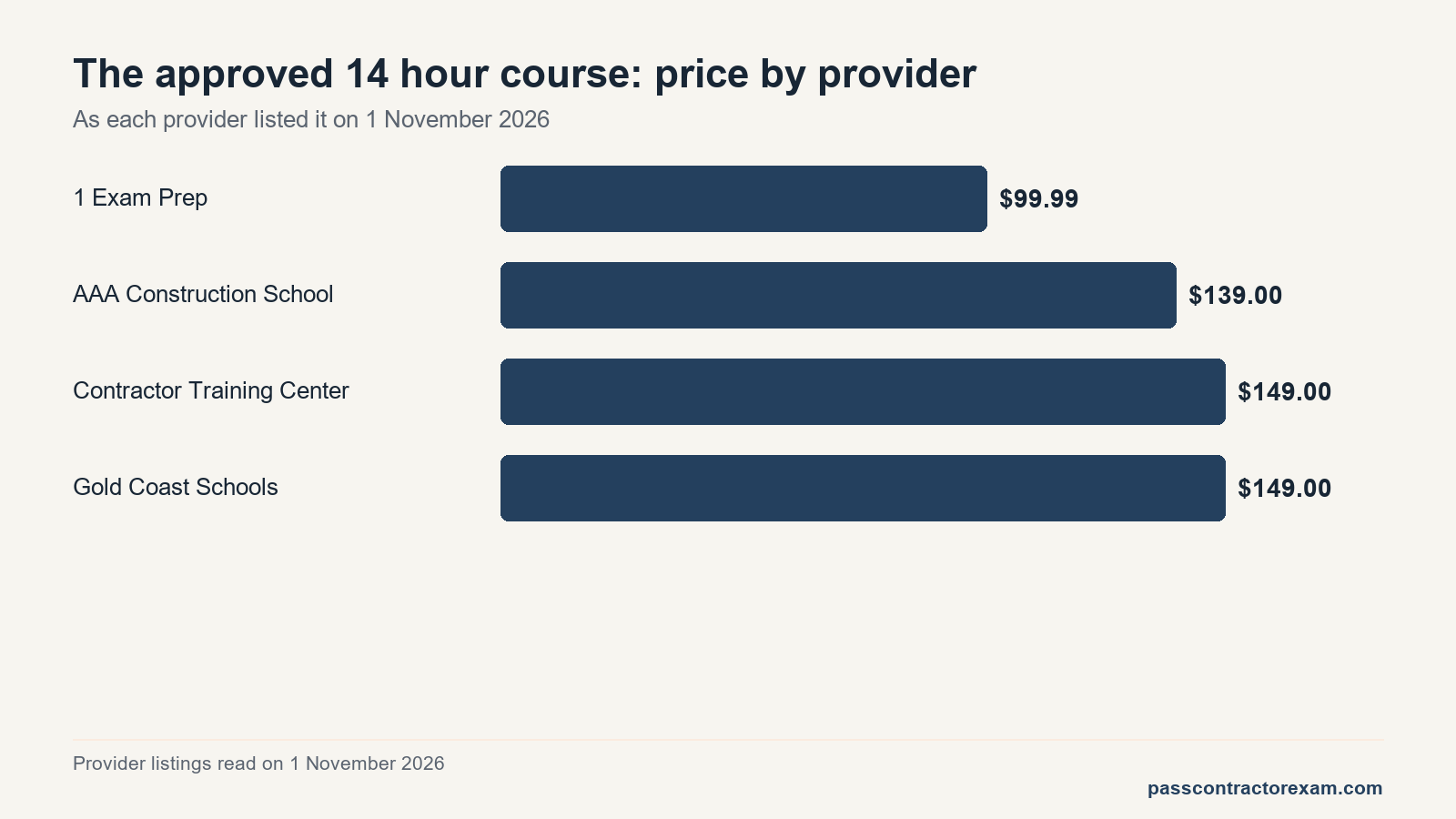
Four approved providers were listing the course on 1 November 2026, and the same 14 hours ran from $99.99 to $149. Prices move and sale codes expire, so read the table as a snapshot of that day, not a quote.
| Provider | Price listed, 1 November 2026 | What the listing says |
|---|---|---|
| 1 Exam Prep | $99.99 | Sale price, regular $111.25; state approved and self paced |
| AAA Construction School | $139.00 | Course number 0609868, online |
| Contractor Training Center | $149.00 | DBPR CILB provider 0008872, course 0613945; a 10 percent code was advertised |
| Gold Coast Schools | $149 | Online tuition, course active for one year from purchase |
One line on those pages deserves a raised eyebrow. Gold Coast’s listing still promises that the course will reduce your contractor bond requirement by 50 percent. That was true of the July 2021 form. Under the rule as it reads today there is no construction board bond to halve, so the course is not a discount on anything: it is the whole route.
What should you do before you apply?
- Pull a report with a FICO score months before you file, so the number is a plan, not a surprise.
- Find any unsatisfied judgment or lien, including against a business you qualified before, and start the satisfaction paperwork.
- Under 660 and applying to the construction board: book an approved 14 hour course and keep the completion details.
- Applying to the electrical board as a business: get a financial statement within 12 months showing the minimum net worth.
- Order the application report, with its public records statement, close to filing.
If you plan to qualify a company, the difference between registered and certified contractors decides which application you file, and the construction industry licensing board reviews it. None of this is a reason to delay the exams. It is a reason to start the paperwork while you study.
Frequently asked questions
Is 660 a FICO 8 score or any FICO score?
The rule says FICO derived and names no version. The department’s application has accepted a FICO or Beacon score from a nationally recognised agency. If your report uses another model, confirm with the department.
Does the credit check apply when I renew my license?
Section 489.115 ties the credit report to an initial application and to a request for a change of status. A routine renewal with no status change is not the trigger.
Can someone else with better credit qualify the business instead of me?
The credit review follows the applicant who qualifies the business, so a different qualifier means that person’s report is reviewed. Lending a license to a business you do not supervise is a separate problem under Chapter 489.
Does taking the 14 hour course raise my credit score?
No. It meets the financial stability requirement in place of the score. Your score stays where it is, and an unsatisfied judgment or lien still has to be satisfied.
If I posted a sub 660 bond before 2022, do I still need it?
We could not confirm how the board treats bonds posted under the old rule. Contact the Construction Industry Licensing Board before cancelling one, because the old bond form required it to stay in force until you showed a 660 score.
Will a collection account or a late payment disqualify me?
The construction board rule names unsatisfied judgments and liens, not late payments. A collection that drops your score below 660 sends you to the course route. The electrical board weighs overall credit history.
Finished the page? The same five questions from the top, to see what stuck.
Rules and fees change without notice. This page was reread on 1 November 2026 against rules 61G4-15.006 and 61G4-12.011, section 489.115 of the 2026 Florida Statutes, the Florida Register notice of 15 March 2024, four provider listings and the Palm Beach County contractor rules. Changed that day: the source for the 2024 amendment, the definition of the credit report, the course price table and a new section on the county 580 floor. If you hit something different, tell us in the comments.

Leave a Reply