
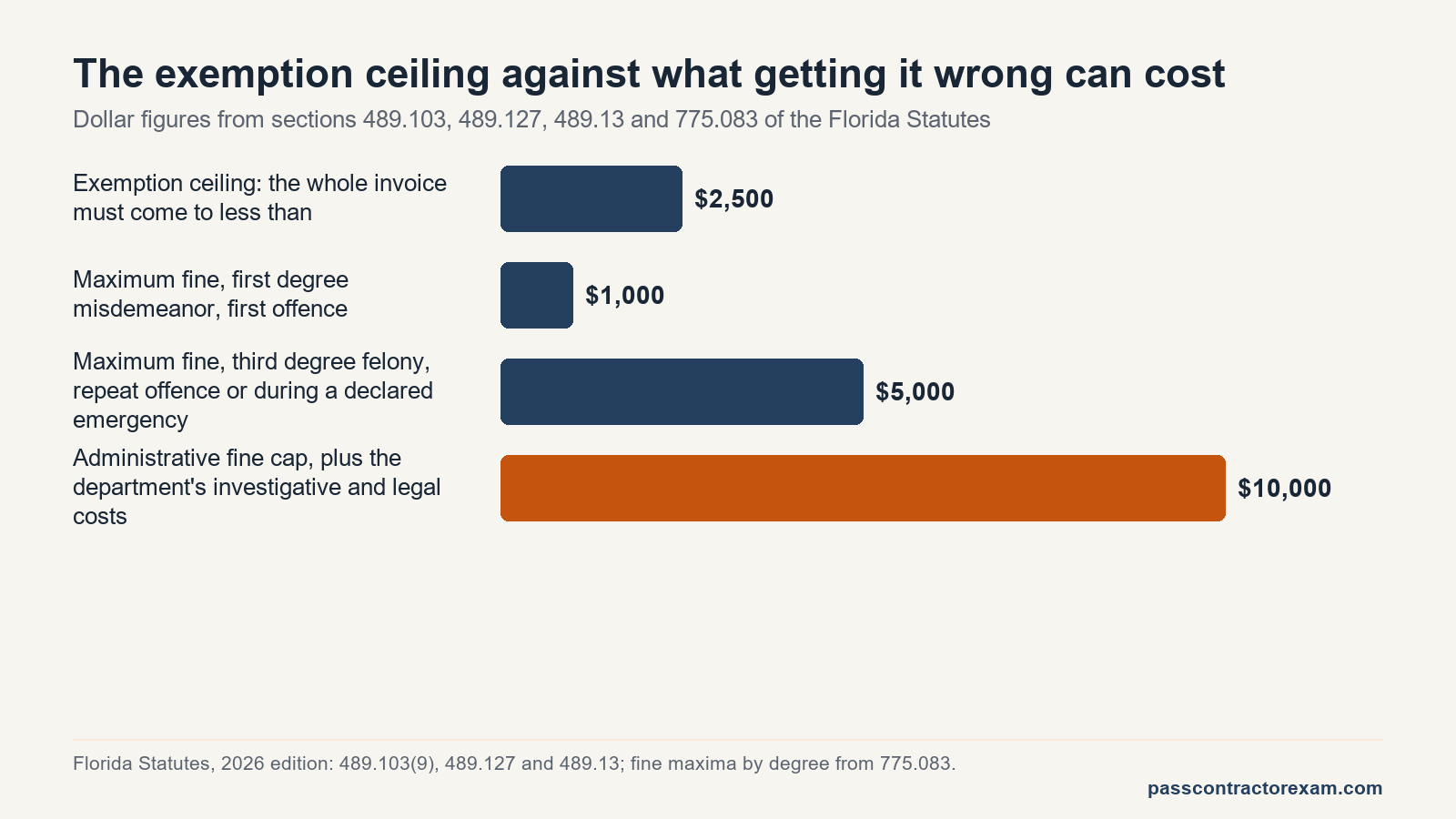
Florida handyman license requirements are short, because the state issues no handyman license at all. Section 489.103(9) of the Florida Statutes exempts casual, minor work where the whole contract, labor and materials together, comes to less than $2,500. Above that figure, on any regulated trade, or on anything needing a permit, the work belongs to a licensed contractor.
Listen to this article, about 15 minutes. A synthetic voice reads the article and announces each section title as it begins; tables are read row by row and the questions at the end are left out.
Recorded 24 October 2026 from the article as published that day. Press a chapter to jump there; the highlighted line is what is playing. A play button sits beside every section heading, and once you scroll past this player a bar at the bottom of the screen keeps the controls in reach. Tap or click any sentence to hear the reading start from there.
On this page: why there is no handyman license to hold and what the $2,500 exemption actually says, eight real jobs in one table with why each is in or out, why the exemption never touches the permit question, what the owner builder route really commits you to, and how fast a misdemeanor becomes a felony after a hurricane.
Think you already know this? Five questions, one minute.
Every answer is on this page. Answer from what you know now; the page fills in the rest.
-
1. What does Florida issue as a handyman license?
Section 489.103 of the Florida Statutes is the whole of it. Fit an exemption and you may work without a license. Fit none and no amount of care about pricing helps you. Read the section
-
2. Under section 489.103(9), what has to come to less than $2,500?
Under, not up to: a job priced at exactly $2,500 is outside. The statute also closes two doors by name, work that forms part of a larger operation and jobs split into contracts under the line, and holding yourself out as a contractor loses the exemption even on a job that would otherwise fit. Read the section
-
3. Replacing a $180 light fitting on an existing circuit: inside the exemption?
The dollar limit is the least important of the three tests. A $400 job can still be illegal depending on the trade and on whether a permit is involved, which is where people who thought they were being careful get caught. Read the section
-
4. Does the exemption let you skip the building permit?
The only ordinary route to a permit without a contractor license is the owner builder exemption, which belongs to the property owner and not to the person working for them. Before you quote, ask the building department whether the work needs a permit. Read the section
-
5. Under section 489.127, what is a first offence of contracting without a license?
Section 489.127 sets the degrees and section 489.13 adds an administrative fine of up to $10,000 plus the department’s costs; the fine maxima for each degree sit in section 775.083. Florida declares emergencies for hurricanes, and post storm repair is exactly when enforcement is most active. Read the section
That $2,500 figure is the first thing to get right, because most of the internet has it wrong. Page after page still says $1,000, including pages updated this year. The limit was $1,000 until CS/HB 1193 of 2020, whose Senate summary says it raised the handyman exception from $1,000 to $2,500, with effect from July 1, 2020. Six years is a long time for a number to stay wrong. If you have been sizing jobs to stay under a thousand dollars, you have been leaving money on the table for no reason.
The second thing to get right is that the dollar limit is the least important of the three tests. A $400 job can still be illegal, depending on the trade and on whether a permit is involved. That is where people who thought they were being careful get caught. Air conditioning is one of those regulated trades, and even the licensed route splits into a Class A or Class B air conditioning contractor license by system size.

Is there such a thing as a handyman license in Florida?
No. There is no state handyman license to apply for, no handyman exam and no handyman category at the Construction Industry Licensing Board. When someone advertises a licensed handyman service in Florida they hold either a local county or city certificate, or a state license in one of the construction categories, or in some cases nothing at all. Which of the three it is takes a minute to settle on the state search, and our guide to reading a Florida contractor license lookup record explains what the letters and the status words on it mean.
That sounds like good news and is not. There is no cheap credential that unlocks small contracting work. What exists instead is a list of exemptions in section 489.103. Fit one and you may work without a license. Fit none and no amount of care about pricing helps you.
What does the $2,500 exemption actually cover?
The statute exempts, in its own words, any work or operation of a casual, minor, or inconsequential nature in which the aggregate contract price for labor, materials, and all other items is less than $2,500. Read that sentence twice. Every clause in it is doing work.
- Casual, minor or inconsequential. The dollar figure is a ceiling, not a definition. Work that is structurally significant does not become minor because it is cheap.
- Aggregate contract price. Labor plus materials plus everything else. Not your labor charge. Not your profit. The whole invoice.
- Less than $2,500. Under, not up to. A job priced at exactly $2,500 is outside the exemption.
- Work or operation. The unit tested is the job, not the contract you wrote for it.
The statute then closes two doors explicitly. The exemption does not apply where the work forms part of a larger or major operation, whether that operation is yours or somebody else’s, and it does not apply where a job has been split into contracts of less than $2,500 to get under the line. Both are written into the section, not read into it by a court.
There is a third condition that catches more people than either. The exemption is lost if you hold yourself out as a contractor. Advertising yourself as a contractor, on a truck, a business card, a website or a listing, puts you outside 489.103(9) even on a job that would otherwise sit comfortably inside it.
The exemption is a description of a kind of work. It is not a status you acquire and then carry from job to job. It is tested fresh every time.
Which jobs fall inside the exemption and which do not?
The wording resolves quickly against real jobs. These examples assume no local rule adds anything, which is worth checking, and they turn on the trade and the permit as much as on the price.
| The job | Inside the exemption? | Why |
|---|---|---|
| Replacing a $180 light fitting on an existing circuit | No | Electrical work is separately regulated. Price is not the test |
| Repainting two bedrooms for $900 | Not needed | Painting is not a state regulated construction category at all |
| Rehanging a sagging interior door for $300 | Yes | Casual, minor, no permit, no regulated trade |
| Retiling a bathroom floor as a standalone repair, $2,200 | Probably | Under the ceiling and arguably minor, but check the county |
| That same tiling inside a $28,000 bathroom remodel | No | Part of a larger operation, which the statute rules out by name |
| Swapping a failed water heater for $900 | No | Plumbing, and it needs a permit in most jurisdictions |
| Splitting an $8,000 job into four $2,000 contracts | No | Division to evade the limit is written into the statute as void |
| Reroofing a shed for $1,400 | No | Roofing is a regulated category with its own license and exam |
Run a job through the statute’s own tests
Six questions, each one a clause of section 489.103(9) or the permit rule. Answer for the job in front of you, not for your business in general, because the exemption is tested fresh every time.
General information, not legal advice. Counties and cities may license trades the state does not; the building department for the address is the only authority for it.
Does the exemption let you skip the building permit?
It does not, and this is the single most expensive misreading of the law we see. Section 489.103 is about licensing. It says nothing about permits. Permit requirements are set by the Florida Building Code and administered by your local building department, and they run on a completely separate track.
In practice the two tracks meet at the counter. A building department will not issue a permit to an unlicensed person for contracted work. The only ordinary route to a permit without a contractor license is the owner builder exemption, which belongs to the property owner and not to the person working for them. If the job needs a permit, the handyman exemption is irrelevant.

Turn that around and you have a usable rule. Before you quote, ask the building department whether the work needs a permit. If it does, you need a license or you need to walk away. If it does not, price and trade and the larger operation test still all have to clear.
What about work on your own home?
Owner builder is a different exemption with different conditions, set out at 489.103(7), and it is genuinely generous on residential property. For a farm outbuilding or a one or two family residence there is no dollar cap at all, provided the building is for your own use and not for sale or lease. On commercial property the ceiling is $75,000.
The conditions are where it bites. You supervise the construction yourself, on site, in person. You sign the permit application personally, with a disclosure that makes you the responsible party for code compliance and for anyone hurt on the job. And the property has to be for your own use: under section 489.103(7), selling or leasing it, or even offering it for sale or lease, within 1 year after completion creates a presumption that the construction was undertaken for purposes of sale or lease. That clause exists to stop people building quietly to sell. You also may not delegate the duty to supervise the work directly to any other person.
It is also not a workaround for hiring an unlicensed contractor. The exemption belongs to the owner and covers the owner’s own work. Handing the job to an unlicensed crew and putting your name on the permit does not make their work legal, and your name is the one on the paperwork afterwards.
What happens if you are caught contracting without a license?
More than most people assume, and the escalation to a felony is faster than most people assume too.
| Situation | Consequence | Source |
|---|---|---|
| First offence, contracting without a license | First degree misdemeanor | F.S. 489.127 |
| A further offence after a previous finding of guilt | Third degree felony | F.S. 489.127 |
| Any offence during a state of emergency declared by the Governor | Third degree felony, first time or not | F.S. 489.127 |
| Administrative action by the department | Fine of up to $10,000, plus its investigative and legal costs | F.S. 489.13 |
Chapter 489 does not set the jail time or the fines itself; it points to Florida’s general penalty sections. Section 775.082 caps a first degree misdemeanor at 1 year and a third degree felony at 5 years, and section 775.083 caps the fines at $1,000 and $5,000. Counties and cities can also cite unlicensed work through their own code enforcement under section 489.127(5), with civil penalties up to $2,000 on a citation.
The state of emergency clause deserves its own sentence. Florida declares emergencies for hurricanes, and post storm repair is exactly when unlicensed work spikes and enforcement is most active. The job that would be a misdemeanor in June is a felony in October.
There is a civil side too, and it is blunter than most people expect. Section 489.128 makes a contract entered into by an unlicensed contractor unenforceable in law or in equity by the unlicensed contractor, and section 713.02(7) says no lien shall exist in favor of a contractor who is unlicensed. The customer can still enforce the contract against you; you cannot enforce it against them. So the practical risk is not only prosecution. It is doing the work, not being paid, and having no legal way to chase the money.
Is a county business tax receipt the same as a license?
No, and this is where a lot of honest handymen get confused. A local business tax receipt, the document most counties and cities issue when you register a business, is a tax. It says you paid to trade in that place. It says nothing about whether you are competent or allowed to do construction work.
The law treats the two as separate in both directions. Section 205.194 says that for any profession the department regulates, the applicant must exhibit an active state certificate, registration, or license before the receipt is issued, so a contractor needs the license first and the receipt second. And section 489.128 says plainly that not holding a business tax receipt does not, on its own, make someone an unlicensed contractor.
So the receipt on your wall is not a handyman license, and the lack of one is not unlicensed contracting. What decides the legal question is still the job itself, tested against the three conditions above. Some counties go further and certify trades the state leaves alone, which is a separate local license, not the tax receipt; the county guides further down this page show what that looks like.
When is it worth getting licensed instead?
The honest answer is arithmetic. If you are regularly turning work down, quietly splitting jobs, or taking permitted work and hoping, the exemption has stopped being a business model and become a risk you carry for free.
The state route runs through experience, financial responsibility, insurance and the examinations, and the paperwork takes longer than the studying does. The financial responsibility step is the one that catches people out: the board wants a FICO derived score of 660, and what the Florida contractor license credit score rule asks for explains the 14 hour course that stands in for it when the number falls short. We set all of it out in the full license requirements checklist. If you know your category, how to get a general contractor license covers the broadest one, the electrical contractor license the trade with the strictest separate route, and the roofing license and its scope the category most affected by Florida weather. Once you hold the license the upkeep is modest by comparison, at 14 hours of continuing education every two years plus the renewal fee.
The exams themselves are less mysterious than the prep industry suggests. All three parts are open book, and how the three exams are structured explains what each one is and how long you get. The exception is plumbing, whose trade paper is pencil and paper on fixed dates and carries five hand drawn isometric drawings worth 50 of its 160 points, set out in our Florida plumbing license exam guide.
What could not be verified for this article?
The $2,500 threshold, the conditions that void the exemption, the owner builder terms and the penalty provisions were read directly from the Florida Senate’s published statute pages for the 2026 edition of sections 489.103, 489.127 and 489.13, reread on 24 October 2026 along with sections 489.128, 713.02, 205.194, 775.082 and 775.083. Those are primary sources and those parts are solid.
Two gaps from the first version are now closed. On 24 October 2026 the Florida Senate’s summary of CS/HB 1193 confirmed the move from $1,000 to $2,500 and its July 1, 2020 start, and the history note on section 489.103 lists that law as chapter 2020-160. The jail and fine maxima now come from sections 775.082 and 775.083 directly. One thing is still not checked: the department’s own guidance pages refuse automated readers, so nothing here relies on them.
Local rules are the standing caveat on all of it. Counties and cities may license trades the state does not, and several do. Call your building department before you quote. Irrigation is the clearest example of a trade licensed at both levels, and whether you need the state irrigation certificate or a county card turns on how many jurisdictions you work in. It is the only source authoritative for your address, and this article is general information rather than legal advice. Palm Beach County shows how far that can go: it still certifies 23 specialty trades, drywall and fence among them, and our guide to the Palm Beach county certificate, its fees and its 2026 board dates lists every one.
Frequently asked questions
Do you need a license to be a handyman in Florida?
Not for work that fits an exemption in section 489.103. There is no handyman license to hold in Florida, so the question is never whether you are licensed as a handyman. It is whether each individual job is casual and minor, under $2,500 in total, outside the regulated trades and free of any permit requirement.
Is the Florida handyman limit $1,000 or $2,500?
The 2026 edition of section 489.103(9) reads $2,500, and so does the 2025 edition. The $1,000 figure was correct years ago and is still repeated across a great many websites. The threshold covers the aggregate contract price for labor, materials and everything else, and the job must be under it rather than at it.
Can I split a large job into smaller contracts to stay under the limit?
No, and the statute rules it out by name. The exemption does not apply where a division of the operation has been made into contracts of less than $2,500 for the purpose of evading the licensing requirement. It also does not apply where the work forms part of a larger operation, even one that somebody else is carrying out.
Does the exemption cover electrical or plumbing work?
No. Those trades are regulated separately and the dollar figure does not reach them. A small electrical or plumbing job is still electrical or plumbing work, and it usually needs a permit as well, which closes the second door. Roofing, air conditioning, pools and several other categories sit in the same position.
What is the penalty for unlicensed contracting in Florida?
Under F.S. 489.127 a first offence is a first degree misdemeanor, and a further offence after a previous finding of guilt is a third degree felony. Any offence committed during a state of emergency declared by the Governor is a third degree felony regardless of history. The department may separately impose an administrative fine of up to $10,000 under F.S. 489.13.
Can I do the work on my own house without a license?
Usually yes, under the owner builder exemption at 489.103(7). On a one or two family residence there is no dollar cap, provided the property is for your own use and not for sale or lease, and the equivalent commercial ceiling is $75,000. You must supervise the work personally and sign the permit yourself with the statutory disclosure. Selling or leasing the property within 1 year of completion creates a presumption that you built it for sale or lease.
Finished the page? The same five questions from the top, to see what stuck.
Rules and fees change without notice. This page was reread on 24 October 2026 against sections 489.103, 489.127, 489.128, 489.13, 713.02, 205.194, 775.082 and 775.083 of the 2026 Florida Statutes and the Senate summary of CS/HB 1193. Changed that day: the title, the answer paragraph, the owner builder sale or lease rule (it is a presumption, not a year of occupancy), the penalty sources, the civil side and a new section on business tax receipts. If you hit something different, tell us in the comments.

Leave a Reply