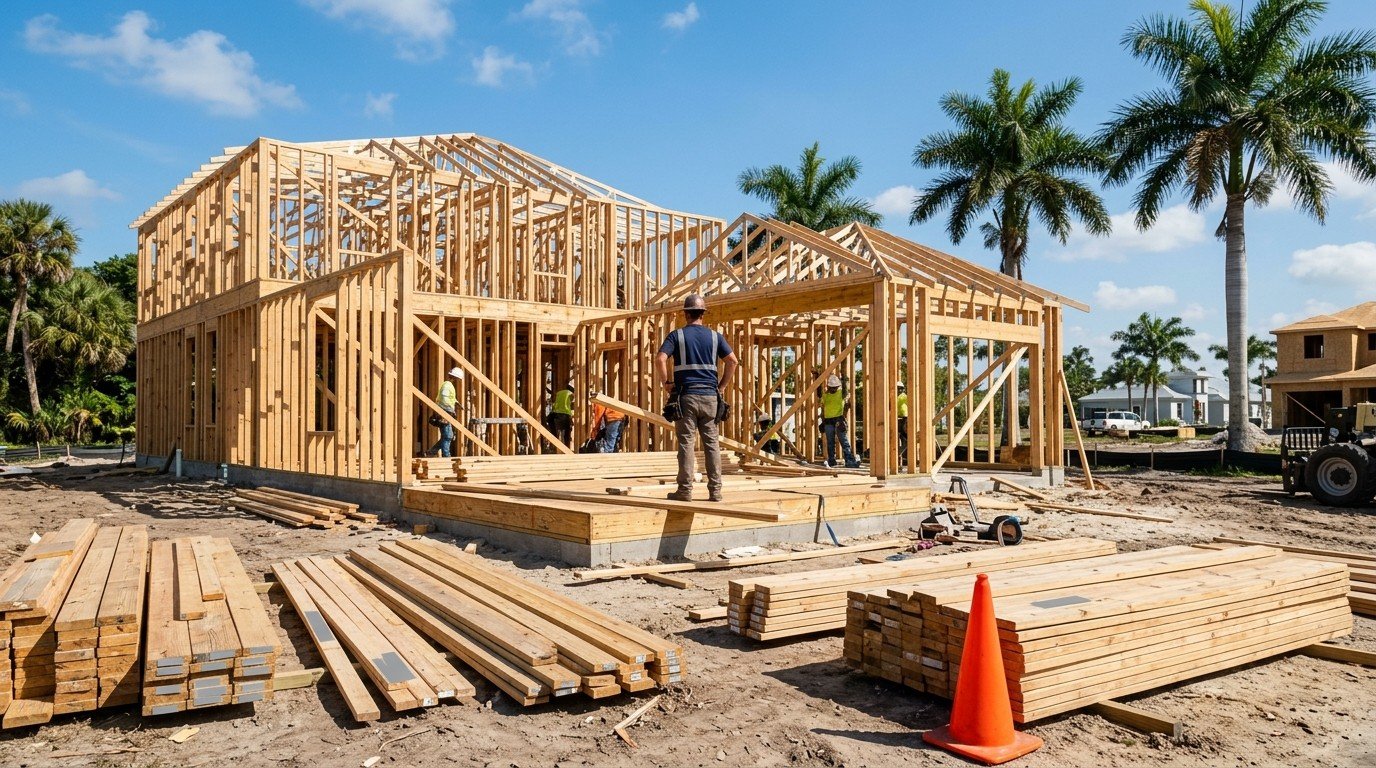
A general contractors license in Florida takes four years of commercial construction experience, including one year on a building of four or more stories, a FICO score of 660 or a 14 hour course, $300,000 of liability cover, three open book state exams, and $540 in exam and application fees in the current fee window.
Listen to this article, about 25 minutes. A synthetic voice reads the article and announces each section title as it begins; tables are read row by row and the questions at the end are left out.
Recorded 29 October 2026 from the article as published that day. Press a chapter to jump there; the highlighted line is what is playing. A play button sits beside every section heading, and once you scroll past this player a bar at the bottom of the screen keeps the controls in reach. Tap or click any sentence to hear the reading start from there.
On this page: the four qualifying routes from section 489.111 in one table, the board’s six structural areas and the four story year, a fee table that prices the exams and the application at $540 in the current window with the rule and form disagreement worked through, and eight 2026 forum accounts of exam attempts and review times.
Think you already know this? Five questions, one minute.
Every answer is on this page. Answer from what you know now; the page fills in the rest.
-
1. Under section 489.105, which Division I licence has no height limit?
Section 489.105(3)(a) describes the general contractor’s services as unlimited as to the type of work, while (3)(b) caps the building contractor at three stories: s. 489.105, Florida Statutes 2026. Read the section
-
2. How many of the rule’s six structural areas must a general applicant’s commercial experience cover?
Rule 61G4-15.001(2)(a) requires commercial experience in four or more of the six areas, and (2)(b) adds one year on a building of four or more stories. Read the section
-
3. How many scored questions does the Business and Finance paper carry?
The DBPR Candidate Information Booklet gives Business and Finance 120 scored questions in 6.5 hours and each general trade paper 60 in 4.5 hours; 125 is the count with the unscored pilot questions included. Read the section
-
4. What does form CILB 5-A charge for an initial application filed in October 2026?
Form CILB 5-A, effective July 2024, prints $245 from 1 May of an even year to 31 August of an odd year and $145 for the other half of the cycle; $335 is the older total in rule 61G4-12.009. Read the section
-
5. After the licence is issued, how long does the department’s checklist give you to have workers’ compensation cover or an exemption?
The DBPR application checklist says workers’ compensation insurance or an exemption must be obtained within 30 days of issuance of the licence. Read the section
It is the broadest construction license the state issues, valid in all 67 counties, and it is the reason people sit the exams rather than settling for a narrower category. Getting one comes down to three things: qualifying on experience or education, passing three exams, and satisfying the financial and insurance requirements at application. Every figure on this page was reread on 22 October 2026 against the statute, the board’s rules and the department’s own application form, and each one is linked where it is used. There is also a national route into the trade portion, and what the NASCLA commercial building contractor exam actually contains sets out its 115 questions section by section if you are weighing that instead. The exam is the part everyone worries about. The paperwork is the part that actually holds most people up.
What can a Florida general contractor build that others cannot?
General is the top of Division I. Section 489.105(3)(a) of the Florida Statutes describes the general contractor’s services as “unlimited as to the type of work which he or she may do”, while paragraph (3)(b) caps the building contractor at buildings that “do not exceed three stories in height” and (3)(c) holds the residential contractor to homes “not exceeding two habitable stories above no more than one uninhabitable story”. That height line is the whole practical difference.
| License | What it covers | Height limit |
|---|---|---|
| General | Any building, commercial or residential | None |
| Building | Commercial and residential structures | Up to three stories |
| Residential | One, two and three family homes | Up to two habitable stories |
If you never intend to work above three stories, the building contractor license covers you and the qualifying route is similar. Our walk through the certified building contractor license requirements lays out the six structural areas the board checks for both licenses and the one extra year a general applicant needs on four story buildings. People often apply for general anyway, because the difference in effort is small and the difference in what you can bid on is not. If your work only ever touches single family homes, duplexes and triplexes under two stories, the narrower scope and its own experience test in our guide to the Florida residential contractor license are worth reading before you commit to general.
Should you go certified or registered?
This is the distinction that confuses nearly everyone, and choosing wrong is expensive.
A certified license is issued by the state through the Construction Industry Licensing Board, part of the DBPR. It is valid in all 67 counties. You get it by passing the state examination, which you book through two separate vendors in a registration sequence that catches most people out. That board and the department it sits inside decide different parts of your file, and the split between what the board decides and what DBPR staff decide is worth knowing before you apply.
A registered license is issued by a local licensing authority, a county or a municipality, and then registered with the state. It only authorizes work inside that jurisdiction. Instead of the state exam you show a certificate of competency from that local authority. Pasco County is a clear worked example of that local layer, from recording a state certified license before you pull a permit to sitting the county trade exam.

Registered is faster to obtain and it locks your business to one geography. If you take a job one county over you are working unlicensed, unless that county accepts your registration, and our comparison of where a registered license stops and a certified one keeps going sets out that exception and the statute behind it. Most people who start registered end up sitting the state exam within a few years anyway, having paid for the process twice. The trade list is often what tempts people local, and the 31 categories Palm Beach County certifies include specialties the state does not issue at all.
Certified is the right default unless you are certain your work will never leave one jurisdiction, and it is the route the rest of this article assumes. The distinction outlives the application too, because certified and registered licenses sit on opposite halves of the renewal cycle and each carries 14 hours of continuing education every two years. It is also the first thing a customer sees on the public record, where the letter before your number reads C or R, and our guide to what a Florida contractor license lookup record shows walks through every field a client will read. Your first renewal is usually lighter than the full 14 hours, and our guide to Florida contractor license renewal fees and first renewal hours shows how the issue date decides it.
How do you qualify on experience or education?
The eligibility test is section 489.111(2) of the Florida Statutes. You must be 18, “of good moral character”, and meet one of the routes in paragraph (c). The statute counts a year as “a minimum of 2,000 person-hours”, so part time years are pro rated, and it says in so many words that junior college and community college courses count as accredited college level courses.
Those routes are not a sliding scale. The statute names four, and the board’s rule narrows the degree route: under rule 61G4-15.001(4) the only degrees that count for the general, building and residential categories are civil engineering, building construction and architecture. A construction management degree is not on that list, whatever a course brochure implies.
| Route | What section 489.111(2)(c) requires | Paragraph |
|---|---|---|
| Degree | A bachelor’s degree from an accredited four year college in engineering, architecture or building construction, plus one year of proven experience in the category | (c)1. |
| Experience | Four years of active experience as an apprentice, skilled worker or foreman, with at least one year as a foreman in charge of a crew | (c)2. |
| College plus experience | One year as a foreman plus three years of college credits; or one year as a skilled worker, one as a foreman and two years of credits; or two years as a skilled worker, one as a foreman and one year of credits | (c)3. |
| Upgrade | An active certified residential or building contractor with four years of proven experience in that classification, who then passes the general contractor examination | (c)4.b. and 4.c. |
The same rule, last amended on 16 May 2024, defines what the experience must look like for a general applicant. It must be “commercial construction experience involving construction, erection, alteration, or modification of buildings”, not sheds, carports, barns or towers, and it must cover four or more of six structural areas: foundations or slabs over 20,000 square feet, masonry walls, steel erection, elevated slabs, column erection, and formwork for structural reinforced concrete. On top of that, rule 61G4-15.001(2)(b) wants at least one year of it “in the construction of structures not less than four stories in height”. Residential and building contractors moving up under the upgrade route are excused from the four story year; everyone else is not. The rule also accepts experience from outside Florida when it fits the 489.105 definitions, and only experience gained under a contractor who was properly licensed for that scope.
- Experience must be in the category you are applying for, not construction generally
- It must be verifiable by employers, supervisors or licensed contractors who will sign for it
- Self employment counts, but you need documentation that stands up: contracts, permits, tax records
- Time spent as a helper or laborer is weighted differently from time carrying responsibility
- Military construction experience generally counts and is worth raising explicitly
The rest of the eligibility picture, including the financial responsibility and insurance side, is covered in the full eligibility requirements. If the credit check is the part that worries you, our explainer on what a 660 credit score means for your license application walks through the rule and the course that replaced the old bond.
Which qualifying route fits you?
Pick the line closest to your record. The answer names the paragraph of section 489.111(2)(c) and what rule 61G4-15.001 adds on top. The board decides eligibility, not this box, and nothing here is about the exams.
A guide to the statute and rule text as read on 22 October 2026, not a determination. Nothing is stored or sent.
Which three exams do you have to pass?
Division I candidates sit three separate papers, and all three must be passed. The counts below are from the DBPR construction Candidate Information Booklet, the edition effective July 2024, which is also where the timings on our exam format page come from.
- Contract Administration. 60 scored questions in 4.5 hours for the general paper. Contracts, bidding, bonds, lien law as it meets the contract, and the AIA documents.
- Project Management. 60 scored questions in 4.5 hours. Plans reading, estimating, scheduling, site safety and the Florida Building Code in use. How the two trade papers differ goes through the content weights for each.
- Business and Finance. 120 scored questions in 6.5 hours. Contract law, lien law, bookkeeping, payroll, insurance and business administration. It is the one that catches experienced builders out.
Each paper also carries a few unscored pilot questions, which the booklet does not count in the totals above, and the pass mark on every paper is 70 percent.
That second paper is worth taking seriously and is worth its own preparation. A great many people who have built for twenty years fail it, because knowing how to run a site is not the same as knowing how to record a transaction. the Business and Finance exam goes through what is on it, and the general contractor study guide built from the DBPR outlines turns the department’s own weights for all three papers into a study order. Much of that paper’s clock goes on arithmetic, and the Business and Finance exam math you have to run from memory separates what the approved books hand you from what you work out yourself.
All three exams are open book, which sounds generous and is not. what open book really means here explains why, and the approved book list covers what you are allowed to bring. Before you mark any of them, the rules on tabbing and highlighting your exam books are narrower than most candidates assume, and a tab with a formula on it counts as a note.
What does qualifying a business mean for your license?
A license is held by a person, but a construction business needs a licensed person attached to it in order to operate. That person is the qualifying agent, and understanding this changes how you think about the whole exercise. What a qualifying agent owes the company and the state sets out the duties in the statute’s own words; the short version is below.
If you are setting up your own company, you qualify your own business and the arrangement is simple. What is worth knowing is the alternative: an unlicensed business owner can bring in a licensed qualifier. That is legal and common, and it is also where a great deal of trouble originates.
- The qualifier is legally responsible for the work performed under their license, whether or not they were on site
- A qualifier who lends their license to a business they do not actually control is exposed to everything that business does
- If the qualifier leaves, the business loses its authority to operate until a replacement is registered
- One person can qualify more than one business, but each relationship has to be properly registered
If someone offers to pay you to qualify their company while you have no operational involvement, understand what you are agreeing to. Your license, your liability, and their decisions. This arrangement destroys careers with some regularity.
What does a general contractors license in Florida cost?
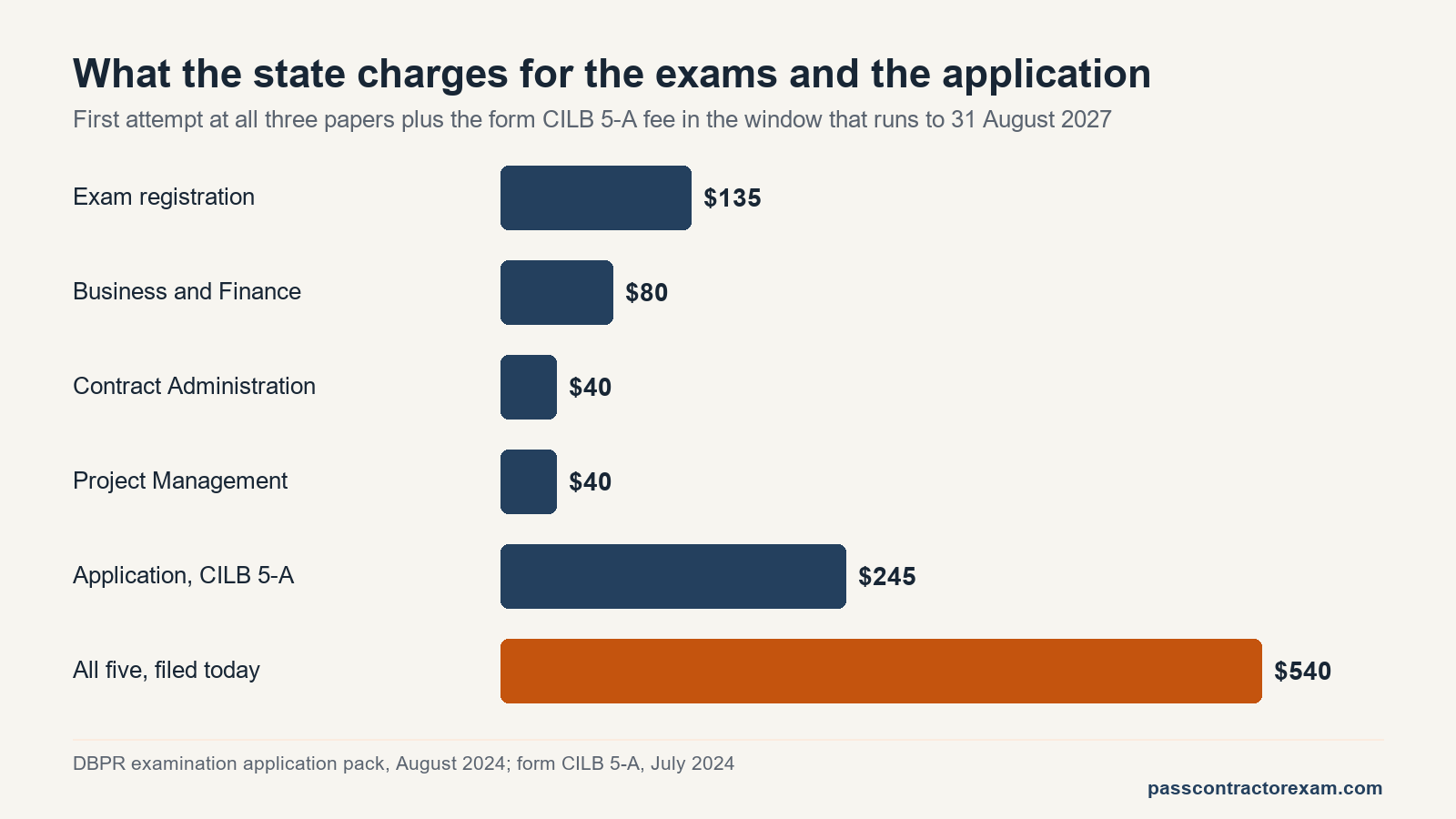
Nobody publishes a single number because the department and its testing vendor charge separately, and the application fee changes with the calendar. Put together from the documents that print each figure, the state’s part looks like this.
| Item | Amount | Where the number is printed |
|---|---|---|
| Examination registration, paid to Professional Testing | $135 | DBPR examination application pack (August 2024) and rule 61G4-12.009 |
| Business and Finance paper | $80 | Application pack; the rule’s $80 per test |
| Contract Administration paper | $40 | Application pack. The rule counts Contract Administration and Project Management as one $80 test, which comes to the same $80 for both |
| Project Management paper | $40 | Application pack |
| Application for initial certification, filed 1 May of an even year to 31 August of an odd year | $245 | Form CILB 5-A, effective July 2024, incorporated by rule 61-35.010 |
| Application for initial certification, filed 1 September of an odd year to 30 April of an even year | $145 | Form CILB 5-A |
| Exams plus application, filed today | $540 | Our arithmetic: $135 + $80 + $40 + $40 + $245 |
| Qualifying a business organisation, if you contract through a company | $50 | Rule 61G4-12.009 |
| Credit report with a FICO derived score, from a board approved agency | Set by the agency | Rule 61G4-15.006 |
| 14 hour financial responsibility course, only if the score is under 660 | Set by the provider | Rule 61G4-15.006 |
| Public liability and property damage insurance, general contractor | $300,000 and $50,000 minimum | Rule 61G4-15.003 and form CILB 5-A |
| Biennial renewal | $200 | Rule 61G4-12.009 |
There is a disagreement worth knowing about. Rule 61G4-12.009, last amended in October 2017, says the application and examination fee is $335, made of the $135, $80 per test, and $40 “for processing of the application after they have successfully passed the examination”. The form the department actually hands you, CILB 5-A of July 2024, prints $245 or $145 instead. We read the difference as the rule’s $40 processing fee plus its $200 initial certification fee, which drops to $100 in the second year of the licensing biennium, plus the $5 unlicensed activity fee that section 455.2281 adds to every application: $40 + $200 + $5 is $245 and $40 + $100 + $5 is $145. That reading is ours, not the department’s, but the arithmetic fits and the form is what you will be charged.
The bond that older guides mention is gone. Since the 5 May 2024 amendment, rule 61G4-15.006 offers an applicant under 660 one route, the 14 hour financial responsibility course, and says nothing about a bond. What the 660 credit score rule really asks for walks through it line by line.
The book cost surprises people most. The approved reference list runs to several volumes and buying them new is a real expense, which is why the used market for previous editions is busy. Be careful there: the edition matters, and an out of date volume is worse than useless because it will confidently give you a wrong answer. Before you buy a used volume, check which edition the reference list for your test date names, because two of the trade exam books moved to new editions on July 1, 2026. If you are weighing a course instead, the Florida contractor exam prep prices, provider by provider, set against buying the books and studying alone show how much of each package is really the book set.
What will the state and its vendor charge you?
Adds up the fees printed in the DBPR examination application pack and form CILB 5-A for your filing date and the papers you still have to sit. It says nothing about passing and nothing about books, courses, the credit report or insurance.
Exam fees from the DBPR examination application pack of August 2024: $135 registration per sitting plus $80, $40 and $40 per paper. Application fee from form CILB 5-A of July 2024. Business qualification from rule 61G4-12.009. Worked in your browser, nothing is stored or sent.
Why do applications get rejected or continued?
Rejections are usually procedural rather than substantive, which is frustrating and also good news, because procedural problems are preventable. A file the staff cannot approve goes to the Construction Industry Licensing Board’s monthly application review, where it is approved, continued for more paperwork, or denied; who decides what on that board explains the split. The reasons that come up most:
- Experience that cannot be verified to the required standard, or verifiers who do not respond.
- Experience in the wrong category for the license applied for.
- Financial documentation that is incomplete or inconsistent with the credit review.
- Insurance that is not yet in force at the point of application.
- Non disclosure on the background section, which is far more damaging than whatever was not disclosed.
- Simple omissions: an unsigned form, a missing page, a fee paid at the wrong stage.
Before the file goes in
Every line comes from the department’s application checklist, form CILB 5-A or a board rule named on this page. Tick what is already in the envelope.
A packing list from the public documents, not legal advice and not a promise of approval. Ticks stay in your browser only.
What do people who got the license in 2026 actually report?
The statute says nothing about how long the review takes or which paper fails people, so we read two 2026 threads, 59 comments on r/Contractor and 15 on r/GeneralContractor, and kept the eight accounts that gave a date, a number or a sequence. This is what people report, not evidence; the links go to the threads.
- A poster with about five years running jobs failed Business and Finance twice, scoring 66 and then 64, and blamed time rather than content: the open book format ran out before the questions did, because they had studied the material instead of the books (r/Contractor, April 2026).
- A commenter on the same thread needed three attempts at Business and Finance, and passed the trade paper in about 50 minutes with a 93 (r/Contractor, April 2026). Another bought about $300 of books and studied for six months after work.
- A third commenter took seven or eight Saturdays of a Central Florida class, memorised the tables of contents, and scored over 90 on all three papers first time, which cuts against the pattern (r/Contractor, April 2026).
- A July 2026 comment gave the fullest timeline: Business and Finance booked in April and sat in May, Contract Administration in mid June, Project Management five days later, the application filed a few days after that, and the license in hand by mid July (r/Contractor, July 2026). They worked the paper in two passes, about 1.5 hours straight through and 2 hours on the tagged questions.
- On r/GeneralContractor the thread starter had passed all three papers and filed online; the status still read “eligible for exam” after three weeks, and the license was approved four days after they asked, with no application company involved (r/GeneralContractor, July 2026).
- A commenter there waited six weeks in all and was told by the review staff that each part of the application is checked separately and at the same time, not in sequence. Another said reviews take four to five weeks and every deficiency letter restarts that clock (r/GeneralContractor, July 2026).
- The same commenter quoted the board’s 10 June 2026 application review as 30 files: 9 approved, 7 continued, 1 pulled, 6 withdrawn and 7 denied, and used it to argue for paying an application service, which another poster disputed. The minutes PDF sits on a DBPR server that refuses automated readers, so those counts are as the commenter quoted them, not as we read them (r/GeneralContractor, July 2026).
Where the accounts and the rules agree: the department’s application checklist ties the application to the Exam Candidate ID from the exams, so the sequence those posters describe, exams first and the file afterwards, is the one the department designs for. Where the accounts add something the rules do not say: Business and Finance is the paper people fail, time is the reason they give, and a complete file is reported as four to six weeks to a license. Where to be careful: the review counts above are one forum poster’s reading of one month’s minutes, and nothing in them says why those seven files were denied.
In what order should you do things?
- Work out which category you actually need. General if you might go above three stories, building or residential if you definitely will not.
- Audit your experience honestly against rule 61G4-15.001: four of the six structural areas, one year on a four story building, and a licensed contractor who will sign for it. Start this early, because tracking down a supervisor from six years ago takes weeks.
- If you are relying on a degree, check it is one of the three the rule names before you count it as three years.
- Register for the examinations with Professional Testing, which issues the Exam Candidate ID the application is linked to, then prepare for all three papers. Most people underestimate Business and Finance and overestimate the trade papers.
- Book and sit the exams, paying the $135 and the per paper fees at scheduling.
- File form CILB 5-A with the experience verification, the credit report and the insurance affidavit, and send your fingerprints through a Livescan provider “immediately after submitting your application”, as the department’s checklist puts it; the results take up to five days to reach the department.
- If you will contract through a company, qualify it with its own application and $50 fee.
- Within 30 days of the license being issued, have workers’ compensation cover or an exemption in place, which is the checklist’s deadline, not ours.
Fees and current requirements change, so take those from DBPR directly rather than from any guide, this one included. Veterans, their spouses and Florida National Guard members can ask for a fee waiver with the application, and the checklist says military construction experience counts.
Where do applicants actually come unstuck?
Not the exam. The two things that derail applications are experience that cannot be verified to the standard required, and financial documentation that is not ready when the rest is.
If you do fail a paper it is not the end of anything, and the retake rules are more forgiving than people fear. what happens if you fail covers what happens next.
Frequently asked questions
What is the difference between a certified and a registered contractor in Florida?
A certified license is issued by the state and is valid in all 67 counties. A registered license comes from a local licensing authority and only lets you work in that jurisdiction. Certified requires passing the state exam. Registered requires a local certificate of competency instead.
How many years of experience do I need?
Four years of active experience with at least one year as a foreman, under section 489.111(2)(c). A bachelor’s degree in civil engineering, building construction or architecture cuts that to one year of experience in the category, and three fixed mixes of college credits and experience sit in between. For general, the board’s rule also wants one of those years on a building of four or more stories.
What can a general contractor build that a building contractor cannot?
The general contractor license is the broadest of the Division I licenses and is the one that permits unlimited height. A building contractor license is limited to commercial buildings up to three stories and residential work. If you plan to work above three stories you need the general.
Do I need to pass more than one exam?
Yes, three. Division I candidates sit Contract Administration, Project Management and Business and Finance, all open book, and every paper must be passed. The DBPR booklet gives the general contractor papers 60, 60 and 120 scored questions. Many experienced tradespeople find Business and Finance the hardest, because it tests bookkeeping and law rather than building.
Can I use my Florida license in another state?
Sometimes. A certified Florida license carries more weight for reciprocity than a registered one, but every state sets its own terms and several require you to sit their own exam anyway. Check with the receiving state rather than assuming.
How long does the whole process take?
Realistically several months. Gathering verifiable experience documentation is usually the slowest part, then exam scheduling, then application review. People who treat the paperwork as an afterthought are the ones who take a year.
Finished the page? The same five questions from the top, to see what stuck.
Rules and fees change without notice. This page was reread on 22 October 2026 against sections 489.105, 489.111 and 455.2281 of the 2026 Florida Statutes, board rules 61G4-15.001, 61G4-15.003, 61G4-15.006 and 61G4-12.009, form CILB 5-A of July 2024 and the department’s application checklist. Changed that day: the answer paragraph, the exam count (three papers, not two), the fee table, the bond sentence, the qualifying routes and the accounts section. If you hit something different, tell us in the comments.

Leave a Reply