A Florida contractor license lookup is free on the DBPR’s Verify a Licensee search at myfloridalicense.com, by name, license number, city or county, or license type. Read three things on the result: the letters in the number, where C means certified statewide and R means registered locally; a status of Current, Active; and the expiry date.
Listen to this article, about 14 minutes. A synthetic voice reads the article and announces each section title as it begins; tables are read row by row and the questions at the end are left out.
Recorded 28 September 2026 from the article as published that day. Press a chapter to jump there; the highlighted line is what is playing. A play button sits beside every section heading, and once you scroll past this player a bar at the bottom of the screen keeps the controls in reach. Tap or click any sentence to hear the reading start from there.
On this page: every license code letter decoded from the DBPR’s own code list, each status word defined from the department’s glossary, a table of what the record does and does not answer, and a six point checklist to run before you sign.
Think you already know this? Five questions, one minute.
Every answer is on this page. Answer from what you know now; the page fills in the rest.
-
1. Why can a search on a contracting company’s name come back empty even when the work is licensed?
Under section 489.119 a business organization operates through a qualifying agent who must be certified or registered, so search the qualifier’s name or the license number. Read the section
-
2. On the DBPR’s code list, what is a CCC license?
The DBPR code list gives CCC as Certified Roofing Contractor, and RC as its registered equivalent. Read the section
-
3. What does Current, Inactive mean on a contractor’s record?
The DBPR glossary defines Inactive as having met the requirements but not being allowed to work under the license. Read the section
-
4. Where may a registered contractor, with a number starting R, contract?
Section 489.105(10) says registered contractors may contract only in the jurisdictions for which the registration was issued. Read the section
-
5. When does a complaint against a Florida contractor become a public record?
Section 455.225(10) keeps complaints confidential until 10 days after probable cause is found. Read the section
A whole cottage industry of lookup sites now sits on top of that free state search, each one repackaging the same public data with more advertising and less explanation. This page does the opposite. It sends you to the official search and then explains what each field on the record means, using the department’s own code table and glossary and the statutes behind them, all read on 28 September 2026. This site is independent of the DBPR and has no access to anything the public search does not show.
Where do you look up a Florida contractor license?
The search is the department’s Verify a Licensee page on myfloridalicense.com. It offers four ways in: search by name, by license number, by city or county, and by license type. Name is the one most people use, and the one most likely to mislead, because the business on the truck is often not the person who holds the license.
That is by design. Under section 489.119 of the Florida Statutes, a company does not hold its own contractor certificate. It operates through a qualifying agent who must be certified or registered, which our guide to the qualifying agent’s legal obligations covers in detail. So if a search on the company name comes back empty, search the individual named on the contract, or use the number itself. The same statute requires the license number to appear on every offer of services, bid, contract and advertisement, so a contractor who cannot show you one has already told you something.
The record also carries two kinds of name. The department’s glossary defines the primary name as the legal name on the license and the alternate name as an additional one the licensee has given, such as a doing business as name. A trading name that appears on neither is worth a question.
What do the letters at the front of the license number mean?
Every construction license number begins with a letter code for the license type, followed by digits. The code is the fastest way to tell what the person is licensed to do and whether that license travels. The table below is compiled from the occupation code list on the DBPR’s Understanding DBPR Codes page, as captured in May 2026, with the categories checked against the definitions in section 489.105.
| Code | What the DBPR code list says it is | Reach |
|---|---|---|
| CGC | Certified General Contractor | Statewide |
| CBC | Certified Building Contractor | Statewide |
| CRC | Certified Residential Contractor | Statewide |
| CCC | Certified Roofing Contractor | Statewide |
| CAC | Certified Air Conditioning Contractor, with a class A, B or service class | Statewide |
| CMC | Certified Mechanical Contractor | Statewide |
| CFC | Certified Plumbing Contractor | Statewide |
| CPC | Certified Pool/Spa Contractor, commercial, residential or service | Statewide |
| CUC | Certified Utility and Excavation Contractor | Statewide |
| CVC | Certified Solar Contractor | Statewide |
| RG, RB, RR | Registered General, Building and Residential Contractor | Only where the local competency was earned |
| RC, RF, RA, RM | Registered Roofing, Plumbing, Air Conditioning and Mechanical Contractor | Only where the local competency was earned |
| EC, ER | Electrical Contractor (certified) and Registered Electrical Contractor, under a separate board | Statewide, or local for ER |
Two details trip people up. CCC is roofing, not some general construction class, so a CCC holder quoting for a kitchen extension is outside the license. And RR is Registered Residential, not roofing: at least one third party lookup guide we read on 28 September 2026 lists RR as a roofing license, while the department’s own list gives roofing the code RC. Electrical work sits under a different board altogether, so an electrician’s number starts with E, as our guide to the Florida electrical contractor license explains.

What does each license status on the record mean?
The status line joins two words. The DBPR’s code list gives the primary status as Current, Probation or Suspended, and the secondary status as Active or Inactive. The glossary then defines each word. The one you want to see when hiring is Current, Active: up to date with the department’s requirements and allowed to operate under the license.
| Status word | What the DBPR glossary says | Can the holder contract? |
|---|---|---|
| Current | Up to date with the department’s requirements for licensure | Only if also Active |
| Active | Allowed to operate under the associated license | Yes, if Current |
| Inactive | Has met the requirements but is not allowed to work under this license | No |
| Delinquent | Has not completed a timely renewal | No, not until renewed |
| Null and Void | Has failed to renew and would have to reapply | No |
| Probation | Placed on probation as part of discipline or as a condition of licensure | Yes, under conditions |
| Suspended | Work privileges suspended for a specified period | No |
| Revoked | No longer meets the requirements to operate under the license | No |
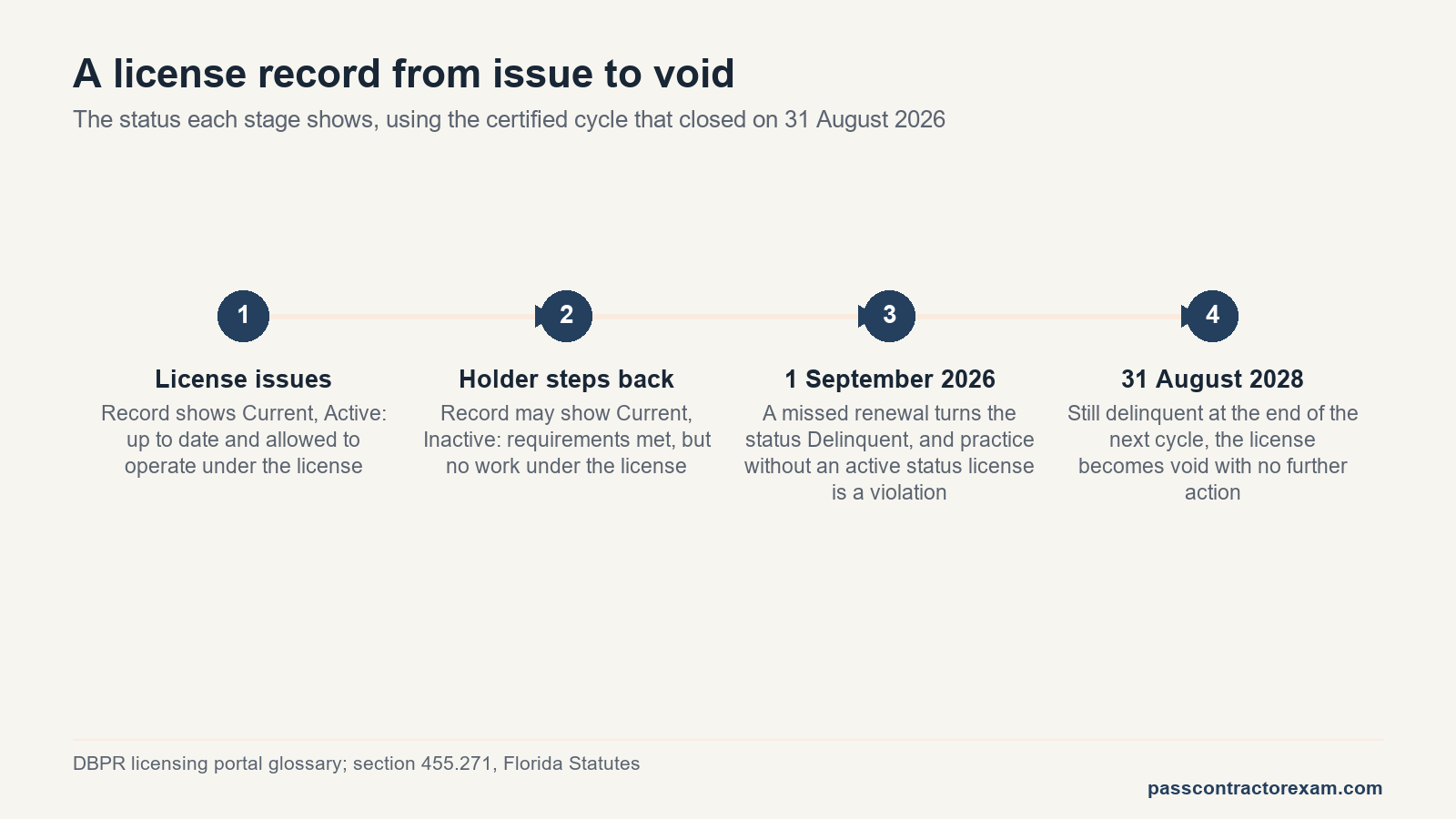
The law behind the last column is short. Section 455.271 says a licensee may practice only with an active status license, and a delinquent license that is not made active or inactive before the end of the current licensure cycle becomes void without any further action. Construction licenses renew every two years on 31 August, even numbered years for certified and odd numbered years for registered, which our renewal guide sets out with the fees. So a record showing Delinquent in September is a renewal that slipped, and one showing Null and Void is a license that no longer exists.
Is the license certified or registered, and why does it matter?
The statute draws the line plainly. A certified contractor, under section 489.105(8), holds a state certificate of competency and may contract in any jurisdiction in Florida without meeting that jurisdiction’s own competency requirements. A registered contractor, under section 489.105(10), registered with the state after meeting a local jurisdiction’s competency requirements, and may contract only in those jurisdictions.
In practice that means an RG license from one county says nothing about the next county over. If your job is in Tampa and the number starts with R, check whether the competency was earned in Hillsborough, which our Hillsborough County contractor license guide covers, or ask the local building department. The full comparison, including why someone would still choose the local route, is in registered versus certified contractors in Florida.
Trades the state does not license at all, such as painting or flooring in many places, will not appear in the state search, and that is not a red flag in itself. Our page on what you can legally do without a contractor license draws the line between that work and work that needs one.
What does the DBPR record not tell you?
A clean record is less reassuring than it looks, for three reasons.
First, complaints stay private for a while. Under section 455.225(10), a complaint and the investigation behind it are confidential until 10 days after probable cause has been found, unless the licensee waives that. A contractor can have several open complaints and a spotless record, and one dismissed without probable cause never becomes public at all. What you see is finished discipline, not accusations.
Second, the record is not an insurance certificate. It shows the license, not whether a liability policy is in force today. Ask for the certificate and confirm it with the insurer. Workers’ compensation is separate again: the state keeps its own online search of policies and of the construction exemptions that corporate officers can elect under section 440.05, so an exemption is worth checking there rather than taking on trust.
Third, it does not confirm the scope of the job. A license tells you the category, and the category sets the limits. The record will not tell you that a residential contractor is quoting a four storey commercial building, or that a roofer is quoting the structural repair underneath. You have to set the code against the work.
| Question you have | Does the DBPR record answer it? | Where the answer is |
|---|---|---|
| Is this person licensed, and in what category? | Yes | License number and code |
| Can they contract today? | Yes | Status: Current, Active |
| Can they work in my county? | Yes for C codes; partly for R codes | Code prefix, then the local building department |
| Are there complaints against them? | Only after probable cause | Section 455.225(10) |
| Do they carry liability insurance now? | No | Their certificate, confirmed with the insurer |
| Do they carry workers’ compensation? | No | The state’s workers’ compensation coverage search |
| Is my job inside their license? | Only indirectly | The category definitions in section 489.105 |
Six things to confirm on a DBPR record before you sign
Run these against the official search result, not a screenshot someone sends you. Each one comes from the statute or the department’s own glossary.
A clean record means the license is valid today. It does not rate the contractor’s work, and complaints only appear after probable cause. Ticks are saved on this device only.
What should you do when the record does not match?
If the number belongs to someone else, the name does not match, or the status is anything other than Current, Active, do not sign or pay a deposit until it is explained. Contracting without a license is a crime under section 489.127: a first offence is a first degree misdemeanor, and a further offence, or any offence during a declared state of emergency, is a third degree felony. Declared emergencies in Florida usually follow a hurricane, so that clause bites hardest after a storm.
You can report it through the DBPR’s complaint page. There is also a backstop that only applies to licensed work. The Florida Homeowners’ Construction Recovery Fund repays homeowners harmed by certain violations of a certified or registered contractor. Section 489.143 caps each claim, for contracts entered into on or after 1 July 2024, at $100,000 for general, building and residential contractors and $30,000 for the other categories. The department’s annual report for 2023 to 2024 records 168 claims paid that year, totalling $3,219,606.86. The fund is built around claims against certified or registered contractors, so it is little comfort if the person you paid was never licensed, which is the strongest argument for running the search before the deposit rather than after it.
If you are reading this as an exam candidate: once you pass and your license issues, this is the record every customer will check. Our guide to what to do after passing the Florida contractor exam covers getting from a pass to a Current, Active status. No lookup trick makes that faster, and no prep course can promise it.
Frequently asked questions
Does the Florida contractor license lookup cost anything?
No. The DBPR’s Verify a Licensee search on myfloridalicense.com is free and needs no account. Third party lookup sites draw on the same public data.
Can I look up a contractor by company name?
You can search by name, but a business operates through a qualifying agent’s license under section 489.119, so the company name may not return the record you need. Search the qualifier’s name or the license number instead.
Why does a license I know exists not show up?
Check the spelling, try the license number, and check whether the trade is licensed by a county rather than the state. Locally licensed trades the state does not regulate will not appear in the state search at all.
What does Current, Inactive mean on a contractor’s record?
The holder has met the department’s requirements but is not allowed to work under that license. It is common for retired contractors and for people between employers, and it means they cannot contract on it right now.
How long can a license stay Delinquent before it is void?
Under section 455.271(6)(a), a delinquent license that is not made active or inactive before the end of the current licensure cycle becomes void with no further action by the board. After that the holder has to apply again.
Does a license on the record mean the contractor is any good?
No. It means the person met the state’s requirements, passed the exams and is up to date. It says nothing about workmanship, price or how they treat a customer, and complaints only become public after probable cause is found.
Finished the page? The same five questions from the top, to see what stuck.
Rules and fees change without notice. This page was verified on the date shown and is rechecked on the weekly refresh. If you hit something different, tell us in the comments.

Leave a Reply