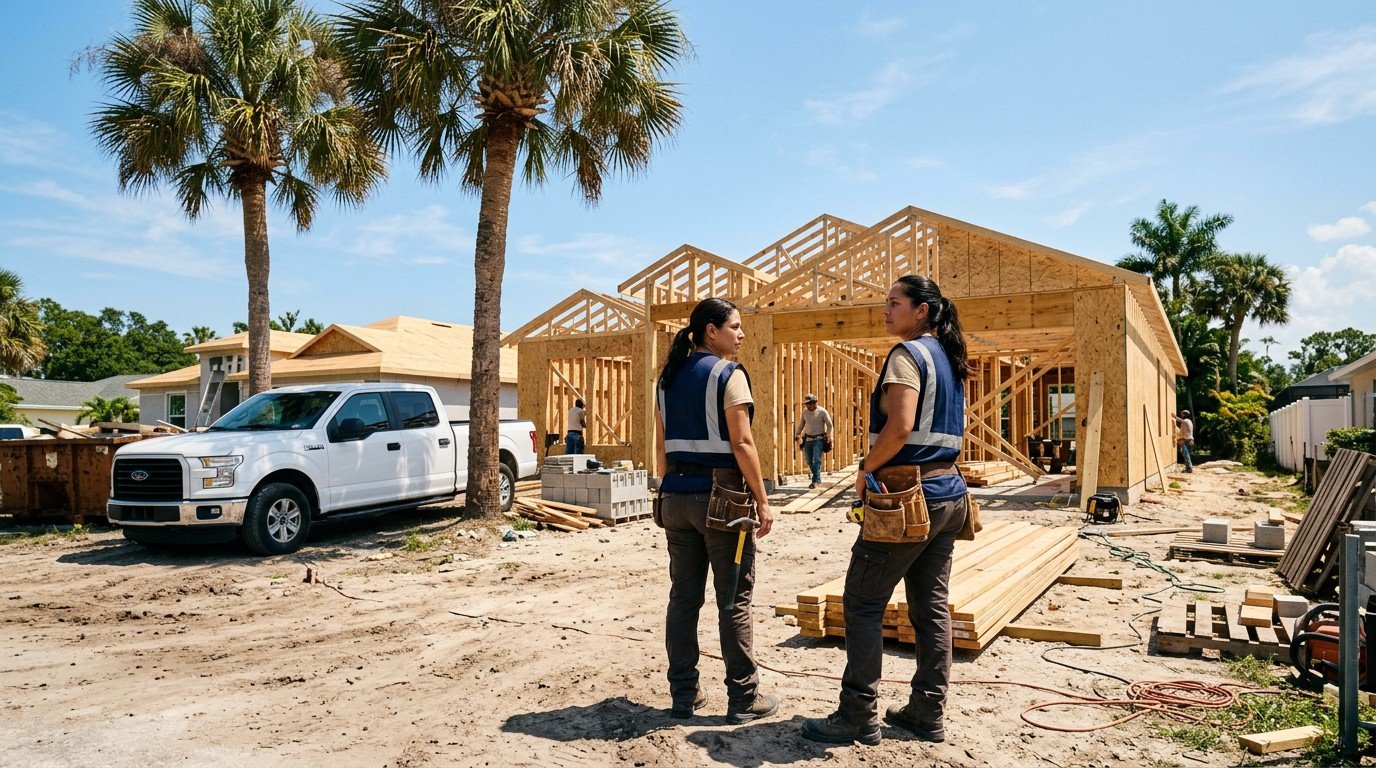
The registered vs certified contractor Florida question comes down to geography. A certified contractor passes the state exam and may contract in any Florida jurisdiction without sitting local competency tests. A registered contractor holds a local license recorded with the state and may contract only where those local requirements are met.
Listen to this article, about 12 minutes. A synthetic voice reads the article and announces each section title as it begins; tables are read row by row and the questions at the end are left out.
Recorded 3 October 2026 from the article as published that day. Press a chapter to jump there; the highlighted line is what is playing. A play button sits beside every section heading, and once you scroll past this player a bar at the bottom of the screen keeps the controls in reach. Tap or click any sentence to hear the reading start from there.
What is the actual difference between a registered and a certified contractor?
The statute does it in two sentences, which is more than can be said for most pages selling a course on the subject. Under section 489.105(8) of the Florida Statutes, a certified contractor holds a certificate of competency issued by the department and may contract in any jurisdiction in the state without meeting that jurisdiction’s competency requirements. Subsection (10) of the same section defines a registered contractor as one who has registered with the department after meeting the competency requirements of the jurisdiction the registration is issued for.
Read those side by side and the design becomes obvious. Both kinds of license end up on the state’s books, and both are regulated by the same board, which our piece on what the Florida Construction Industry Licensing Board actually does covers. The difference is who tested you. For a certified contractor it was the state. For a registered contractor it was a county or a city, and the state simply records the result. You can usually tell them apart on the license lookup: certified numbers begin with C, as in CGC for a certified general contractor, and registered numbers begin with R. Every code letter on the record, from CGC to RR, is decoded in our guide to reading a Florida contractor license lookup.
Can a registered contractor work in another county?
Only where that other county’s requirements are also met. Section 489.117(1)(b) of the Florida Statutes says registration allows the registrant to contract only in the counties, municipalities or development districts where he or she has complied with all local licensing requirements. That is a hard line, and it is the line most people are asking about when they type this search.
The Department of Business and Professional Regulation adds one piece of nuance in its own published answer on the two classifications, updated on 9 September 2025. A registered contractor may practise in the county or city that issued the local license, along with any adjoining locales that will accept the registration. Note the word “accept”. Some neighbouring jurisdictions do, some do not, and the only party who can tell you is the building department you want to work in. Ask before you bid, not after you win the job.

So a roofer registered in Pasco who wins a job across the line in Hillsborough has three honest options: confirm Hillsborough accepts the registration, earn Hillsborough’s own competency card, or hold a state certification. Our walkthrough of the Pasco County contractors license process shows how differently a county treats the two kinds of license holder at the permit counter.
How do the two routes compare, row by row?
This is the decision table the ranking pages skip. Every row carries the rule it comes from, checked on 13 September 2026, so you can read the source rather than take our word for it.
| Question | Registered contractor | Certified contractor | Source |
|---|---|---|---|
| Where can you contract? | Only where local licensing requirements are met, plus adjoining locales that accept the registration | Any jurisdiction in Florida, without local competency requirements | s. 489.117(1)(b); s. 489.105(8); DBPR answer 1366 |
| Who tests your competency? | The county or city, using its own exam if it has one | The state, through the certification examination | s. 489.105(10); s. 489.111 |
| Is a state exam required? | No. An examination is not required for registration | Yes | s. 489.117; s. 489.111 |
| Experience needed | Whatever the local board sets | Four years in the category, at least one as a foreman, with up to three years replaceable by college credit | Local ordinance; s. 489.111 |
| How you apply to the state | File evidence of passing the local examination and licensing requirements | Pass the exam, then apply for certification | s. 489.117; DBPR answer 1366 |
| State renewal | 31 August of odd numbered years | 31 August of even numbered years | DBPR renewal schedule |
| Changing later | Grandfather to certified if you meet five conditions, or sit the state exam | Already statewide | s. 489.118 |
The renewal row matters more than it looks. The two groups are on opposite halves of the same two year cycle, which is why Florida contractor continuing education deadlines catch people who assumed everyone renews together, and our guide to the renewal dates and fees for each licence type sets out which August is yours and what falls due on it.
What does the registered route involve, step by step?
Registration is a local license first and a state record second. The order is always the same.
First, earn the local credential, usually called a certificate of competency. The county or city sets the exam, the experience rule and the fee, and they vary a lot: Pasco wants four years of experience and charges fifty dollars for its application, while Miami Dade runs its own board with its own paperwork, set out in our guide to Miami Dade contractor registration. Second, apply to the state for registration with evidence that you met those local requirements. Section 489.117 is explicit that you file evidence of compliance with the local examination and licensing requirements for the area where you want registration, and that no state examination is needed.

Third, keep both layers alive. The state registration renews every other August. The local certificate runs on whatever cycle the county uses. Let the local one lapse and the state registration loses the thing it was recording.
What does certification ask of you instead?
More up front, less forever after. Section 489.111 of the Florida Statutes sets the gate for the certification exam: be at least 18, and show four years of experience in the category with at least one year as a foreman, where up to three of those years can be replaced by accredited college credit. A four year degree in engineering, architecture or building construction plus one year of experience also qualifies.
Then comes the exam itself. For the general, building and residential categories that means three open book, multiple choice parts: Business and Finance at 125 questions over 6.5 hours, and Contract Administration and Project Management at 65 questions and 4.75 hours each. Our breakdown of the Florida contractor exam format goes through what each part tests. You retake only the parts you fail, after a 30 day wait.
What you get for that effort is the line from the department’s own help file: a certified contractor may work in any jurisdiction without fulfilling local competency requirements. You still pay the local business tax receipt and the permit fees like everyone else. You just do not sit a second test in every county you cross into.
Can a registration become a certification without the state exam?
Yes, if you meet every condition in section 489.118, the grandfathering provision. The current text on section 489.118 says the board shall issue a certificate in the appropriate category to a registered contractor who applies and can show all of the following. We have turned the rule into a checklist.
| Condition in s. 489.118 | What it means in practice |
|---|---|
| (1) Holds a valid registered local license in a category in s. 489.105(3)(a) to (p) | Active registration, in a named category. The list stops at (p), so the specialty contractor category in (q) is not on it |
| (2) Has passed a written examination the board finds substantially similar to the state exam | The statute names proctored exams by the National Assessment Institute, Block and Associates, NAI/Block, Experior Assessments, Professional Testing, Inc. and Assessment Systems, Inc. as substantially similar |
| (3) At least 5 years of experience as a contractor in that category | Or 5 years as an inspector or building administrator with oversight of that category, counted at the time you apply |
| (4) Clean license history | Never revoked; not suspended in the last 5 years; no fine above $500 in the last 5 years |
| (5) Insurance and financial responsibility | The same requirements as s. 489.115(5) impose on everyone else |
Condition two is the one worth pausing on. If your county exam was produced by one of the named organisations, and Professional Testing, Inc. is the same vendor that runs the state exam today, the statute treats it as substantially similar and says the board may not impose requirements about the nature or content of those exams. If your county used someone else, the board decides, and you should expect questions.
The department’s answer on grandfathering restates the same five conditions. It was last updated on 1 July 2021, and it does not list a form or a fee, so call the department on 850.487.1395 for the current application before you assemble five years of paperwork.
Is there still a deadline to grandfather?
Not in the text published today, and this is the point on which older advice goes wrong. The 2013 version of section 489.118 said applicants had to make application by 1 November 2015, and a lot of pages still repeat that the window has closed. The current version, whose history line now ends with chapter 2025-40, Laws of Florida, carries no application date at all.
We could not confirm against an official source which amendment removed the date, or whether the board applies any deadline by rule. Treat the absence of a date in the statute as a reason to ask, not as a promise. Confirm with the department in writing before you rely on grandfathering instead of booking the exam.
Which one makes sense for the work you actually do?
The question is not which license is better. It is how far your trucks travel. A remodeler who has worked one county for twenty years and never bids outside it gains little from certification except an exam. A contractor in a border county, or one chasing commercial work that moves around the state, pays for the local route over and over, one competency card at a time.
Three things tip the balance. The first is how many jurisdictions you realistically work in over the next five years. The second is whether you already qualify to grandfather, which makes certification a paperwork problem rather than a study problem. The third is your category, because a specialty registration sits outside the grandfathering list. If certification is the answer, our guide to getting a general contractors license in Florida sets out the full sequence, and the Palm Beach contractors license piece shows the same choice from the county side.
Frequently asked questions
Is a registered contractor license a state license?
It is recorded by the state, but the competency behind it is local. The department registers you after you meet a county or city licensing requirement, and the registration lets you contract only where those local requirements are met.
Does a certified contractor still need a local business tax receipt?
Yes. Certification removes the local competency exam, not local fees. A certified contractor still pays the business tax receipt and permit fees that other contractors pay in that jurisdiction.
Does a county exam from Professional Testing count toward grandfathering?
Section 489.118 names written, proctored exams produced by Professional Testing, Inc. among those considered substantially similar to the state exam. You still need the other four conditions, including five years of experience in the category.
Can a specialty contractor grandfather into a state certification?
The grandfathering section covers registered licenses in the categories listed in s. 489.105(3)(a) to (p). The specialty contractor category sits in (q), outside that list, so confirm your options with the department.
Do registered and certified contractors need the same continuing education?
Both need 14 hours per two year renewal cycle, but they renew in different years: certified contractors by 31 August of even numbered years, registered contractors by 31 August of odd numbered years.
How can I check whether a contractor is registered or certified?
Search the license on the DBPR license lookup. Certified license numbers begin with C, such as CGC for a general contractor, and registered numbers begin with R. The record also shows status and any discipline.
Rules and fees change without notice. This page was verified on the date shown and is rechecked on the weekly refresh. If you hit something different, tell us in the comments.

Leave a Reply