The irrigation certification Florida issues at state level, the Certified Specialty Irrigation Contractor license, is voluntary. What it buys is reach: a certificate holder may contract in any Florida jurisdiction without meeting local competency requirements. County irrigation cards survived the July 2025 licensing change, and a card held by June 30, 2021 can now skip the state exam.
Listen to this article, about 22 minutes. A synthetic voice reads the article and announces each section title as it begins; tables are read row by row and the questions at the end are left out.
Recorded 12 October 2026 from the article as published that day. Press a chapter to jump there; the highlighted line is what is playing. A play button sits beside every section heading, and once you scroll past this player a bar at the bottom of the screen keeps the controls in reach. Tap or click any sentence to hear the reading start from there.
On this page: why the state and local systems are a fork rather than a ladder, the statute clause that lets a certificate holder skip every county test, what you need before the two open book exams, the reported route for local card holders that skips the exam, and what the 2024 rule repeal actually changed.
Think you already know this? Five questions, one minute.
Every answer is on this page. Answer from what you know now; the page fills in the rest.
-
1. What does the state Certified Specialty Irrigation Contractor licence buy?
Section 489.113(4)(a) says a certificateholder is required only to exhibit evidence of a current certificate and pay the occupational licence and permit fees required of other persons. It is a fork, not a ladder, and picking the wrong prong costs mobility or two exams you did not have to sit. Read the section
-
2. What survives when a state certificate holder works in a new county?
The department’s own answer says a certified contractor may contract in any jurisdiction without fulfilling local competency requirements, citing section 489.105(8). Registration, the other half of chapter 489, reaches only the jurisdictions where local requirements have been met. Read the section
-
3. How many of the four years of experience can be substituted with accredited college courses?
A personal credit report and fingerprinting with a background check are consistently reported but could not be confirmed against a department page that would load. Ask the board before you assume either one. Read the section
-
4. What does the Florida Irrigation Society report about local card holders since July 2024?
The May 2025 article lists the criteria and reports approval typically taking 60 to 90 days. The provision could not be located in the statute text or on a department page, which is why the caution is written straight. Read the section
-
5. Rule 61G4-15.035 is marked repealed from 5 May 2024. What does this page say that means?
Rule 61G4-15.100 now holds the irrigation definition, and the repealed rule’s page records the history line. Be equally suspicious of the fee figures in any guide that has not noticed. Read the section
Is irrigation certification in Florida a state license or a local one?
Both exist, and that is the entire source of the confusion. Counties and municipalities have licensed irrigation work for decades, usually as a certificate of competency, sometimes bolted onto a specialty plumbing card. The state category is much newer. The rule creating it was adopted on 13 February 2013, and the Department of Business and Professional Regulation answer on the subject still carries the line about the written examination being administered for the first time on 16 and 17 April 2013.
So the useful question is not how do I get an irrigation license in Florida. It is which of the two systems you want to be inside. Almost every page ranking for this query treats it as one ladder with the state license at the top. It is not a ladder. It is a fork, and picking the wrong prong costs you either mobility or two open book exams you did not have to sit.
Does the state license really cancel the local one?
Yes, and the rule text is unusually blunt about it. Section 489.113(4)(a) of the Florida Statutes says that when a certificateholder wants to work anywhere in the state, he or she “shall be required only to exhibit to the local building official … evidence of holding a current certificate and to pay the fee for the occupational license and building permit required of other persons.”
The department says the same thing in one sentence in its own help file: a certified contractor is permitted to contract in any jurisdiction in the state without being required to fulfill local competency requirements, citing section 489.105(8). Note the two things that survive. You still pay the local business tax receipt, and you still pay permit fees. You register with the building department like everyone else. You simply do not sit their test.
Compare that with registration, the other half of chapter 489. Under section 489.117(1)(b) a registration allows the registrant to contract only in the counties, municipalities or development districts where local licensing requirements have been met. That is the geographic difference in one clause.
What do you need before you can sit the exams?
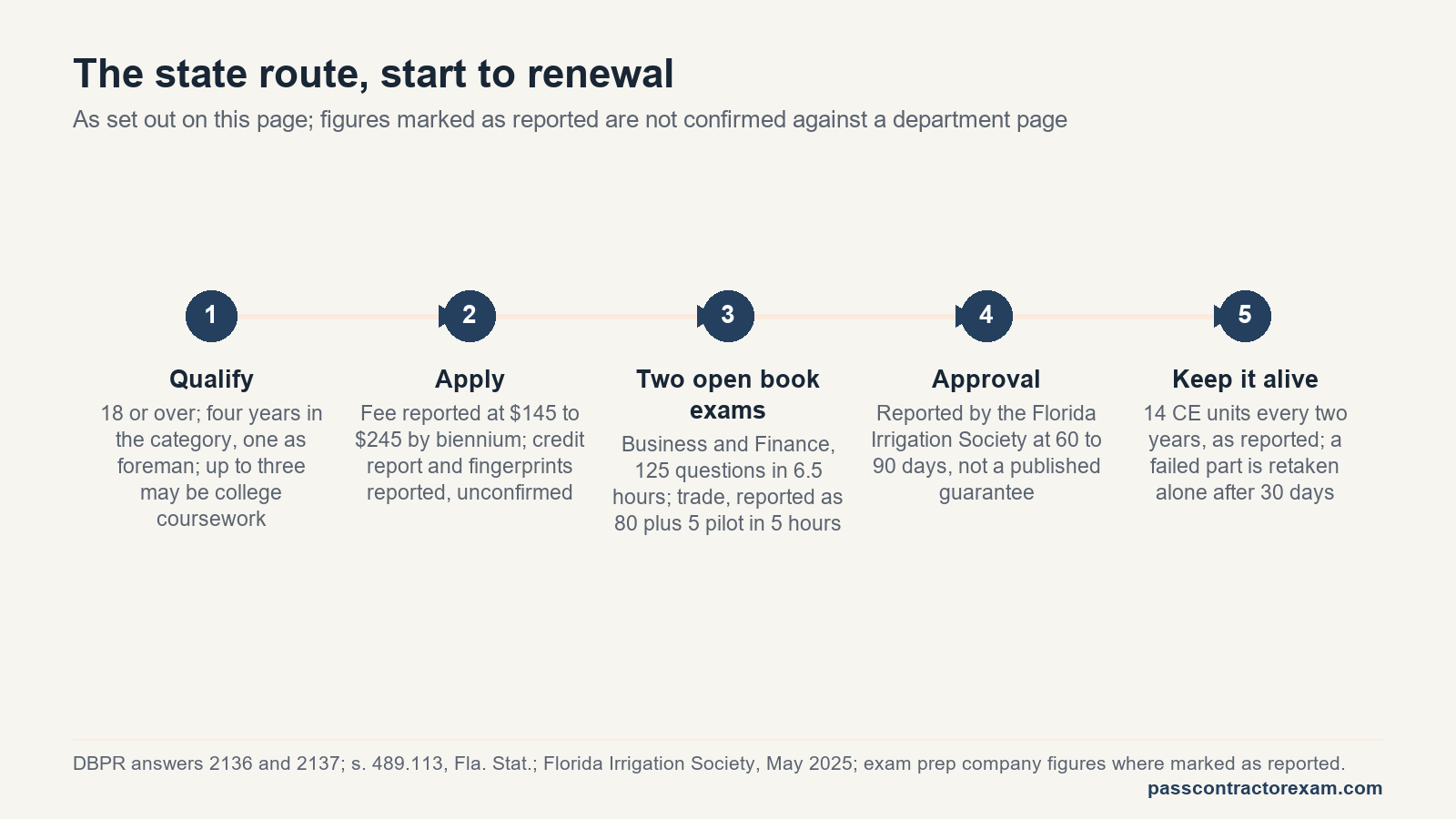
The department’s published answer sets out the gate: be 18 or older, prove four years of experience in the category including a minimum of one year as a foreman, and meet the other licensing requirements such as good moral character and financial responsibility. Up to three of those four years may be substituted with accredited college level courses, which leaves exactly one year that has to be real time on real systems.
Two further requirements apply to every certification category, not just this one. The board’s financial responsibility rule turns on a FICO derived score of 660, with a 14 hour course where the score falls short, and our guide to the 660 credit score rule walks through it. Fingerprinting with a background check comes with the application package, as both the department and the Florida Irrigation Society describe it. Neither comes from an irrigation specific page; both belong to the general certification route, and it is worth knowing which board that actually is and what it has the power to decide before you call the wrong office.
What are the two exams, and how open book are they?
There are two. One covers the business and financial management of a contracting firm. The other covers the irrigation trade: site analysis and plan review, installation and wiring, maintenance, scheduling and water conservation, and the hydraulics behind pipe and pump sizing. Both are computer based and both are open book.
The business half is the same Business and Finance paper every Florida certification category sits: 120 scored questions in 6.5 hours, with a small number of unidentified pilot questions on top, as the DBPR candidate booklet sets out and our breakdown of that paper explains. The irrigation trade test is commonly quoted at 80 scored questions plus 5 pilot questions in 5 hours. That count comes from exam prep companies; two attempts to read the department’s own booklet table on 12 October 2026 did not reach the irrigation row, so treat it as reported until you see it in your own candidate booklet.
Open book has a narrow meaning here, and it is the meaning that catches people out. It means the approved reference list and nothing else. Permanent tabs are allowed. Highlighting and underlining are allowed. Handwritten and typewritten notes are not, and existing handwriting has to be blacked or whited out until it is illegible. We go through the exact boundary in what you may actually do to your books, and the wider point about why an open book exam is still hard in the open book explainer. Which editions count is a separate trap covered in the approved books list.
Can a local competency card holder skip the exam entirely?
Possibly, and this is the part the exam prep shops are in no hurry to put at the top of their page. The Florida Irrigation Society reported in May 2025 that since July 2024, holders of a local or county competency card can apply for the state certification without sitting the state examination.
The criteria the society lists are specific: you held the competency card as of June 2021 or earlier, you passed the exam that earned that card, you have no disciplinary action in the past five years, you complete fingerprinting and a background check, you have four years of irrigation experience, and you have a credit score of at least 660 or you complete a 14 hour financial responsibility course instead. The society reports approval typically taking 60 to 90 days.
Checked again on 12 October 2026, and the picture is better than it was in September. The department’s own construction industry pages now describe the exemption in their own words. An applicant who held a valid local competency card in the license category sought as of June 30, 2021 qualifies, provided the card has not been disciplined in the past five years and is not under pending discipline, and provided the applicant passed a written exam the board finds substantially similar to the state specialty exam. The applicant attaches a copy of the card and skips the Florida exam. An applicant who cannot produce the card sits the exam. The department dates the exemption to the new specialty license types that took effect on June 20, 2024, and says it also applies to the existing specialty types, irrigation among them. The wording comes from the department’s construction industry FAQ and its individual irrigation application form, as search returned them on the day; both refuse automated readers, so open them yourself before you file.
What still has no statute behind it is the exemption itself, and we read the three places it could live. Section 489.118, the grandfathering route, covers the categories in 489.105(3)(a) to (p), and irrigation is (q). Section 489.117(2)(b), written for people whose local license type disappeared, issues a registration without an exam on the strength of a 2021, 2022 or 2023 local license, and again stops at (o). Section 489.113(6) only says the board designates specialty categories by rule and that each one is voluntary. So the irrigation exemption is the board’s own application policy, which it can change without a bill. Ask before you plan a year around it, but ask with the form in front of you.
What changed in the rules, and does the certification still exist?
Checked on 8 September 2026. Rule 61G4-15.035, Certification of Irrigation Specialty Contractors, is marked repealed. The rulemaking history line reads: “New 2-13-13, Repealed by Florida Register Volume 50, Number 080, April 23, 2024 effective 5/5/2024,” as recorded in the Florida Administrative Code annotations.
That reads alarming and is not. The specialty categories were consolidated rather than abolished: the irrigation definition now sits inside rule 61G4-15.100, Certified Specialty Contractors, the department was still answering questions about the license after that date, and the Florida Irrigation Society was still helping people apply for it in 2025. The category survived the renumbering. Only its address changed.
The practical value of knowing that is simple. If a guide you are reading cites 61G4-15.035 as the authority for your license, that guide has not been rechecked since spring 2024, and you should be equally suspicious of its fee figures.
Did the July 2025 local licensing change end county irrigation cards?
No, though you will meet people who think it did. The department’s hot topics page, read on 12 October 2026, puts it plainly: SB 1142 (2024) extended all local specialty contractor licensing until June 30, 2025. From July 1, 2025 local governments may only license specialty types that substantially correspond to the ones the Construction Industry Licensing Board offers, or that section 489.117 lets them keep. Irrigation is a board type: it is paragraph (q) of rule 61G4-15.100. A county irrigation card therefore survives wherever the county chooses to keep issuing one.
The list of jobs a county may no longer license at all is in section 489.117(4)(a): painting, flooring, cabinetry, interior remodeling, driveways and tennis courts, handyman services, decorative stone and tile, plastering, pressure washing, stuccoing, caulking, and canvas awning and ornamental iron. Irrigation is not on it. Highlands County’s building department reads the law the same way and lists carpentry and irrigation among the specialty areas it may still license. What a county may not do any more is run an irrigation card wider than the state scope, and the department says it will investigate building officials who demand a license the statute does not allow.
The scope itself is worth reading once. Rule 61G4-15.100(1)(q) lets an irrigation specialty contractor install, maintain, repair, alter, extend, manage, monitor and audit a system. It defines the system down to the piping, fittings, sprinklers, drip products, valves, controllers, control wiring, rain sensors, pumps and water conservation devices, including the main line downstream of a utility potable water meter and the dedicated backflow prevention device. Agricultural irrigation is outside it, and so is work on water wells, which the rule leaves to the well contractor license under section 373.323.
| What decides it | What the text says | Where, read 12 October 2026 |
|---|---|---|
| Can a certificate holder work anywhere in Florida? | Yes. The holder is required only to exhibit evidence of a current certificate and pay the occupational license and building permit fees other persons pay | s. 489.113(4)(a) |
| Is the state irrigation license mandatory? | No. A specialty category exists as a voluntary statewide licensing category and does not create a mandatory licensing requirement | s. 489.113(6)(a) |
| Where may a registered contractor work? | Only in the counties, municipalities or development districts where local licensing requirements have been met | s. 489.117(1)(b) |
| Can a county still license irrigation after July 1, 2025? | Yes, where the local type substantially corresponds to a board type, and irrigation is paragraph (q) of the specialty rule | s. 489.117(4)(a), DBPR hot topics |
| Is there a statutory no exam route for irrigation? | No. Section 489.118 covers 489.105(3)(a) to (p); section 489.117(2)(b) covers (a) to (o) and ends in a registration, not a certificate | s. 489.118, s. 489.117(2)(b) |
| Is there a department no exam route? | Yes, by application policy: a local card held as of June 30, 2021, no discipline in five years, a substantially similar exam already passed | DBPR construction FAQ, form CILB 5AC |
State or local: which route actually fits you?
| Route | Where you can work | What you have to pass | Where that comes from |
|---|---|---|---|
| Certified specialty irrigation contractor, state | Any jurisdiction in Florida, on showing the certificate and paying local occupational and permit fees | Business and finance test plus the irrigation trade test, both open book | s. 489.113(4)(a), Fla. Stat.; DBPR answer 2136 |
| Local certificate of competency | Only the counties, municipalities or districts where you have met local licensing requirements | Whatever that jurisdiction sets, commonly a trade test written around its own code | s. 489.117(1)(b), Fla. Stat. |
| Local card upgraded to state certification | Statewide once issued | No state examination, if you held the local card by June 2021 and meet the other criteria | Florida Irrigation Society, May 2025, no statute cited |
| Certified plumbing contractor | Statewide, with irrigation inside the scope | The full plumbing certification route, a longer road than this article covers | Reported as the third alternative in DBPR guidance we could not open |
If you work in one county and intend to keep working in one county, the local card is cheaper and shorter, and the state certification buys you very little. If your work already crosses county lines, or your customers do, the arithmetic flips fast: one certificate against four or five local competency exams is not a close call.
Which route fits where you work?
Pick the line that describes your work. The answer comes from the table above, with the clause each route rests on.
General information, not advice about your application. This site is independent and not connected to the Department of Business and Professional Regulation.
What do Florida irrigation contractors say about the license online?
Four threads on r/Irrigation from February to August 2026 carry what Florida people actually say about this license, six accounts in all, read on 12 October 2026. They are testimony, not evidence, and they part company with the rule text in one useful place.
In February 2026, a Tampa Bay user flaired as a Florida licensed contractor replied to a lawn care owner planning paid system checkups. In most, perhaps all, Florida counties, he said, irrigation is a licensed trade, needing either a contractor license plus registration with the county or a statewide license through the department. He added that unlicensed service work breeds a race to the bottom and suggested partnering with a licensed contractor instead. That is the fork on this page, described from inside it.
In April 2026, a South Florida maintenance and repair company said it had grown to the point of needing permits and was looking for a licensed irrigation qualifier, with no interest in any license renting arrangement. The one reply came from a holder of seven state licenses offering a financially responsible officer agreement. Our page on what a qualifying agent owes explains why that offer is the regulated version of the thing the company was trying to avoid.
In July 2026, a Lehigh Acres worker with just over two years in the trade, one of them supervising, asked where to start. Three replies are the useful part. One pointed at the department’s site and the Florida Irrigation Society. One said two more years were needed, which matches the four year requirement in the department’s answer above. And a Lehigh contractor who has run an irrigation company since 2013 called it “a state license now”, said a lawn business can repair but not install without one, and told him not to be a fly by night. A fourth reply told him to get more field time before the test and asked whether he could name the Florida incidents that put backflow devices in the code.
Where the accounts and the rule text disagree: “a state license now” overstates it, because section 489.113(6)(a) still calls the specialty category voluntary and county cards continue after July 2025 where counties keep them. The repair without a license idea is not in the rule either; rule 61G4-15.100(1)(q) puts maintain and repair inside the licensed scope, and whether a county tolerates minor repair work is a local question. On the four years of experience and on the two layer structure, the accounts and the department agree. A fifth thread from April 2026 turned out to be about Texas and was left out.
What does it cost, and what keeps it alive?
The fees now reconcile with the department’s own documents rather than prep company pages. Professional Testing charges a $135 registration fee every time a registration is made for any part of the examination. Pearson VUE adds $80 when you schedule each exam, $80 for Business and Finance and $80 for a trade knowledge exam, so a first sitting of both irrigation parts comes to $295, the figure that circulates without its arithmetic. The breakdown by part, from the examination application pack, is in our retake guide. The license application fee is then $245 or $145 depending on where in the two year licensing cycle you apply, as our requirements checklist reconciles against the fee rule. Books are the cost people underestimate, broken down separately in what the reference books actually cost.
On renewal, the board’s continuing education rule, rule 61G4-18.001, asks every certificateholder for at least 14 hours per two year cycle, which is the figure the Florida Irrigation Society quotes, and our continuing education guide lists the pinned hours inside it. If a part of the examination goes badly, only the failed part is retaken. There is no waiting period in the rule: the retake application has to reach Professional Testing at least 30 days before the exam date you want, which is where the thirty day myth comes from, and the retake rules are set out here. This site is independent. It is not affiliated with, endorsed by or connected to the Department of Business and Professional Regulation, and nothing here is a promise about your result.
What has changed since this was first published?
12 October 2026: the department’s own pages now state the no exam route for local card holders, a card held as of June 30, 2021, no discipline in five years and a substantially similar exam already passed, where in September only the Florida Irrigation Society said so. A new section covers the July 1, 2025 local licensing change, which leaves county irrigation cards in place. The Business and Finance count is corrected from 125 questions to 120 scored questions. The examination fees are restated from the examination application pack, $135 plus $80 per part, and the application fee as $245 or $145 under the fee rule. The thirty day retake wait is removed, since the rule sets a 30 day application deadline, not a wait. The 14 continuing education hours are traced to rule 61G4-18.001. A section of dated accounts from Florida contractors is added. The irrigation trade test is still reported at 80 scored questions plus 5 pilots in 5 hours, because the department’s booklet table did not load.
8 September 2026: first published, with rule 61G4-15.035 checked as repealed and the category traced into rule 61G4-15.100.
Frequently asked questions
Do I need a license to install a sprinkler system in Florida?
It depends on where you are working. Many counties and municipalities require a local certificate of competency for irrigation work, and the requirement is set locally rather than statewide. The state certified specialty irrigation license is one way to satisfy that, not an extra layer on top of it.
Does the state irrigation certification cover system design?
The certified specialty irrigation category is described as covering installation, maintenance, repair, alteration, extension, management, monitoring, auditing and, where not prohibited by law, design of irrigation systems. That last qualifier matters, because other statutes can reserve certain design work, so check the scope for your specific project.
How long does approval take after I pass?
The Florida Irrigation Society reports state approval typically arriving within 60 to 90 days, and around the same window for the local card upgrade route. Processing times are not a published guarantee and they move with application volume, so treat that as a planning figure rather than a deadline you can rely on.
Can I use a plumbing license instead of an irrigation one?
A certified plumbing contractor’s scope is reported to include irrigation work, which is why the specialty category is described as an alternative to the plumbing route rather than a replacement for it. It is a much longer qualification, so it makes sense only if plumbing is where you were heading anyway.
Do I still need a local business tax receipt with a state certificate?
Yes. Section 489.113(4)(a) says a certificateholder exhibits the certificate and pays the fee for the occupational license and building permit required of other persons. The state certificate removes the local competency examination, not the local fees, and building departments still expect you to register with them.
Is there a state irrigation exam workshop or approved course I have to take?
No course is required to sit the examinations. County extension offices and trade bodies have run exam workshops, and prep companies sell book bundles and classes, but none of them is a licensing prerequisite. The requirements that are actually enforced are the experience, the application and the passing scores.
Finished the page? The same five questions from the top, to see what stuck.
Rules and fees change without notice. This page was verified on the date shown and was last rechecked on 12 October 2026. If you hit something different, tell us in the comments.

Leave a Reply