The Florida pool contractor license exam is not one exam but a choice of three licences: commercial, residential and servicing. Each is two open book computer tests, Business and Finance plus a trade knowledge exam for that licence. Commercial builds any pool, residential builds only residential pools, and servicing repairs but never builds.
Listen to this article, about 17 minutes. A synthetic voice reads the article and announces each section title as it begins; tables are read row by row and the questions at the end are left out.
Recorded 6 November 2026 from the article as published that day. Press a chapter to jump there; the highlighted line is what is playing. A play button sits beside every section heading, and once you scroll past this player a bar at the bottom of the screen keeps the controls in reach. Tap or click any sentence to hear the reading start from there.
On this page: the three pool licences side by side from the statute, the question counts and hours for every pool exam from the DBPR booklet, the trade weights from rule 61G4-16.001, and the fee arithmetic from rule 61G4-12.009.
Think you already know this? Five questions, one minute.
Every answer is on this page. Answer from what you know now; the page fills in the rest.
-
1. Which pool licence can build a new hotel pool?
Section 489.105 of the Florida Statutes gives the commercial licence any pool, public or private, limits residential to residential pools, and gives servicing repair and servicing only, with no construction. Read the section
-
2. Besides the standard four year route, what does the statute accept for the servicing licence?
Section 489.111 adds a servicing route of 60 hours of instruction in courses related to the scope of work and at least 1 year of proven experience. Read the section
-
3. Which content area does the DBPR servicing outline list alongside plans, specifications and codes?
The DBPR servicing content outline lists reading plans and specifications, reading codes, and basic mathematics such as area, volume, percentages and the sides of triangles. Read the section
-
4. What Business and Finance exam does a pool/spa servicing candidate sit, according to the DBPR booklet?
The DBPR construction candidate information booklet, effective July 2024, lists Business and Finance Service Pool at 60 questions and 3.5 hours, beside the standard 120 questions and 6.5 hours. Read the section
-
5. Under rule 61G4-12.009, what do the exam fees for both pool tests come to on a first sitting?
Rule 61G4-12.009 sets a $135 examination development fee and $80 administration for each test, so two tests come to $295; the $335 figure adds the $40 application processing fee. Read the section
Search for this and you land in a shop. Every page ranking for it is a prep school with a separate product for each licence, which leaves you to work out which licence you need by comparing price tags. That is backwards. The licence decides the exam, the books and the work you are allowed to take, so it comes first. Everything below was read from the statute, the Florida DBPR and the testing vendor on 21 September 2026.
What are the three Florida pool and spa licences, and what can each one build?
The definitions sit in section 489.105 of the Florida Statutes, and the difference between them is a single word each time. A commercial pool/spa contractor covers the construction, repair and servicing of any swimming pool, hot tub or spa, “whether public, private, or otherwise.” A residential pool/spa contractor covers the same work on a “residential swimming pool.” A swimming pool/spa servicing contractor covers “the repair and servicing” of any pool, public or private, and the word construction is simply absent.
So the residential licence cannot build the hotel pool, and the servicing licence cannot build anything. Community pools are where people get caught. The commercial reference list carries Chapter 64E-9 of the Florida Administrative Code, the Department of Health rule for public swimming pools, and a pool shared by a condominium or a homeowners association is often a public pool under that rule, not a residential one. If the job is anything other than a pool at a private home, confirm the classification before you bid on it.
There is also a narrower fourth option. The Florida Swimming Pool Association lists a residential pool/spa servicing specialty licence, limited to residential work, which it says cannot build a new pool or affect the structure. It is a specialty rather than one of the three statutory categories above. Its exams are no longer a mystery: rule 61G4-16.001(11) puts it under the same heading as the full servicing licence, with the same two tests, so everything below about the servicing exams applies to it too. It stays out of the comparison table because its scope is narrower, not because its exams differ.
How do the three pool licences compare side by side?
This is the table none of the ranking pages builds, because each of them is selling one row of it. Every row carries its source, and where the sources disagree the cell says so.
| Commercial pool/spa | Residential pool/spa | Pool/spa servicing | |
|---|---|---|---|
| Scope | Build, repair and service any pool or spa, public or private (s. 489.105) | Build, repair and service residential pools and spas (s. 489.105) | Repair and service any pool or spa; no new construction (s. 489.105) |
| Standard eligibility | Four years of experience, at least one as a foreman, or a degree or college credits in place of part of it (s. 489.111) | Same four year route (s. 489.111) | Same four year route, or 60 hours of instruction plus one year of proven experience (s. 489.111) |
| Exam parts | Business and Finance plus Commercial Pool trade knowledge | Business and Finance plus Residential Pool trade knowledge | Business and Finance plus Service Pool trade knowledge |
| Trade exam questions | Commonly quoted at 80 by prep schools; not confirmed against a DBPR outline | Prep schools quote 80; the DBPR content outline is indexed as 60 equally weighted questions. Unresolved | 60 equally weighted questions (DBPR content outline) |
| Trade exam time | 5 hours (DBPR) | 5 hours (DBPR) | 5 hours (DBPR) |
| Reference list includes | ANSI/APSP 1 public pools standard, Chapter 64E-9 public pool rule (DBPR list) | ANSI/APSP/ICC 5 residential inground pools, 2011; Florida Building Code, Building, 2023 (DBPR list) | Pool and Spa Operator Handbook, 2022; Florida Building Code, Building, 2023 (DBPR list) |
| Exam fees | $135 plus $80 per test (rule 61G4-12.009) | $135 plus $80 per test | $135 plus $80 per test |
Business and Finance is not quite the same exam for all three, which is the one thing this table got wrong when it was built. Commercial and residential candidates sit the standard paper every Florida construction licence uses, 120 scored questions in 6.5 hours. Servicing candidates sit a separate form that the DBPR candidate information booklet lists as Business & Finance Service Pool, 60 scored questions in 3.5 hours. Our page on the Business and Finance exam covers what is in it and why it is the part most people underestimate.
Why is the servicing licence the odd one out on eligibility?
Commercial and residential both run on the standard certification routes in section 489.111: four years of experience with at least one year as a foreman, or a relevant degree or college credits standing in for up to three of those years. Servicing gets one extra door. The statute says an applicant is eligible for the servicing licence after passing its examination with “60 hours of instruction in courses related to the scope of work” and “at least 1 year of proven experience.”
That is a much shorter road than four years, and it is the reason the servicing licence suits a pool service technician who has been fixing pumps and heaters for a couple of years. It is also where the prep pages wander. Several describe servicing eligibility using only the four year route, and the trade association page states that each pool licence requires four years. Both are describing a route that exists. Neither mentions the one the statute adds for servicing, which is the one most service technicians would actually use.
Proving the year is where applications stall. The board wants experience it can verify, usually under a licensed contractor, so gather the licence numbers of the people you worked for before you apply rather than after the deficiency letter. The credit review, the insurance and the fingerprints come after that, and our checklist of every Florida contractor license requirement puts them in the order that saves the most time.
What is actually on each trade knowledge exam?
All three trade exams share a skeleton. The DBPR content outline for the servicing exam lists reading and interpreting plans and specifications, reading and interpreting codes, and basic mathematics, including area, volume, percentages and the sides of triangles. Volume is the one to practise, because gallons, chemical dosing and turnover rates all start there.
Beyond that, the content follows the scope. The construction licences are tested on the full build: site preparation, excavation, plumbing and electrical work, shell, deck, tile and coping, interior finish, start up and equipment. The servicing exam is weighted toward what a service contractor touches, which is plumbing, equipment, finishes, start up, maintenance and safety procedures. These are summaries of the published outlines, not questions, and nobody outside the testing vendor has the actual questions, whatever the forum rumours about a secret bank say.
The reference lists are where the categories really split, which matters because these exams are open book. Residential is built around the ICC 5 residential pool standard. Commercial adds the public pool standard and the Department of Health rule. Servicing leans on the Pool and Spa Operator Handbook. Buy the list for your licence and no other, and check the edition dates against which books you may take in.

How long is each pool exam, and what does the rule weight most?
The question counts the table above had to hedge are settled by the DBPR’s own candidate information booklet for construction exams, effective July 2024 and still the copy the DBPR was serving in October 2026. It lists every pool exam in one place, and it ends the residential argument: 80 scored questions, the same as commercial, not the 60 an old outline was indexed as.
| Licence | Business and Finance | Trade knowledge | Biggest trade weights |
|---|---|---|---|
| Commercial pool/spa | 120 questions, 6.5 hours | 80 questions, 5 hours | Excavation 15%, plumbing 12.5%, then shell, tile and coping, accessories, and service and maintenance at 10% each |
| Residential pool/spa | 120 questions, 6.5 hours | 80 questions, 5 hours | Excavation 15%, plumbing 12.5%, then shell, tile and coping, service and maintenance, and equipment at 10% each |
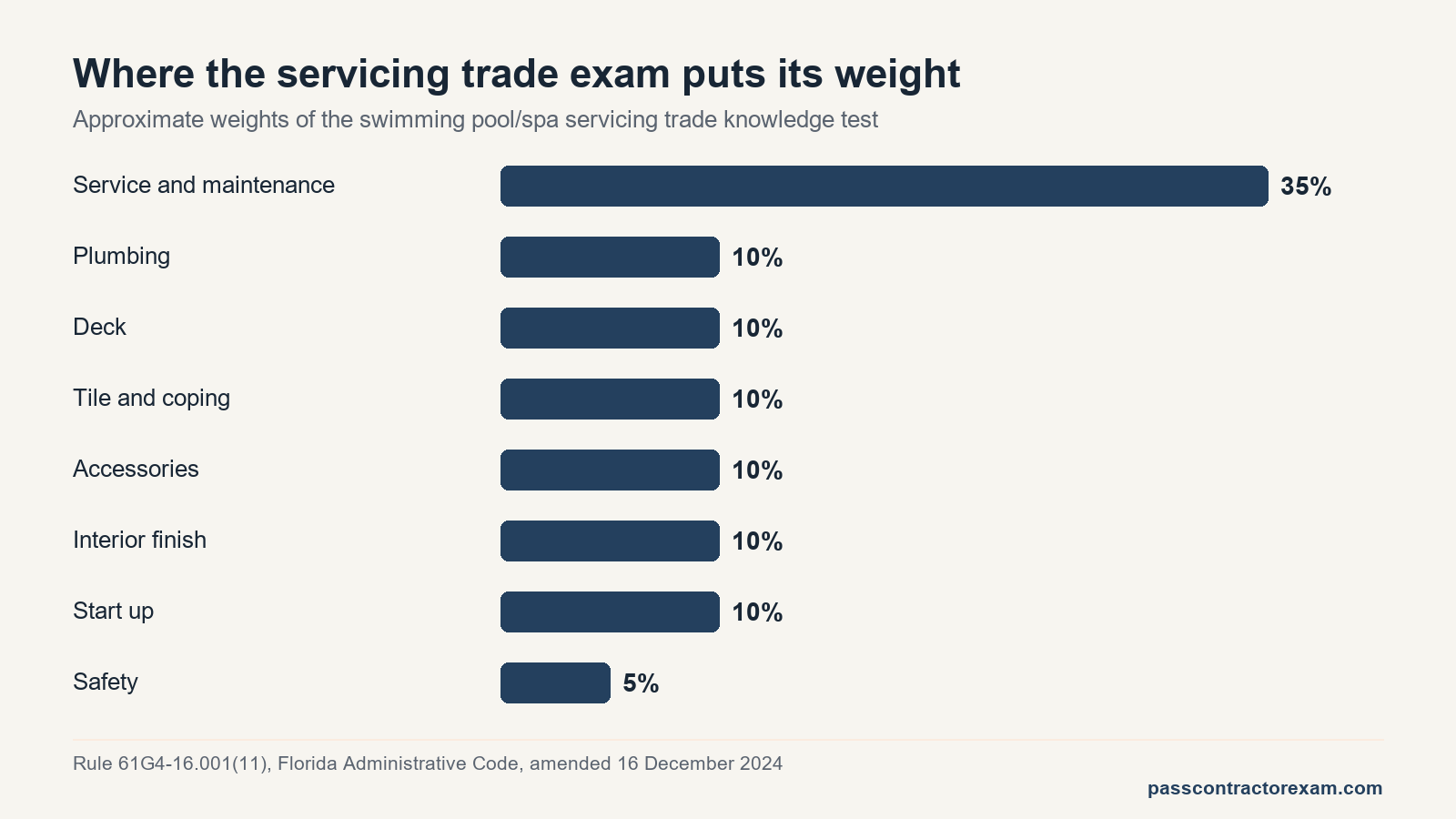
| Pool/spa servicing, and the residential servicing specialty | 60 questions, 3.5 hours | 60 questions, 5 hours | Service and maintenance 35%, then plumbing, deck, tile and coping, accessories, interior finishing and start up at 10% each |
Two things jump out. Servicing candidates face half the Business and Finance questions in three fewer hours, but the syllabus is not lighter. Rule 61G4-16.001 sends all three licences to the same business weights in subsection (22), where accounting functions carry the biggest share at 32 percent. Fewer questions on the same syllabus means each one counts for more, so skipping a topic and hoping is a worse bet on the short form, not a better one.
Second, the servicing trade exam puts 35 percent on service and maintenance alone, more than any three other areas put together, while the construction exams spread their weight across the whole build. Commercial and residential look almost identical on paper and differ by a few points on site preparation, accessories and equipment. The real gap between them lives in the reference books.
Every part passes at 70 percent, all questions are equally weighted, and the booklet says construction scores are not rounded, so 69.9 is a fail. On an 80 question paper that means 56 correct answers. On a 60 question paper it means 42, and 42 is the target on both servicing exams.
How much does the Florida pool contractor license exam cost?
Written straight, because this is money. Under Florida Administrative Code rule 61G4-12.009 the examination development fee is $135 and administration is $80 for each test sat. A pool licence has two tests, so the exam fees come to $295: $135 plus two lots of $80. Cam Tech School quotes the same $295 total. The same rule adds a $40 application processing fee, which is how the rule’s own $335 figure for certification is reached.
| Item | Amount | When |
|---|---|---|
| Examination development | $135 | When you register with the testing vendor |
| Business and Finance administration | $80 | Per test sat |
| Trade knowledge administration | $80 | Per test sat |
| Application processing | $40 | Part of the rule’s $335 certification total |
| Retaking one failed part | $135 plus $80 | After a failed part |
Applications must reach the vendor at least 30 days before the exam date, according to Professional Testing’s instructions. After you pass both parts there is still the licence application itself, with its own fee and the experience review, so passing is not the same as being licensed. The registration guide walks through that sequence.
Pool exam numbers for your licence
Pick a licence and which parts you are sitting. This shows each paper’s length from the DBPR booklet, the correct answers that 70 percent works out to, and the exam fees under rule 61G4-12.009. It is arithmetic from the published numbers, not a prediction of your result.
Lengths from the DBPR construction candidate information booklet, effective July 2024; fees from rule 61G4-12.009 ($135 development plus $80 per test). The $40 application processing fee and the licence fee after passing are not included. Worked in your browser, nothing is stored or sent.
Which pool licence should you sit?
Work backwards from the jobs you want in two years, not the jobs you have now. A rough guide from the scope language:
- You only ever build pools at private homes: residential. It is the narrower exam and the narrower list of books.
- You want hotels, schools, apartment complexes or community pools: commercial, since a residential licence cannot reach them.
- You repair equipment, piping and finishes and do not build: servicing, and check whether the 60 hour route gets you there years sooner.
- You are not sure yet: price the reference lists for both construction licences before deciding, because the books are a large part of the cost.
If a general contractor licence is also on your mind, the certified or registered question matters just as much, and our guide to registered and certified licences explains it. And if the first attempt goes badly, you retake only the failed part, which our page on failing a part covers in full. If the plan is commercial work beyond the pool itself, what the Florida building contractor licence covers and the commercial experience it asks for is the comparison to make next.
Which pool licence fits the work you want?
Pick the work you want to be doing in two years. The answer follows the scope language in section 489.105; confirm a borderline job with the board before you bid.
A guide to the statute’s scope words, not legal advice on a particular job.
What has changed since this was first published?
This page was published on 21 September 2026 and rechecked on 25 October 2026. Two things have moved since, and the table above predates both.
- Settled, 25 October 2026: the commercial question count. The DBPR’s own Commercial Pool trade knowledge content outline gives 80 equally weighted questions in computer based format, so the figure the table credits only to prep schools is the official one. The residential count was settled on 6 November 2026, in the paragraph below.
- Coming on 31 December 2026: the 9th edition (2026) Florida Building Code, which the Florida Building Commission’s October 2026 workplan schedules to take effect that day. The residential and servicing reference lists above cite the 2023 code. For a while the edition on your exam list and the edition your permits are reviewed under may differ, so check the list valid for your exam date rather than buying the newest book by reflex.
Rechecked again on 6 November 2026, and two more cells of the comparison table are now out of date. The residential trade exam is 80 questions, not an unresolved 60, and the servicing licence sits its own shorter Business and Finance exam rather than the standard one. Both come from the DBPR candidate booklet and are set out in the section on exam length above.
Frequently asked questions
Can a residential pool contractor work on a commercial pool?
Building one, no. The residential licence covers residential pools. Repair work on public pools is a grey area that prep sources describe differently, so check with the Construction Industry Licensing Board before quoting the job.
Is the pool contractor exam open book?
Yes. Both parts are open book, using only the references on the DBPR list for your licence. Permanent tabs and highlighting are allowed; written notes are not.
Do I take a different Business and Finance exam for a pool licence?
For commercial and residential, no: it is the standard 120 question exam every Florida construction licence uses. Servicing candidates sit a shorter Business and Finance Service Pool exam of 60 questions in 3.5 hours, built on the same content areas.
What are the 60 hours for the servicing licence?
The statute requires 60 hours of instruction in courses related to the servicing scope of work, alongside one year of proven experience. It does not name a single approved provider, so confirm a course qualifies before paying for it.
Can I upgrade from residential to commercial later?
Section 489.111 includes eligibility routes for existing certified pool contractors moving up a category. How much experience it wants depends on your history, so confirm the route with the board before you apply.
Where do I take the exams?
Registration runs through Professional Testing, Inc., which the state contracts for these examinations, on 407-264-0562. The exams themselves are computer based at test centres.
Finished the page? The same five questions from the top, to see what stuck.
Rules and fees change without notice. This page was verified on the date shown and is rechecked on the weekly refresh. If you hit something different, tell us in the comments.

Leave a Reply