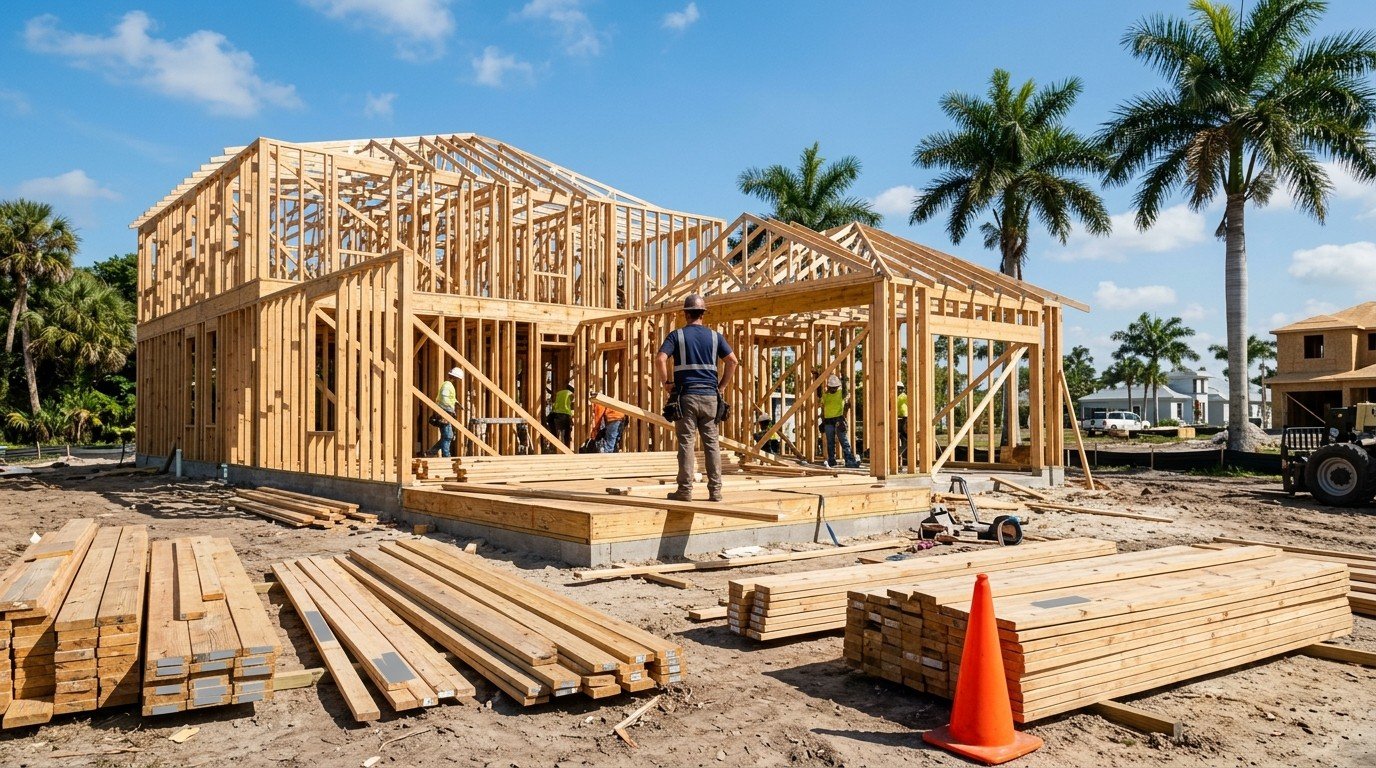
A Florida general contractor license lets you build anything, at any height, anywhere in the state. It is the broadest construction license the state issues, and it is the reason people sit the exam rather than settling for a narrower category.
Getting one comes down to three things: qualifying on experience or education, passing two exams, and satisfying the financial and insurance requirements at application. There is also a national route into the trade portion, and what the NASCLA commercial building contractor exam actually contains sets out its 115 questions section by section if you are weighing that instead. The exam is the part everyone worries about. The paperwork is the part that actually holds most people up.
What the license actually permits
General is the top of Division I. It permits construction of any building without a height restriction, which is the practical difference between it and the categories immediately below it.
| License | What it covers | Height limit |
|---|---|---|
| General | Any building, commercial or residential | None |
| Building | Commercial and residential structures | Up to three stories |
| Residential | One, two and three family homes | Up to two habitable stories |
If you never intend to work above three stories, the building contractor license covers you and the qualifying route is similar. People often apply for general anyway, because the difference in effort is small and the difference in what you can bid on is not.
Certified or registered, and why it matters more than people expect
This is the distinction that confuses nearly everyone, and choosing wrong is expensive.
A certified license is issued by the state through the Construction Industry Licensing Board, part of the DBPR. It is valid in all 67 counties. You get it by passing the state examination. That board and the department it sits inside decide different parts of your file, and the split between what the board decides and what DBPR staff decide is worth knowing before you apply.
A registered license is issued by a local licensing authority, a county or a municipality, and then registered with the state. It only authorizes work inside that jurisdiction. Instead of the state exam you show a certificate of competency from that local authority. Pasco County is a clear worked example of that local layer, from recording a state certified license before you pull a permit to sitting the county trade exam.

Registered is faster to obtain and it locks your business to one geography. If you take a job one county over you are working unlicensed. Most people who start registered end up sitting the state exam within a few years anyway, having paid for the process twice. The trade list is often what tempts people local, and the 31 categories Palm Beach County certifies include specialties the state does not issue at all.
Certified is the right default unless you are certain your work will never leave one jurisdiction, and it is the route the rest of this article assumes. The distinction outlives the application too, because certified and registered licenses sit on opposite halves of the renewal cycle and each carries 14 hours of continuing education every two years.
How you qualify
The baseline is four years of construction experience in the category you are applying for. What counts is more specific than people assume: it needs to be verifiable, at a level of responsibility appropriate to the license, and documented by someone who can attest to it.
Accredited education substitutes for part of that experience. A construction related four year degree counts for a substantial share, and college level coursework in construction management, engineering or architecture counts for less but still counts. Sources differ on exactly how many years each is worth, and it depends on how your specific credits are assessed, so confirm your own combination with DBPR rather than planning around a number you read somewhere.
- Experience must be in the category you are applying for, not construction generally
- It must be verifiable by employers, supervisors or licensed contractors who will sign for it
- Self employment counts, but you need documentation that stands up: contracts, permits, tax records
- Time spent as a helper or laborer is weighted differently from time carrying responsibility
- Military construction experience generally counts and is worth raising explicitly
The rest of the eligibility picture, including the financial responsibility and insurance side, is covered in the full eligibility requirements.
The two exams
Division I candidates sit two separate papers, and both must be passed.
- The trade knowledge exam. This is the one about building. It covers the Florida Building Code, plans reading, estimating, scheduling and the practical work of running construction.
- The Business and Finance exam. This covers contract law, lien law, bookkeeping, payroll, insurance and business administration. It is the one that catches experienced builders out.
That second paper is worth taking seriously and is worth its own preparation. A great many people who have built for twenty years fail it, because knowing how to run a site is not the same as knowing how to record a transaction. the Business and Finance exam goes through what is on it.
Both exams are open book, which sounds generous and is not. what open book really means here explains why, and the approved book list covers what you are allowed to bring.
The part almost nobody explains: qualifying a business
A license is held by a person, but a construction business needs a licensed person attached to it in order to operate. That person is the qualifying agent, and understanding this changes how you think about the whole exercise.
If you are setting up your own company, you qualify your own business and the arrangement is simple. What is worth knowing is the alternative: an unlicensed business owner can bring in a licensed qualifier. That is legal and common, and it is also where a great deal of trouble originates.
- The qualifier is legally responsible for the work performed under their license, whether or not they were on site
- A qualifier who lends their license to a business they do not actually control is exposed to everything that business does
- If the qualifier leaves, the business loses its authority to operate until a replacement is registered
- One person can qualify more than one business, but each relationship has to be properly registered
If someone offers to pay you to qualify their company while you have no operational involvement, understand what you are agreeing to. Your license, your liability, and their decisions. This arrangement destroys careers with some regularity.
What the money actually looks like
Nobody publishes a single number because there is not one, but the categories are predictable and worth budgeting for as a whole rather than being surprised by one at a time.
| Cost | Timing | Notes |
|---|---|---|
| Exam preparation | Before the exam | Self study through to full courses, a wide range |
| Reference books | Before the exam | Multiple required volumes, and they are not cheap |
| Exam fees | Per attempt, per paper | Two papers means two fees |
| Application fee | At submission | Set by DBPR, changes |
| Bond | Only if credit requires it | Ongoing cost, not one off |
| Insurance | Before licensure, then ongoing | General liability and workers compensation |
The book cost surprises people most. The approved reference list runs to several volumes and buying them new is a real expense, which is why the used market for previous editions is busy. Be careful there: the edition matters, and an out of date volume is worse than useless because it will confidently give you a wrong answer.
Why applications get rejected
Rejections are usually procedural rather than substantive, which is frustrating and also good news, because procedural problems are preventable.
- Experience that cannot be verified to the required standard, or verifiers who do not respond.
- Experience in the wrong category for the license applied for.
- Financial documentation that is incomplete or inconsistent with the credit review.
- Insurance that is not yet in force at the point of application.
- Non disclosure on the background section, which is far more damaging than whatever was not disclosed.
- Simple omissions: an unsigned form, a missing page, a fee paid at the wrong stage.
The order to do things in
- Work out which category you actually need. General if you might go above three stories, building or residential if you definitely will not.
- Audit your experience honestly against the four year requirement, and identify who will verify it. Start this early, because tracking down a supervisor from six years ago takes weeks.
- Get the education assessed if you are relying on it, rather than assuming your degree counts for a particular number of years.
- Prepare for both exams. Most people underestimate Business and Finance and overestimate the trade paper.
- Book and sit the exams.
- Submit the application with the financial and insurance documentation in order.
Fees and current requirements change, so take those from DBPR directly rather than from any guide, this one included.
Where people actually come unstuck
Not the exam. The two things that derail applications are experience that cannot be verified to the standard required, and financial documentation that is not ready when the rest is.
If you do fail a paper it is not the end of anything, and the retake rules are more forgiving than people fear. what happens if you fail covers what happens next.
Frequently asked questions
What is the difference between a certified and a registered contractor in Florida?
A certified license is issued by the state and is valid in all 67 counties. A registered license comes from a local licensing authority and only lets you work in that jurisdiction. Certified requires passing the state exam. Registered requires a local certificate of competency instead.
How many years of experience do I need?
Four years of construction experience is the standard requirement, and accredited education can substitute for part of it. Exactly how much it substitutes varies by how your credits are assessed, so confirm your own situation with the DBPR before you count on it.
What can a general contractor build that a building contractor cannot?
The general contractor license is the broadest of the Division I licenses and is the one that permits unlimited height. A building contractor license is limited to commercial buildings up to three stories and residential work. If you plan to work above three stories you need the general.
Do I need to pass more than one exam?
Yes. Division I candidates sit a trade knowledge exam and a Business and Finance exam. Both must be passed. Many experienced tradespeople find the Business and Finance paper harder than the trade one, because it tests bookkeeping and law rather than building.
Can I use my Florida license in another state?
Sometimes. A certified Florida license carries more weight for reciprocity than a registered one, but every state sets its own terms and several require you to sit their own exam anyway. Check with the receiving state rather than assuming.
How long does the whole process take?
Realistically several months. Gathering verifiable experience documentation is usually the slowest part, then exam scheduling, then application review. People who treat the paperwork as an afterthought are the ones who take a year.
Rules and fees change without notice. This page was verified on the date shown and is rechecked regularly. If you hit something different, tell us in the comments.

Leave a Reply