
How to get a Florida contractor license
Which license fits you, whether you qualify and what to do first... Requirements, procedure, costs... Find all the answers and get "The Florida Contractor License Toolkit - 2026 Edition" by taking the free Readiness Check below.
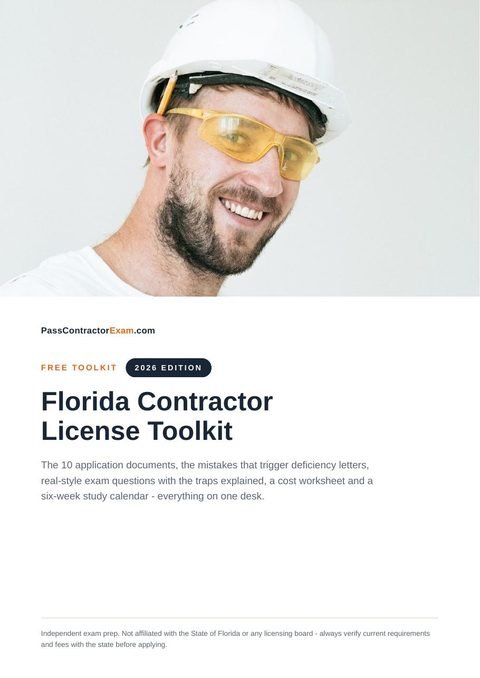
The Florida Contractor License Toolkit - 2026 Edition
A 14-page, print-ready PDF that puts the whole application on your desk - so when you file, nothing comes back with a deficiency letter. Inside:
- ▸The 10 documents your application needs - where each one comes from, and the delay-trap on each (one of them is a punctuation difference).
- ▸The 5 mistakes that trigger deficiency letters - a one-page check to run the day before you file.
- ▸3 exam questions in the real paper's style - with the traps explained, including the bid-math move that quietly protects your profit.
- ▸The eligibility table - five "if this is you" rows that show how the 4-year rule actually bends.
- ▸A cost worksheet, a fill-in 6-week study calendar, and the exam-day checklist - write on them, tick them off.
Finish the 60-second check above and it's all in your inbox within a minute: your readiness tier and readout, the Toolkit PDF, the week-by-week study plan, and free enrollment in the 15-day License Launch course - one short email a day, we never share your email, unsubscribe in one click.
Start the check - get the Toolkit free →In a hurry? Skip the check - just email me the Toolkit →
Certified vs. registered - pick certified
Florida has two license flavors. A certified license (CGC, CBC, CRC…) is earned by passing the state examination and is valid statewide. A registered license comes from qualifying locally and only works in that locality. Almost everyone building a real contracting business wants certified - and that's the exam this site prepares you for.
The three license tiers
- ▸Certified General Contractor (CGC): unlimited - any structure, any height. The most common goal.
- ▸Certified Building Contractor (CBC): commercial and residential buildings up to 3 stories.
- ▸Certified Residential Contractor (CRC): 1-2 family homes and townhouses.
What Florida requires (the short version)
To sit for certification you'll need to be 18+, pass the exam, and show four years of construction experience - with several allowed combinations of college credit and experience that can substitute for part of it (a year of experience as a foreman is the anchor most paths share). After passing, the application asks for fingerprints/background check, proof of financial responsibility (Florida uses a credit-score threshold - commonly cited at 660 - with a bond alternative if you're under it), and insurance (general liability + workers' comp position) when you activate the license.
Exact combinations, current fees, and forms change - always verify the current requirements on the DBPR/CILB website before applying. We're prep, not the state.
The exam: three parts, open-book, and that's the trap
The certification exam has three parts - Business & Finance, Contract Administration, and Project Management - taken computer-based against a published list of approved reference books (the Florida Contractors Manual, code books, AIA documents and others).
"Open-book" makes people relax. It shouldn't. There is nowhere near enough time to look up every answer - the exam is really testing whether you can navigate the references at speed and whether the fundamentals (lien deadlines, workers' comp rules, margin math, scheduling logic) are already in your head. That's a trainable skill, and practice questions are how it's trained.
What each part actually looks like
Straight from the DBPR's own Examinations at a Glance and the published content outlines. Verify current details with the state before you book - these do change.
Building contractor candidates sit the same 120-question Business & Finance paper, with 50-question Contract Administration and Project Management parts.
The weighting matters as much as the length. Project Management, for instance, is 63% construction methods, materials, tools and equipment - it is a means-and-methods paper, not the scheduling-and-cost paper its name suggests. Business & Finance leans hardest on accounting, at 32%. Prep that ignores those weights has you studying the wrong things.
A realistic timeline
- 1Weeks 1-2: confirm your eligibility path and gather the reference books.
- 2Weeks 3-8: study part by part - Business & Finance first (its fundamentals reappear everywhere) - switching from reading to timed practice as early as you can bear.
- 3Final 2 weeks: full-length timed practice exams only. Review every miss the same day.
- 4After the pass: application, background check, financial responsibility, insurance - then you're licensed statewide.
Get the Toolkit PDF + the whole path as a checklist
One email, four things: the 14-page License Toolkit (2026 edition), the path checklist, the week-by-week study plan, and day one of the 15-day License Launch course. We never share your email - unsubscribe in one click.
Costs to expect
Budget for exam fees (per part, with re-take fees if needed), the application fee, fingerprinting, the reference books, and your prep. All-in, most first-time candidates spend several hundred to a little over a thousand dollars - the retake fees and lost weeks are what good prep exists to avoid. Verify current fee amounts on the DBPR site; they change and we deliberately don't hard-code them here.
Prefer it in your inbox? Get the free Toolkit PDF + the path as a checklist by email.