A Florida air conditioning contractor license comes in two classes you can still apply for. Class A is unlimited. Class B is capped at 25 tons of cooling and 500,000 Btu of heating in any one system. Both sit Business and Finance plus a trade exam, and moving from B to A later means another application and exam.
Listen to this article, about 10 minutes. A synthetic voice reads the article and announces each section title as it begins; tables are read row by row and the questions at the end are left out.
Recorded 3 October 2026 from the article as published that day. Press a chapter to jump there; the highlighted line is what is playing. A play button sits beside every section heading, and once you scroll past this player a bar at the bottom of the screen keeps the controls in reach. Tap or click any sentence to hear the reading start from there.
What is the difference between a Class A and a Class B air conditioning license?
One sentence of statute. Section 489.105 of the Florida Statutes defines both classes with the same list of work: to install, maintain, repair, fabricate, alter, extend or design central air conditioning, refrigeration, heating and ventilating systems. The only difference is the ceiling. A Class A contractor’s services are “unlimited”. A Class B contractor’s services are “limited to 25 tons of cooling and 500,000 Btu of heating in any one system.”
There is also a Class C, limited to servicing rather than installing, and you cannot have it. The statute keeps that classification for people who held it on 1 October 1988, so anyone pitching Class C as the easy way in is about 38 years late.
How big is 25 tons, and what work does Class B shut you out of?
A ton of cooling is 12,000 Btu per hour, the heat needed to melt a ton of ice in a day. The Class B arithmetic, then:
- Cooling cap: 25 tons x 12,000 Btu per hour = 300,000 Btu per hour in any one system.
- A 3 ton system, a size commonly quoted for a mid sized single family home: 36,000 Btu per hour, about an eighth of the cap.
- A 30 ton rooftop unit on a small commercial building: 360,000 Btu per hour, 60,000 over the cap.
- Heating cap: 500,000 Btu per hour in any one system, which a typical residential furnace or heat pump sits far below.
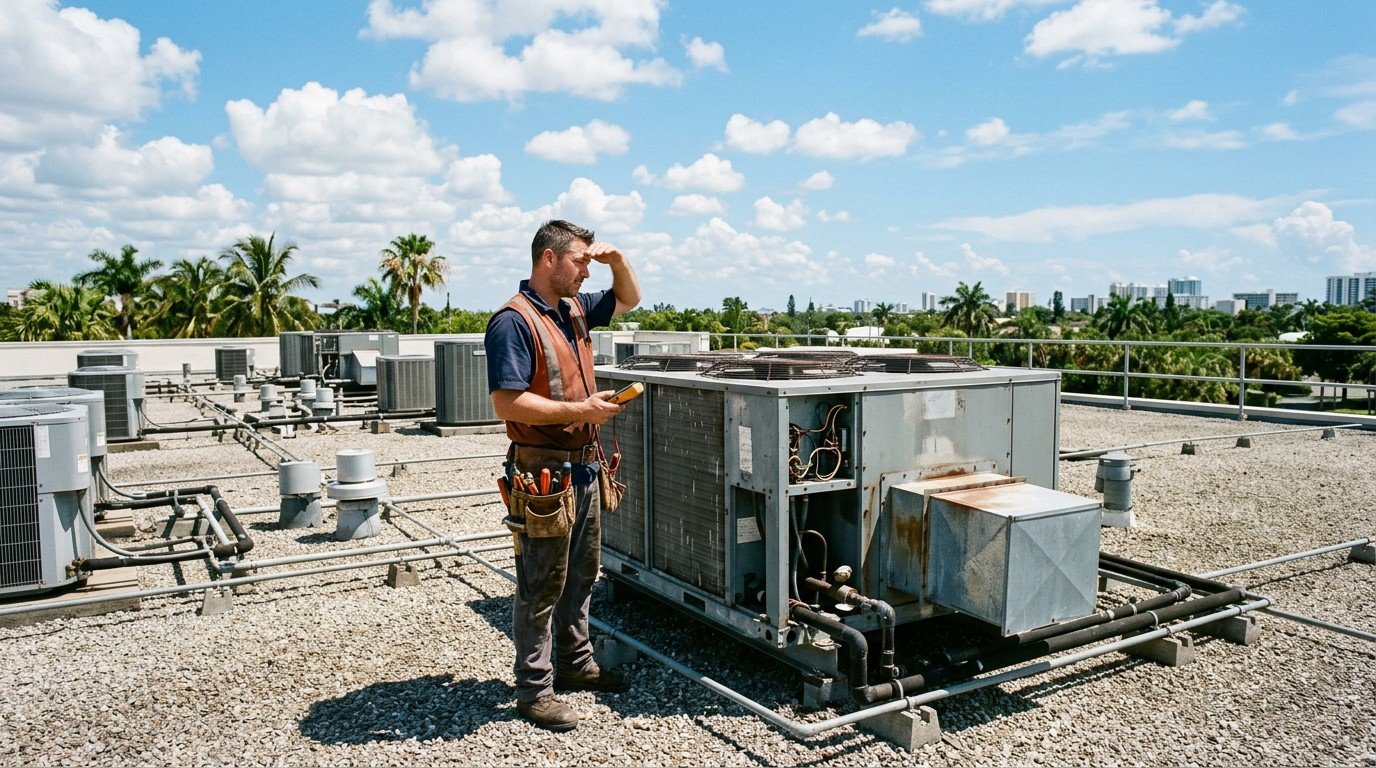
So Class B covers essentially every house in the state and a good deal of light commercial work. What it closes is the bigger commercial job: the strip mall rooftop unit, the chiller, the central plant. Nobody finds that out on exam day. They find it out when a 30 ton job lands on the desk, which is exactly what one Florida contractor described below.
Note the wording, too. The statute says “in any one system”, not per building or per contract. Read literally, a building served by several systems each under 25 tons stays inside Class B. We could not find a board ruling on that reading, so ask the Construction Industry Licensing Board in writing before you bid a multi system job on a Class B license.
Which exams do Class A and Class B candidates sit?
Two each, and not the three you may have read about. Air conditioning is a Division II trade, so candidates sit the Business and Finance exam plus one trade knowledge exam. Contract Administration and Project Management belong to the general, building and residential categories. The DBPR construction examinations page gives Business and Finance 6.5 hours and every Division II trade exam 5 hours, except Air A and Mechanical, which get 7.5. Like every Florida construction exam they are open book and multiple choice. Our page on the practice tests goes further into what the air conditioning trade papers actually contain, with the scored counts and the subject weighting taken from the rule.
The comparison below is built from the statute and the department’s own pages, checked on 15 September 2026, with the source on every row. Where only prep companies publish a figure, the row says so.
| Point | Class A | Class B | Source |
|---|---|---|---|
| Cooling capacity | Unlimited | 25 tons (300,000 Btu per hour) in any one system | s. 489.105(3), F.S. |
| Heating capacity | Unlimited | 500,000 Btu in any one system | s. 489.105(3), F.S. |
| Permitted work | Install, maintain, repair, fabricate, alter, extend, design | The same list, inside the cap | s. 489.105(3), F.S. |
| Exams sat | Business and Finance plus Air A trade knowledge | Business and Finance plus Air B trade knowledge | DBPR construction examinations page |
| Trade exam time | 7.5 hours | 5 hours | DBPR construction examinations page |
| Trade exam scored questions | 130 | 80 | DBPR candidate information booklet |
| Experience from scratch | Four years, including one as a foreman, with college credit able to replace part | The same | s. 489.111, F.S. |
| Route from Class C | At least 4 years of proven experience | At least 3 years of proven experience | s. 489.111, F.S. |
| Route from Class B | At least 1 year of proven experience, a new application and the Air A exam | Not applicable | s. 489.111, F.S.; application and exam steps as reported, confirm with PTI |
Updated on 25 September 2026: the counts of 130 and 80 are confirmed by the DBPR candidate information booklet, which lists them as scored questions, with pilot questions added on top and extra time given for them. Professional Testing, Inc., which runs the examinations, answers on 407-264-0562.
What experience do you need, and what does moving from B to A cost?
The experience bar is the same for both classes. Section 489.111 of the Florida Statutes asks for four years in the trade including at least one as a foreman, with accredited college credit able to replace up to three of those years. Nothing in it makes Class B the lower entry bar. Logging those years, and the foreman year in particular, means finding the work first, which is what current HVAC jobs in Florida are for. Our Florida contractor license requirements checklist covers the credit, insurance and fingerprint steps that sit around it.
Moving up is where Class B costs you. A certified Class B contractor needs at least one year of proven experience before upgrading to Class A. In practice that is a new application, a new registration with Professional Testing and the 7.5 hour Air A exam. Whether Business and Finance must be sat again on an upgrade is something we could not confirm from an official source. Ask Professional Testing before you register, because every registration carries its own fee.
What do people who have sat the Florida HVAC exams actually report?
We read three threads in the r/HVAC community on Reddit, with comments dated May 2024 to September 2025, and about ten accounts in them from people applying in Florida. This is what people report, not official guidance.
- A contractor who sat Class B wrote in September 2025 that a 30 ton job had since come up, over their cap, and that they now had to hold Class B for a full year before sitting Class A. Their advice to another candidate was to go straight for A. The one year wait matches section 489.111.
- The same contractor, in April 2025, said the application took about five months to process after passing, and that test centre staff nearly refused their book tabs.
- In August 2025 another candidate reported a low 70s score on Business and Finance after months of study, and a trade exam with around 15 books.
- In May 2025 a commenter who had passed both papers first time, twice, about ten years apart, said to learn to navigate the books rather than memorise them. Another found Business and Finance mostly straightforward.
- In August 2024 a Class B candidate who had passed every exam asked how to apply, and two replies called the department’s licensing website messy.
Where the accounts agree with the rules: the one year wait before upgrading is real, the exams test finding answers in the approved books, and tabs are allowed but checked, as our guide to tabs, highlighting and notes explains. Where they do not: one May 2024 commenter described both papers as 130 questions, while the Business and Finance format is 125. Verdicts on Business and Finance ran from brutal to straightforward.

Do you also need EPA 608 certification or a local registration?
The state license and the federal refrigerant certification are separate things. The US Environmental Protection Agency requires technicians who maintain, service, repair or dispose of equipment that could release refrigerant to hold Section 608 certification, and refrigerant may only be sold to a certified technician or their employer. Passing the Florida exams does not give you one.
Locally, a certified license works statewide; our comparison of registered and certified contractors explains the alternative.
So which class should you apply for?
Pick by the largest system you expect to touch in the next few years, not by which exam sounds shorter. If every job is residential, Class B covers it. If commercial work over 25 tons in one system is even a possibility, Class A saves you a year of waiting and a second application. And if a paper does not go your way, our guide to failing a part of the Florida contractor exam covers the retake.
Frequently asked questions
Can I still apply for a Class C air conditioning license in Florida?
No. Section 489.105 limits Class C to people who were registered or certified in that classification on 1 October 1988. New candidates choose between Class A and Class B.
Is an air conditioning license the same as a mechanical contractor license?
No. A mechanical contractor covers air conditioning work plus a wider set of piping systems, and sits a separate Mechanical trade exam, which DBPR also times at 7.5 hours.
Can a Class B contractor work on exactly 25 tons?
The statute says services are limited to 25 tons of cooling in any one system, which reads as up to and including 25. On a borderline job, confirm with the Construction Industry Licensing Board before signing.
If I fail the Air B trade exam, do I retake Business and Finance too?
No. You retake only the part you failed and a part you passed stands. There is a 30 day wait before a retake, and each registration with Professional Testing carries its own fee.
Can a handyman replace an air conditioning unit in Florida?
Air conditioning contracting is a licensed category under Chapter 489, so contracting for it without a license is not a handyman job. Our Florida handyman guide sets out where the line sits.
Does a Class A or Class B license need continuing education?
Yes. Certified contractors complete 14 hours per two year renewal cycle and renew by 31 August of even numbered years. Our continuing education guide lists the required topics.
Rules and fees change without notice. This page was verified on the date shown and is rechecked on the weekly refresh. If you hit something different, tell us in the comments.

Leave a Reply