Florida electrical license reciprocity does not exist as a blanket agreement with any state. Instead the Electrical Contractors’ Licensing Board runs two separate endorsement routes, one built on ten years of out of state experience and one on an exam it has judged equivalent to Florida’s own, and most states only clear one of the two.
Listen to this article, about 11 minutes. A synthetic voice reads the article and announces each section title as it begins; tables are read row by row and the questions at the end are left out.
Recorded 29 September 2026 from the article as published that day. Press a chapter to jump there; the highlighted line is what is playing. A play button sits beside every section heading, and once you scroll past this player a bar at the bottom of the screen keeps the controls in reach. Tap or click any sentence to hear the reading start from there.
On this page: the Electrical Contractors’ Licensing Board’s own dated lists showing which out of state exams clear Florida’s in full, which clear only half, and the exact fee and paperwork for both endorsement routes.
Think you already know this? Five questions, one minute.
Every answer is on this page. Answer from what you know now; the page fills in the rest.
-
1. Does the Electrical Contractors’ Licensing Board hold reciprocal licensing agreements with other states?
The board’s own 10 year endorsement list states plainly that it has no reciprocal agreements with any state; out of state applicants go through endorsement instead. Read the section
-
2. Under the 10 year endorsement route, what Florida exam do you have to pass?
Under Florida Statute 489.511(5)(c), the 10 year route requires the held license and a 2 hour Florida Building Code course, not a Florida exam. Read the section
-
3. How many of the 11 exams the board has reviewed clear both halves of Florida’s exam outright?
Only California, Georgia and North Carolina clear both halves on the board’s exam endorsement list; the rest are Partial or not recognized. Read the section
-
4. What is the current published fee for the 10 year endorsement application?
Form ECLB 14 lists $492; a temporary halving under HB 1091 expired 1 July 2025 per the Florida Senate’s bill summary. Read the section
-
5. If your state’s electrical license has not been reviewed by the board yet, what can you do?
The board keeps reviewing new license types and exams, with determinations on its exam endorsement list dated as recently as October 2025; the fallback is always sitting Florida’s own exam. Read the section
This site is independent. It is not affiliated with or endorsed by the Florida Department of Business and Professional Regulation, and nothing here is legal advice. Every figure below is checked against the Electrical Contractors’ Licensing Board’s own published lists and Florida Statutes 489.511, current as of 29 September 2026.
Does Florida offer electrical license reciprocity with any other state?
No. The Electrical Contractors’ Licensing Board says so in its own words on both of its published lists: “At this time the Electrical Contractors’ Licensing Board does not have reciprocal licensing agreements with any other state.” Reciprocity, in the strict sense, would mean Florida automatically honors a license issued elsewhere. That does not happen here for electrical work, under the board’s current 10 year endorsement list or its exam endorsement list.
What exists instead is endorsement, a case by case review of your out of state license or exam against Florida’s own requirements. It is a narrower thing than a handshake agreement, and it runs under a different board than most searches on this topic expect. General, building and residential contractors answer to the Construction Industry Licensing Board under Part I of Chapter 489, which does hold a small number of true reciprocal agreements for those trades. Electrical and alarm system contracting sits in Part II of the same chapter, under the separate Electrical Contractors’ Licensing Board, and the CILB’s agreements do not reach it.
What is the 10 year endorsement route, and does your state qualify?
Under Florida Statute 489.511(5)(c), you qualify for this route if you have held a valid, current license to practice electrical or alarm system contracting, issued by another state or territory, for at least 10 years before the date you apply, and you apply while that license is still active or within 2 years after it was last active. There is no Florida exam on this route. The one extra step is a 2 hour course on the Florida Building Code, which can be completed online.
The board has already worked through which out of state license categories are close enough to which Florida categories to count. Its list, last updated 23 March 2026, runs to 57 category matches across 38 states and territories. A Master Electrician license is the most common match, usually mapped to Florida’s Unlimited Electrical Contractor category, but the list also covers low voltage, alarm and sign specialty categories separately. A sample:

| State or territory | Their license | Florida equivalent |
|---|---|---|
| California | Electrical Contractor (C-10) | Unlimited Electrical Contractor |
| Georgia | Electrical Non Restricted (Class II) | Unlimited Electrical Contractor |
| North Carolina | Unlimited Electrical Contractor | Unlimited Electrical Contractor |
| Texas | Master Electrician | Unlimited Electrical Contractor |
| California | Low Voltage Systems Contractor (C-7) | Limited Energy Specialty Contractor |
| New Jersey | Fire Alarm License | Alarm Contractor 1 |
| Puerto Rico | Expert Electrician | Unlimited Electrical Contractor |
Three states get flagged the other way, explicitly, on the same list: Indiana, Kansas and Pennsylvania license electricians only at the local level, so the board has nothing statewide to compare and marks them not substantially similar. New York’s general electrical contractor license fails for the same structural reason, no statewide license exists to review, though New York’s fire and burglar alarm licensing does clear the alarm category. The review runs license type by license type, not state by state as a whole, which is why one state can appear on both sides of the list at once. Anywhere not listed at all simply has not been reviewed yet, and the board accepts applications to review a new state’s license on request.
10 year experience or exam equivalency: how the two routes compare
| Route | What you show | Florida exam | Extra step | Statute |
|---|---|---|---|---|
| 10 year experience | An out of state electrical or alarm license, active or active within the last 2 years, held 10 years or more | None | 2 hour Florida Building Code course | 489.511(5)(c) |
| Exam equivalency | A license from a state whose exam the board has reviewed against Florida’s own | None if fully recognized, one of two exams if partially recognized, both if not reviewed or rejected | None beyond the standard application | 489.511(6)(a) |
What is the exam based endorsement route, and why does “partial” trip people up?
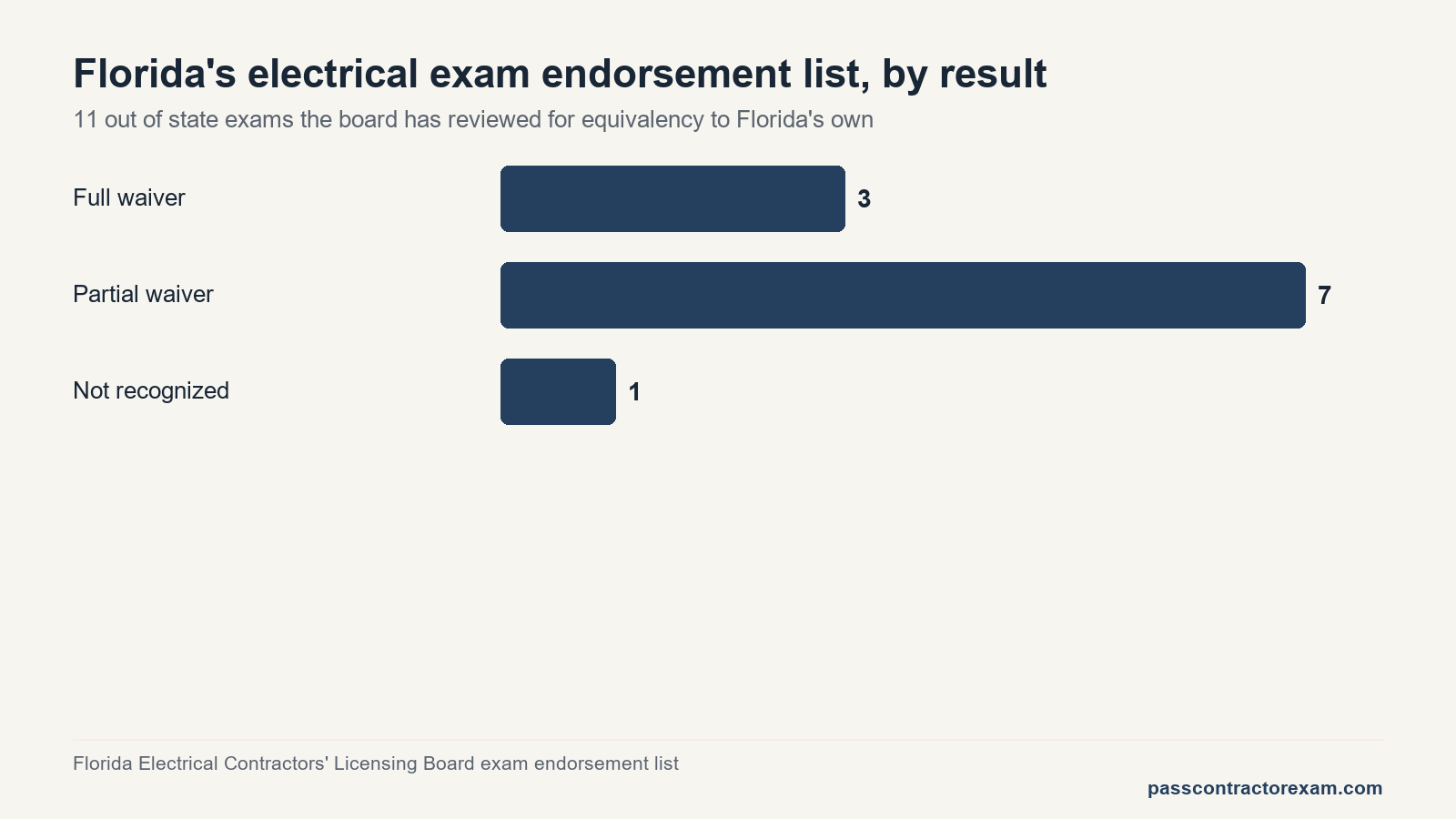
Florida’s own electrical exam has two halves, a Business and Finance exam and a Technical exam for the license category you want. The board has reviewed 11 state or national exams to see whether either half can be waived. Only three clear both halves outright: California’s C-10 exam, Georgia’s Class II Unrestricted exam paired with its Low Voltage Unlimited exam, and North Carolina’s Unlimited exam. Seven more clear only one half and are marked “Partial”, which means the applicant still has to sit the other Florida exam before a license issues. One, Ohio’s electrical contractor exam, was reviewed in April 2024 and rejected as not substantially similar.
| State or exam | Result | Still required | Reviewed |
|---|---|---|---|
| California | Full | Nothing extra | March 2001, Nov 2019 |
| Georgia | Full | Nothing extra | March 1998, March 2010 |
| North Carolina | Full | Nothing extra | March 1998 |
| Colorado | Partial | Florida Business exam | November 2019 |
| NASCLA residential exam | Partial | Florida Business exam | May 2020 |
| Nevada | Partial | Florida Technical exam | April 2020 |
| Oklahoma | Partial | Florida Technical exam | April 2020 |
| South Carolina | Partial | Florida Technical exam | April 2020 |
| Tennessee | Partial | Appropriate Florida Technical exam | October 2025 |
| Texas | Partial | Florida Business exam | December 2019 |
| Ohio | Not recognized | Both Florida exams | April 2024 |
The exam most people never think to check is the one they assume endorsement removes entirely. A “Partial” result on this list is a pass on half the work and a full Florida sitting on the other half, open book, same as every exam this site covers.
What does electrical endorsement actually cost and require?
The published fee for the 10 year endorsement application, DBPR Form ECLB 14, is $492. That same form still carries a leftover notice from HB 1091, a temporary statewide 50 percent cut to initial licensing fees that applied to Florida’s 2023 to 2024 and 2024 to 2025 fiscal years and dropped this specific fee to $346.50. According to the Florida Senate’s own summary of that bill, the relief expired 1 July 2025. Unless the legislature has revived it since, the full $492 is what applies now, so confirm the current figure with the board rather than trusting the printed number on an old form.
- A credit report on the business being qualified, from a nationally recognized agency, checked at local, state and federal level
- A credit report on the individual applicant, same standard
- Verification that the out of state license has been held for at least 10 years and was active within the last 2
- Proof of completion of the 2 hour Florida Building Code course
- Proof of satisfaction of any liens, judgments or bankruptcy discharge, where applicable
Endorsement is a board decision, not a formality, and it is not automatic on either route. Florida’s general guidance for the Construction Industry Licensing Board states plainly that endorsement fees are nonrefundable if the board denies the application. The Electrical Contractors’ Licensing Board’s own forms do not repeat that line for its own applicants, but nothing on them promises a refund either, so budget the fee as spent whether or not the application succeeds.
Electrical endorsement eligibility checklist
Run these against the board’s own lists before you spend the application fee. This does not predict approval, only whether you meet the published conditions.
A clean checklist means your paperwork matches the board’s published conditions. It does not guarantee approval, which is a board decision. Ticks are saved on this device only.
What if your state is not on either list?
You can still apply. The board reviews license types and exams individually, not once and done, and the exam list’s own determination dates run from March 1998 to October 2025, which shows it is still being added to. Ask the board to review your state’s license or exam, or route around the question entirely and take the Florida exam directly, the same path a first time applicant follows, covered in full in this site’s guide to the Florida electrical contractor license. Either way, the exam itself is open book, and knowing what you can and cannot bring into the room matters more than which state you are coming from.
Frequently asked questions
Does Florida have true reciprocity for electrical contractors?
No. The Electrical Contractors’ Licensing Board states directly that it has no reciprocal licensing agreements with any state. Every out of state applicant goes through endorsement instead, either the 10 year experience route or the exam equivalency route.
How long do I need to have held my out of state license for the 10 year route?
At least 10 years before the date you apply, and the license must be active, or have been active within the last 2 years, under Florida Statute 489.511(5)(c).
Which states get a full exam waiver in Florida?
As of the board’s current list, only California’s C-10 exam, Georgia’s Class II Unrestricted exam paired with Low Voltage Unlimited, and North Carolina’s Unlimited exam clear both halves of Florida’s exam.
What does a Partial result mean on the exam endorsement list?
It means only one of Florida’s two exam halves, Business and Finance or Technical, was found substantially equivalent. The applicant still has to sit the other half before a license issues.
How much does electrical endorsement cost in Florida?
The published fee is $492 for the 10 year route, Form ECLB 14. A temporary halving to $346.50 under HB 1091 expired 1 July 2025, so confirm the current figure before you apply.
What if my state isn’t reviewed yet?
You can still apply. The board reviews license types and exams individually and keeps adding determinations, with entries on its current list dated as recently as October 2025.
Finished the page? The same five questions from the top, to see what stuck.
Rules and fees change without notice. This page was verified on the date shown and is rechecked on the weekly refresh. If you hit something different, tell us in the comments.

Leave a Reply