
The Florida contractor exam format depends on your licence. General, building and residential contractors sit three separate open book, multiple choice exams: Business and Finance, Contract Administration and Project Management. Every other trade sits two, Business and Finance plus a trade knowledge exam. Each part is scored on its own, and 70 percent passes.
Listen to this article, about 15 minutes. A synthetic voice reads the article and announces each section title as it begins; tables are read row by row and the questions at the end are left out.
Recorded 13 November 2026 from the article as published that day. Press a chapter to jump there; the highlighted line is what is playing. A play button sits beside every section heading, and once you scroll past this player a bar at the bottom of the screen keeps the controls in reach. Tap or click any sentence to hear the reading start from there.
On this page: the scored questions and hours for each Florida exam by licence, taken from the DBPR candidate booklet, the content weights turned into question counts, and the four year rule for passing every part.
Think you already know this? Five questions, one minute.
Every answer is on this page. Answer from what you know now; the page fills in the rest.
-
1. How many scored questions does a residential contractor get on the Contract Administration exam?
The DBPR construction Candidate Information Booklet lists 45 scored questions in 4.5 hours for the residential contractor, against 50 for building and 60 for general contractors. Read the section
-
2. Which content area carries the largest share of the general contractor Project Management exam?
Construction methods, materials, tools and equipment is 63 percent in the DBPR GC Project Management outline, against 20 percent for safety and 17 percent for plans and specifications. Read the section
-
3. How long do you have to pass every required part of the exam?
The DBPR examination application pack sets a four year window from the first scheduled exam, with unlimited attempts inside it, under Rule 61G4-16.009. Read the section
-
4. You score 83 out of 120 on Business and Finance. What happens?
83 of 120 is 69.2 percent. The candidate booklet sets the pass mark at 70 percent and says construction exam scores are not rounded. Read the section
-
5. What does this page say about the widely quoted pass rates of roughly 50, 55 and 40 percent?
The figures circulate on prep and aggregator sites but could not be traced to a department publication, so the page treats them as a rough shape, not a measured statistic. The department’s own documents are on the DBPR construction examinations page. Read the section
That last point shapes everything else. These are not sections of one long sitting. They are separate exams with separate results, and the question count on two of them changes with the licence you are after, which most pages on this subject quietly skip.
How many questions and hours does each part have?
For a certified general contractor, the combination most people searching this are working towards, the numbers look like this. The questions given include ungraded pilot questions; the scored column is what the 70 percent is taken of.
| Part | Questions given | Of those, scored | Time allowed | Time per question |
|---|---|---|---|---|
| Business and Finance | 125 | 120 | 6.5 hours | about 3 min 7 sec |
| Contract Administration | 65 | 60 | 4.5 hours | about 4 min 9 sec |
| Project Management | 65 | 60 | 4.5 hours | about 4 min 9 sec |
| Total | 255 | 240 | about 15.5 hours | n/a |
The department’s own Candidate Information Booklet for construction examinations confirms the scored counts and the hours: 120 scored questions in 6.5 hours for Business and Finance, and 60 scored questions in 4.5 hours for each of the general contractor’s Contract Administration and Project Management exams. What the booklet does not do is put a number on the pilot questions. It says an exam may contain a small number, that they are not identified, that they never count, and that extra time is built in for them. The figure of 5 per part, giving the 125 and 65 above, comes from providers such as 1 Exam Prep and could not be confirmed against a department document.
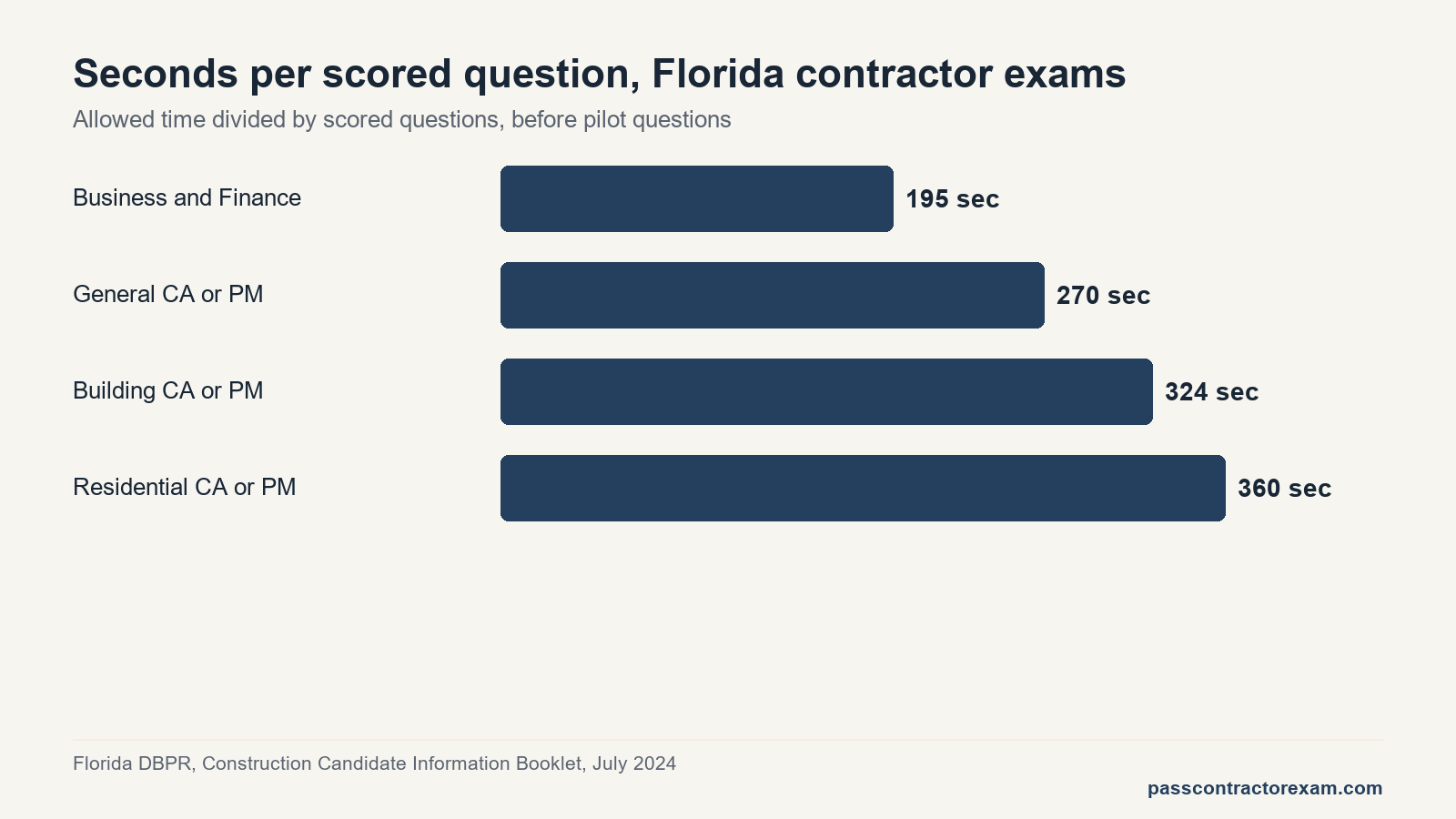
Here is the part the general contractor table hides. The same booklet lists different scored counts for the other two Division I licences, with the same 4.5 hours, so a smaller paper buys you more time per question. The trade exams for Division II licences vary again, and two examples are included for scale. On the air conditioning side the Class B paper is 80 scored questions in five hours, and we work out what that pace means for a Florida HVAC practice test, minute by minute.
| Exam | Who sits it | Scored questions | Hours | Minutes per scored question |
|---|---|---|---|---|
| Business and Finance | Every licence below | 120 | 6.5 | 3.25 |
| Contract Administration and Project Management, each | General contractor | 60 | 4.5 | 4.5 |
| Contract Administration and Project Management, each | Building contractor | 50 | 4.5 | 5.4 |
| Contract Administration and Project Management, each | Residential contractor | 45 | 4.5 | 6.0 |
| Roofing trade knowledge | Roofing contractor | 80 | 5 | 3.75 |
| Class A Air Conditioning trade knowledge | Class A air conditioning contractor | 130 | 7.5 | about 3.46 |
Source for every row: the Examinations at a Glance chart in the DBPR construction Candidate Information Booklet, July 2024 edition, read on 3 October 2026. The last column is simple division of the allowed minutes by the scored questions, and because the allowance also covers the pilot questions you never see flagged, the real figure is a little tighter than it looks.
Business and Finance is the outlier in every direction. It is the longest sitting, it is the same paper for almost every licence, and at 3.25 minutes a question it is the tightest on time. The one exception in the booklet is pool and spa servicing, whose candidates sit a 60 question Business and Finance Service Pool form in 3.5 hours, which our comparison of the three Florida pool licences and their exams sets out. If you are planning around fatigue, that is the one to plan around, and our breakdown of the Business and Finance exam goes through it content area by content area.

What is on each part?
The department publishes a content outline for each exam with the share of questions each area carries, and every share may move by up to three points either way on a given sitting. Converted into rough question counts, the three general contractor papers look like this.
| Exam | Content area (DBPR outline) | Share | About how many questions |
|---|---|---|---|
| Business and Finance | Conducting accounting functions | 32% | 38 of 120 |
| Business and Finance | Managing administrative duties | 26% | 31 of 120 |
| Business and Finance | Complying with government regulations | 15% | 18 of 120 |
| Business and Finance | Establishing the business, trade operations, human resources | 27% combined | 32 of 120 |
| GC Contract Administration | Project contracts | 40% | 24 of 60 |
| GC Contract Administration | Preconstruction activities, including estimating and bids | 27% | 16 of 60 |
| GC Contract Administration | Obtaining licences, permits and approvals | 20% | 12 of 60 |
| GC Contract Administration | Construction procedures and operations | 13% | 8 of 60 |
| GC Project Management | Construction methods, materials, tools and equipment | 63% | 38 of 60 |
| GC Project Management | Safety | 20% | 12 of 60 |
| GC Project Management | Reading plans and specifications | 17% | 10 of 60 |
Two things stand out. Contract Administration is mostly paperwork and money, contracts and estimates; Project Management is mostly the physical job, from site layout and soils to concrete and masonry. If you want the detail on how differently they read, the two exams are compared side by side here. And both outlines expect basic mathematics on every part, area and volume, percentages, triangles and simple algebra, whatever the content area says. The building and residential contractor outlines are separate documents with their own weights, listed on the DBPR construction examinations page; do not assume the general contractor shares carry over.
Do you have to take all three?
Only if your licence is in Division I. The booklet is plain about it: general, building and residential contractors must pass Business and Finance, Contract Administration and Project Management, while every other specialty passes Business and Finance and a trade knowledge exam. Our guide to the Florida contractor licence types sets out which licence falls where. Someone who already passed Business and Finance for one licence and applies for an additional category may be exempt from sitting it again.
Because each part is passed independently, you are not obliged to sit them all at once. The limit is time. The department’s examination application pack says you must pass every required part within four years of your first scheduled exam, with an unlimited number of attempts inside that window, under Rule 61G4-16.009 of the Florida Administrative Code. Passed parts do not lapse when you fail another, but they do not wait forever either. Once everything is passed, turning the result into an actual licence is a separate application with its own decision window.
Which exams does your licence sit?
Pick the licence you are applying for to see the exams, scored questions and hours the DBPR booklet lists for it. It describes the format only; it says nothing about your chances.
Every exam is open book and multiple choice, and 70 percent passes. Confirm against the current DBPR booklet before you book.
How are the exams booked, scored and reviewed?
Two companies are involved and candidates regularly ring the wrong one. Professional Testing, Inc. registers candidates, approves applications, and develops and scores the construction exams for the department; its line is 407-264-0562. Once approved, you book and sit the computer based exam through Pearson VUE, which the booklet names as the department’s scheduling and delivery vendor, on 888-204-6230. Plumbing trade knowledge is the exception and is still a paper exam on set dates.
- Every question has four options and carries equal weight. No part of the exam is worth more per question than another.
- 70 percent passes and nothing is rounded. The booklet says construction scores are not rounded to the nearest percent, so 83 of 120 on Business and Finance is a fail, not a near miss.
- The result arrives before you leave the building. Candidates get a photo bearing result report as soon as the exam ends.
- A failed part can be reviewed. The request has to be made within 21 days, you see only the questions you got wrong, and you usually get half the original exam time with no notes allowed. The application pack adds that you cannot sit an exam within 21 days of a review.
Those rules are the department’s, and they switch off any temptation to be clever: confirm the current version in the booklet itself before you book, because a fee or a deadline read off a prep site is how test dates get lost.

Does the order matter?
It can, and the argument runs both ways depending on what you are optimising for.
- Business and Finance first gets the longest and most time pressured part done while your preparation is freshest, and it is the part whose material overlaps least with site experience. If you are going to fail one, failing it early leaves more of the four year window for the retake.
- Business and Finance last lets you build exam technique on the shorter papers first, where the timing is more forgiving, before facing the one that punishes slow navigation hardest.
- Contract Administration and Project Management together makes sense to some candidates because the material and the reference books overlap more with each other than with Business and Finance.
There is no official recommendation on order, and anyone stating one confidently is expressing a preference. What is not a matter of opinion is that the parts are independent, so you can sequence them deliberately rather than by whichever slot was free.

What about pass rates?
Figures circulate widely: roughly 50% for Business and Finance, 55% for Contract Administration and 40% for Project Management.
We are including them because you will encounter them anyway, and flagging clearly that we could not trace them to an official DBPR publication. They appear on prep and aggregator sites, which have an obvious interest in the exam sounding hard, and none of them says which licence the Contract Administration and Project Management figures are for, which matters now that you know those papers differ. Treat them as a general shape, not as measured statistics, and do not plan around a specific number.
Which examination parts your licence requires, the fees, and the current approved reference list are all set by the Florida DBPR. Confirm your own requirements with the department rather than inferring them from any prep site.
What has changed since this was first published?
This page went up in August 2026 and is rechecked regularly. Here is what moved, and why.
- 3 October 2026: the 60 question papers are the general contractor’s, not everyone’s. Checked against the department’s own booklet this time rather than against providers. Building contractors get 50 scored questions on Contract Administration and Project Management, residential contractors 45, all in 4.5 hours. Earlier versions of this page gave the general contractor figures as if they applied to every Division I licence. The page also now says that Division II trades sit two exams, not three, and gives the four year window for passing every part.
- 20 September 2026: the two shorter general contractor parts allow 4.5 hours, not 4.75. The earlier figure pushed the total sitting time to about 16 hours. It is about 15.5, and the booklet now confirms the 4.5.
- 20 September 2026: 240 of the 255 general contractor questions are scored, not 255. The 70 percent pass mark is taken of the scored questions. The booklet confirms the scored counts; the 5 pilot questions per part remain a provider figure.
Where to go next
Because every part is open book, the binding constraint is retrieval speed rather than recall, and our guide to how the open book format actually works goes through what that means for how you prepare. Before booking anything, check which books you can bring, because the approved list differs by licence category and by edition. If a part has already gone badly, what happens if you fail a part covers the retake rules. When you actually want a date, registering for the Florida general contractor exam step by step walks through what Professional Testing and Pearson VUE need from you and by when, and the exam day preparation checklist covers the morning itself.
Frequently asked questions
How many parts does the Florida contractor exam have?
Three: Business and Finance, Contract Administration, and Project Management. Each is open book, multiple choice, and passed or failed independently.
How many questions are on the Florida contractor exam?
255 are put in front of you and 240 are scored. Business and Finance gives 125 questions of which 120 count, and Contract Administration and Project Management give 65 each of which 60 count. The rest are ungraded pilot questions.
How long is the Florida contractor exam?
About 15.5 hours across all three parts. Business and Finance allows 6.5 hours, and Contract Administration and Project Management allow 4.5 hours each.
Can I take the parts on different days?
The parts are passed independently and passed parts remain valid, so they do not have to be taken in one sitting. Confirm scheduling specifics with the testing vendor when booking.
What order should I take them in?
There is no official recommendation. Taking Business and Finance first gets the longest and most time pressured part done early, while leaving it until last lets you build exam technique on the shorter papers first.
What are the pass rates?
Figures of roughly 50% for Business and Finance, 55% for Contract Administration and 40% for Project Management circulate widely, but could not be traced to an official DBPR publication. Treat them as indicative rather than measured.
Finished the page? The same five questions from the top, to see what stuck.
Exam rules, approved reference lists and fees are set by the Florida DBPR and change without notice. This page was checked against the DBPR construction Candidate Information Booklet and examination application pack on 3 October 2026 and is rechecked regularly. Always confirm against the current DBPR documents for your test date. We are independent and not affiliated with, endorsed by or approved by the Florida DBPR.

Leave a Reply