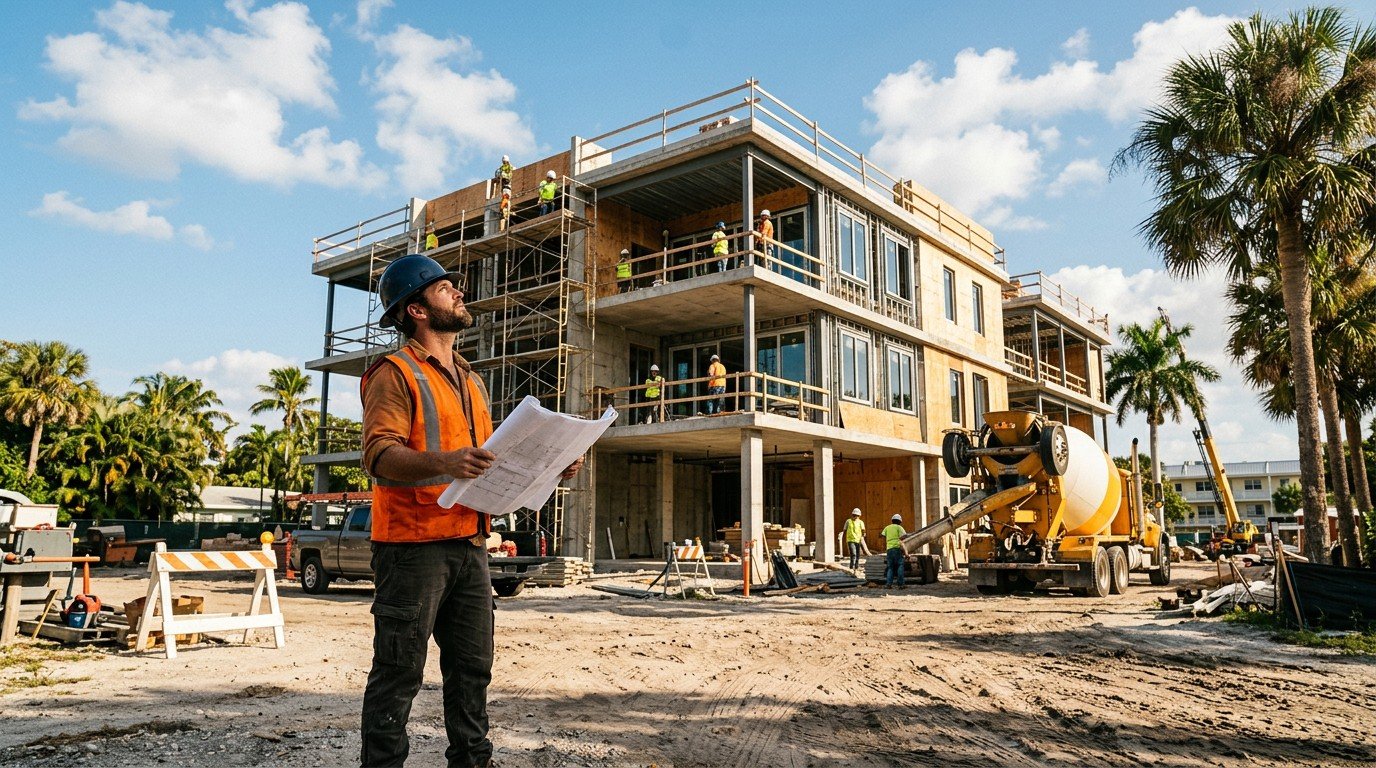
Florida building contractor license requirements come down to three things: four years of qualifying experience, or a relevant degree plus one year; commercial work in at least four of the six structural areas listed in rule 61G4-15.001; and passes on three open book exams. The licence, a CBC, then covers buildings up to three stories.
Listen to this article, about 20 minutes. A synthetic voice reads the article and announces each section title as it begins; tables are read row by row and the questions at the end are left out.
Recorded 31 October 2026 from the article as published that day. Press a chapter to jump there; the highlighted line is what is playing. A play button sits beside every section heading, and once you scroll past this player a bar at the bottom of the screen keeps the controls in reach. Tap or click any sentence to hear the reading start from there.
On this page: the CBC scope quoted from section 489.105, a row by row table of what a CBC, CGC and CRC may build, the six structural areas the experience rule checks, the BC exam numbers from the DBPR booklet, and five dated applicant accounts.
Think you already know this? Five questions, one minute.
Every answer is on this page. Answer from what you know now; the page fills in the rest.
-
1. Under section 489.105(3)(b), what is the height limit on new construction for a certified building contractor?
The building contractor definition covers commercial and residential buildings that do not exceed three stories in height. Section 489.105, Florida Statutes Read the section
-
2. In how many of the six listed structural areas must a building applicant’s commercial experience fall?
Rule 61G4-15.001(2)(a) requires commercial experience in four or more of six areas, including masonry walls, steel erection, elevated slabs and column erection. Rule 61G4-15.001, Florida Administrative Code Read the section
-
3. How many years of proven experience as an active CRC does the statute require before a CRC can obtain a CBC?
Section 489.111(2)(c)4.a sets a minimum of three years for CRC to CBC; four years applies to moves up to the CGC. Section 489.111, Florida Statutes Read the section
-
4. How many scored questions does each BC Contract Administration and Project Management paper have?
The DBPR booklet lists 50 scored questions in 4.5 hours for each BC paper, against 60 for GC and 45 for RC. DBPR Construction Candidate Information Booklet Read the section
-
5. Under the DBPR application pack, what do the three parts cost together at a first sitting?
A $135 registration fee to Professional Testing plus $80, $40 and $40 to Pearson VUE comes to $295. DBPR examination application pack Read the section
The certified building contractor licence is the middle child of Florida’s three Division I licences, and like most middle children it mostly gets described by reference to its siblings. Prep pages take the general contractor page and swap one word. What actually decides a CBC is a three story ceiling in the statute and an experience rule built around commercial structural work. Everything below was read from the statute, the rule and the DBPR’s exam documents on 13 October 2026. This site is independent of the DBPR.
What can a certified building contractor actually build?
The scope is one sentence in section 489.105(3)(b) of the Florida Statutes, and it has two halves joined by an “or”.
“Building contractor” means a contractor whose services are limited to construction of commercial buildings and single-dwelling or multiple-dwelling residential buildings, which do not exceed three stories in height, and accessory use structures in connection therewith or a contractor whose services are limited to remodeling, repair, or improvement of any size building if the services do not affect the structural members of the building.
Section 489.105(3)(b), Florida Statutes, 2026
The first half is new construction up to three stories, commercial or residential. The second half is the bit people skim past: a CBC may remodel, repair or improve a building of any height, provided the work does not touch structural members. The residential definition in section 489.105(3)(c) has no matching “any size building” clause.
The scope also interacts with section 489.113(3), which says what each licence must subcontract. The table puts both together, row by row.
| Work | CGC | CBC | CRC | Where it comes from |
|---|---|---|---|---|
| New commercial building, up to three stories | Yes | Yes | No | s. 489.105(3)(a) to (c) |
| New building of four stories or more | Yes | No | No | s. 489.105(3)(b), three story limit |
| Apartment block or fourplex, up to three stories | Yes | Yes | No | CBC covers multiple dwelling buildings; CRC stops at three family |
| House, duplex or triplex, two habitable stories | Yes | Yes | Yes | s. 489.105(3)(b) and (c) |
| Non structural remodel of a building of any size | Yes | Yes | Only one to three family homes | s. 489.105(3)(b), second clause |
| Clearing, grading and excavation | Any project | Only the lot the building sits on | Only the lot the building sits on | s. 489.113(3)(a) |
| Shingle roofing on a new building of your own construction | Yes | Yes | Yes | s. 489.113(3)(b) |
| Structural swimming pool work | Yes | Subcontract | Subcontract | s. 489.113(3)(c), general contractor only |
| Electrical, plumbing, mechanical, sheet metal, air conditioning | Subcontract | Subcontract | Subcontract | s. 489.113(3), unless you hold that trade’s licence |
What counts as a story is defined in board rule 61G4-12.011(1), which rule 61G4-15.001 points to: a level reachable at grade, by a staircase landing or by an elevator stop, with space where people can safely work or live. Measure your pipeline against that definition, not against the floor count in the sales brochure.
What experience does the board accept for a CBC?
The routes to eligibility sit in section 489.111(2)(c): a four year degree in engineering, architecture or building construction plus one year of proven experience; four years of active experience with at least one as a foreman; or a mix of foreman years and college credit. There is also an upgrade route. Under subsection 4.a, an active certified residential contractor can get a CBC after passing the building exams with a minimum of three years of proven experience as a CRC.
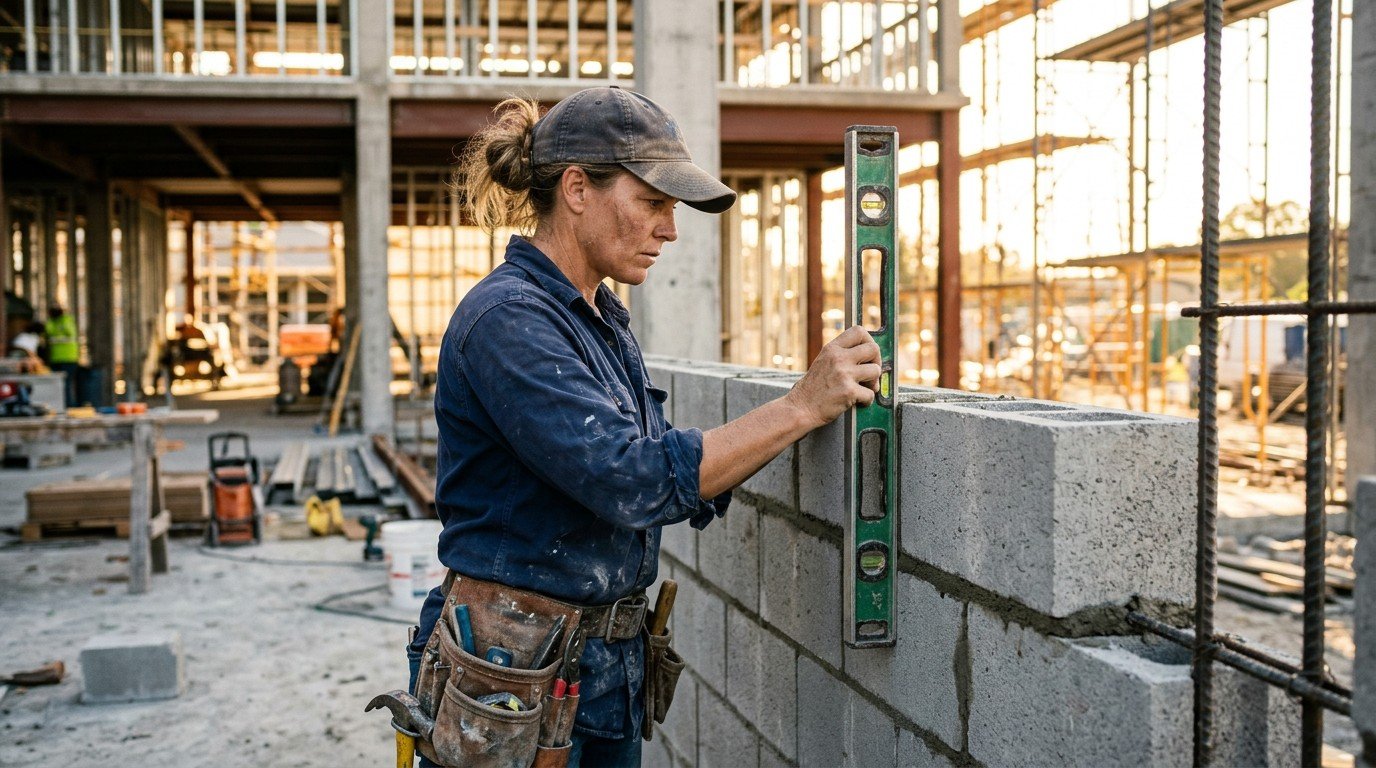
The years are the easy part. The harder part is what rule 61G4-15.001(2)(a) says those years must contain for the general and building categories: commercial construction experience, on buildings of any occupancy class except storage, utility and miscellaneous accessory structures such as barns, carports, garages, sheds and towers. That commercial experience must be in four or more of these six areas:
- Foundations or slabs in excess of 20,000 square feet
- Masonry walls
- Steel erection
- Elevated slabs
- Column erection
- Formwork for structural reinforced concrete
Two more lines matter. Under rule 61G4-15.001(1)(a) the experience must be gained under a contractor licensed in your category, or one whose scope covers it. And a general contractor applicant needs one extra year on structures of four stories or more, which a building applicant does not. That sentence is why so many people end up with a CBC rather than the CGC they wanted.
The residential list asks for three of five areas, including wood framing and demolition, so framing a hundred houses gets you closer to a CRC than a CBC. Our page on the Florida residential contractor licence and its scope covers that side.
What do people who applied for a CBC actually report?
Forum accounts are testimony, not rules, but they show where applications snag. We read two full Reddit threads and three further comments from at least five posters, dated July 2025 to July 2026. Paraphrased, this is what people report.
- In July 2025, a CBC applicant said none of their commercial renovation work was counted, only new builds, and they were allowed to revise the application with more new build projects.
- In February 2026, a poster passed on advice credited to a former board member: describe the work in the rule’s own terms, such as column erection and elevated slab.
- In June 2026, the same poster said experience is now self declared, with contractors listed as contacts, and that a CRC or CBC holder can upgrade to CGC after four years.
- In April 2026, a small firm owner with four years in painting, HVAC, drywall and framing, mostly under a parent with an HVAC licence, asked how to get that verified for a CBC.
- In July 2026, an applicant between GC and BC experience asked if the board would offer the lower licence. Replies put review at four to six weeks and said a downgrade is possible but not automatic.
Set against the rule text, the accounts mostly hold up. The rule does count alteration work, but a tenant fit out rarely involves a 20,000 square foot slab or steel erection, so a renovation heavy record struggles to reach four areas. The April 2026 case has the bigger gap: painting and drywall are not on the list, and time under an HVAC licence is not time under a contractor whose scope covers building work. The upgrade claim needs a correction: section 489.111(2)(c)4 sets four years for CRC or CBC to CGC, but three years for CRC to CBC. One July 2026 commenter cited June 2026 board minutes showing 9 of 30 applications approved; the DBPR server refused our requests for those minutes, so treat that figure as unconfirmed.
How are the building contractor exams different from the GC and RC papers?
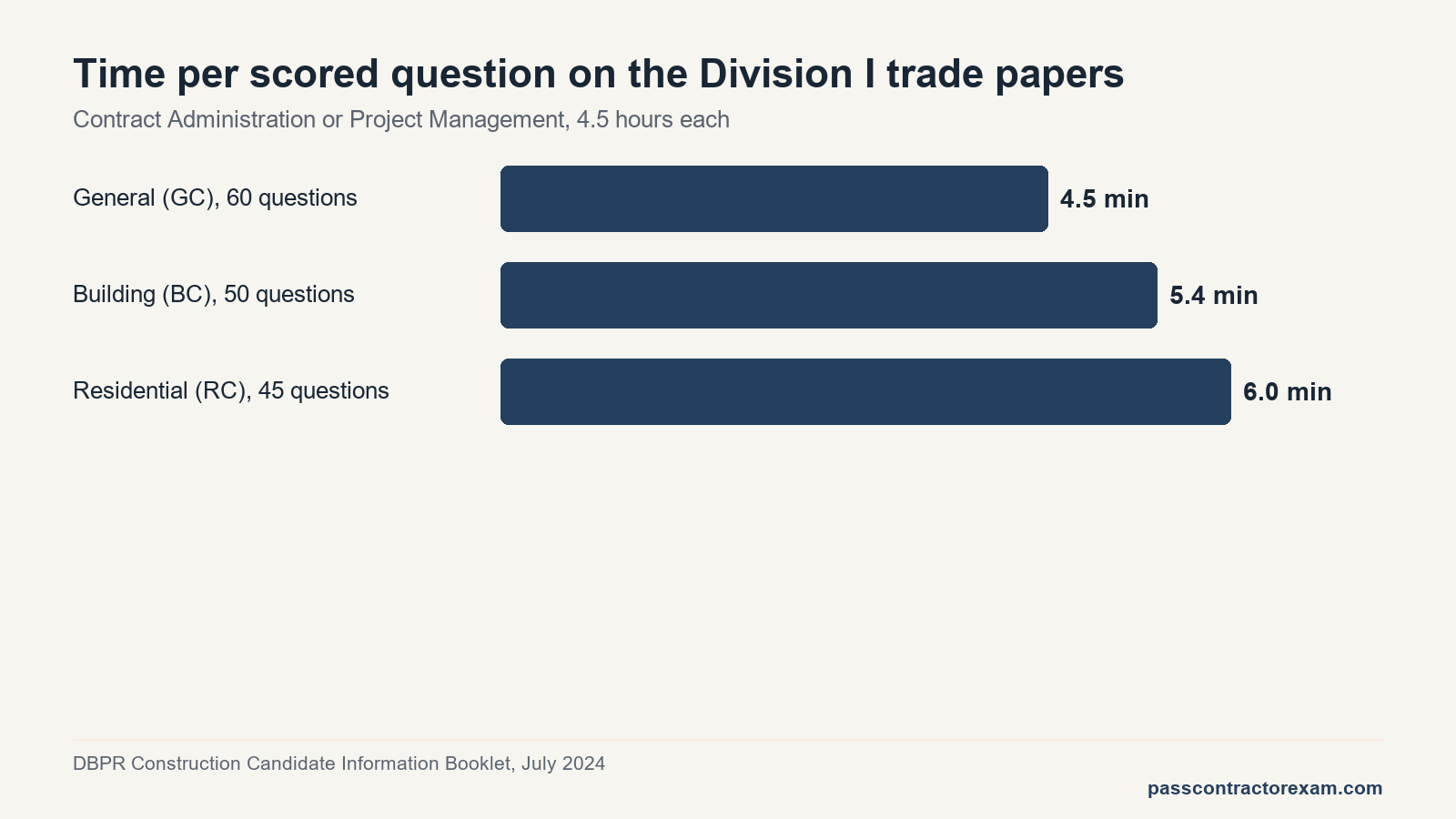
A building applicant sits the same three Division I parts as everyone else: Business and Finance, Contract Administration and Project Management. But the two trade papers are separate BC papers, not the GC papers with a different label. The DBPR’s Candidate Information Booklet, effective July 2024, lists them like this:
| Paper | Scored questions | Time | Minutes per scored question |
|---|---|---|---|
| Business and Finance (all three licences) | 120 | 6.5 hours | 3.25 |
| GC Contract Administration or Project Management | 60 | 4.5 hours | 4.5 |
| BC Contract Administration or Project Management | 50 | 4.5 hours | 5.4 |
| RC Contract Administration or Project Management | 45 | 4.5 hours | 6.0 |
So a BC candidate gets about 5.4 minutes a question, almost a minute more than a GC candidate, with the same books. The pass mark is 70 percent and the booklet says scores are not rounded, so 69.9 is a fail. Prep pages quote these papers at 50, 60 or 65 questions; none of them is the booklet.
The books come from the DBPR’s GC, BC and RC reference list valid January 2026 to December 2026, one list shared by all three licences. It includes AIA A201 (2017), A401 (2017) and A701 (2018), the OSHA construction regulations at 29 CFR 1926 as of July 1, 2025, Principles and Practices of Commercial Construction, 11th edition, and the 2023 Florida Building Code volumes. Underlining and highlighting are allowed, handwritten notes and moveable sticky tabs are not. Our guide to what you can and cannot mark in your exam books goes through the tab rules, and the difference between Contract Administration and Project Management covers which books each paper leans on.

What does it cost to sit the three CBC exams?
The DBPR examination application pack, revised 1 August 2024, sets the fees candidates actually pay. Every registration costs a $135 fee to Professional Testing, Inc., and Pearson VUE charges $80 for Business and Finance and $40 each for Contract Administration and Project Management. Building candidates register through the same two vendors in the same order, which our step by step guide to registering for the Florida contractor exams lays out with the rule figures beside the pack.
| Scenario | Professional Testing | Pearson VUE | Total |
|---|---|---|---|
| All three parts, first sitting | $135 | $80 + $40 + $40 | $295 |
| Retake Business and Finance only | $135 | $80 | $215 |
| Retake Contract Administration or Project Management only | $135 | $40 | $175 |
| Retake both trade papers in one registration | $135 | $40 + $40 | $215 |
Two cautions, written plainly. First, rule 61G4-12.009 still lists examination administration at $80 per test, so the rule and the pack disagree on the trade papers; the pack is what the vendors charge today, but check it before you pay. Second, the pack gives you four years from your first scheduled exam to pass every part, with unlimited attempts inside that window. Plan the order of your sittings around that window, not around the next free date at the test centre.
If you have failed a part before, our guide to what happens after a failed Florida contractor exam covers the retake timing.
What does the board need from you after the exams?
Passing all three papers does not hand you a licence. It gets you the right to apply for one. The application is form DBPR CILB 5-B, the Application for Certified Building Contractor as an Individual, in the July 2024 edition that rule 61-35.010 adopts. The exams come with a whole prep industry attached. The paperwork comes with nobody, and it is the part that actually sits on a desk for weeks. Beyond your exam results, the form asks for five things.
| Requirement | What the form asks for | Where it comes from |
|---|---|---|
| Application fee | $245 if you apply between 1 May of an even year and 31 August of an odd year; $145 from 1 September of an odd year to 30 April of an even year | Form 5-B; rule 61G4-12.009(4)(a) |
| Fingerprints | Electronic fingerprints, mandatory under chapter 455 for every initial construction licence | Form 5-B |
| Liability insurance | $300,000 public liability and $50,000 property damage for general and building contractors; $100,000 and $25,000 for residential | Rule 61G4-15.003(2)(h) |
| Workers’ compensation | A policy, an exemption filed with the Division of Workers’ Compensation, or a promise to get an exemption within 30 days of the licence issuing | Form 5-B |
| Credit | A FICO derived score of 660 or higher and no unsatisfied judgments or liens; below 660, proof of a 14 hour board approved financial responsibility course | Rule 61G4-15.006(2) |
The fee split follows the calendar, not you. Rule 61G4-12.009(4)(a) sets the initial certification fee at $200, cut to $100 when you pay in the second year of a biennium, and the form prices the whole application at $245 or $145 to match. On 31 October 2026 you are in the $245 window, which runs to 31 August 2027. Waiting ten months to save $100 is a real option only if you were not planning to work in those ten months.
The insurance minimums sit in a table in rule 61G4-15.003: $300,000 liability and $50,000 property damage for a building contractor, the same as a general contractor and three times the residential figure. The credit line is in rule 61G4-15.006, last amended effective 5 May 2024, and it says an applicant below a 660 FICO derived score meets the financial stability test by completing a 14 hour board approved course. Some pages still talk about posting a bond instead; the rule as published today mentions no bond. Our guide to what the 660 credit score rule means below the line walks through it.
Two smaller lines on the form are worth knowing before you fill it in. It counts one year of experience as 2,000 hours, so a part time record is measured in hours, not calendar years. And it lets you apply with the licence status set to inactive. An inactive applicant completes sections I to VI and IX only, and both the insurance section and the financial section are marked for active applicants only. That route suits someone who has passed the exams but is not ready to sign contracts yet.
Should you apply for a CBC, a CGC or a CRC?
Pick on the work you will actually take in the next few years, because changing category later means new trade papers. Houses up to two habitable stories: the CRC is the narrower fit. Small commercial jobs, apartment blocks up to three stories, or non structural remodels in tall buildings: the CBC. Four stories or more, site utilities or structural pools: only the CGC, with its extra year on four story buildings. Our guide to the Florida general contractor licence covers that route, and the full Florida contractor licence checklist covers the credit, insurance and background check steps every certified applicant goes through.
One rule does not bend. Work outside the scope of the licence you hold is treated as unlicensed for that job, however real the licence is. A CBC holder building a four story structure is not a slightly overstretched contractor in the board’s eyes, they are an unlicensed one for that project.
Which Division I licence covers what you plan to build?
Pick the description closest to the work you expect to take on. This reads only the statute’s scope definitions, not your eligibility.
This chooser applies the scope wording in sections 489.105 and 489.113. It does not assess your experience, your exams or your chances of approval.
Frequently asked questions
Can a certified building contractor build a four story building?
No. Section 489.105(3)(b) limits new construction to buildings that do not exceed three stories. A CBC can still do non structural remodeling, repair and improvement work in a building of any size.
Can a CBC build single family homes?
Yes. The building contractor definition covers single dwelling and multiple dwelling residential buildings up to three stories, so houses, duplexes and apartment blocks within that height are in scope.
Does residential construction experience count toward a CBC?
The rule asks for commercial construction experience in at least four of six structural areas, such as masonry walls, column erection and elevated slabs. Experience that is only residential framing will not usually meet that test.
Is the CBC exam easier than the CGC exam?
The BC Contract Administration and Project Management papers have 50 scored questions each in 4.5 hours, against 60 for the GC papers, so there is more time per question. The reference list is the same for both.
Can I upgrade from a CRC to a CBC later?
Yes. Section 489.111(2)(c)4.a lets an active certified residential contractor with at least three years of proven experience as a CRC obtain a CBC after passing the building contractor exams.
Do I have to retake Business and Finance to move from a CRC to a CBC?
The DBPR booklet says candidates applying in an additional category may be exempt from retaking Business and Finance. Confirm your own exemption with the department before you register, because it depends on your record.
Finished the page? The same five questions from the top, to see what stuck.
Rules and fees change without notice. This page was verified on the date shown and is rechecked on the weekly refresh. If you hit something different, tell us in the comments.

Leave a Reply