A Florida residential contractor license, the CRC, limits you to one, two or three family homes up to two habitable stories under Florida Statutes 489.105. You still sit all three Division I exams, still need experience in specific structural categories, and the fees run within a few dollars of the general contractor license.
Listen to this article, about 8 minutes. A synthetic voice reads the article and announces each section title as it begins; tables are read row by row and the questions at the end are left out.
Recorded 30 September 2026 from the article as published that day. Press a chapter to jump there; the highlighted line is what is playing. A play button sits beside every section heading, and once you scroll past this player a bar at the bottom of the screen keeps the controls in reach. Tap or click any sentence to hear the reading start from there.
On this page: the statute wording that sets a CRC’s scope, the six ways to qualify on experience and which structural categories actually count, and the real three exam fee math against the general license.
Think you already know this? Five questions, one minute.
Every answer is on this page. Answer from what you know now; the page fills in the rest.
-
1. Under Florida Statutes 489.105, what is the largest building a CRC covers?
Section 489.105(3)(c) limits a residential contractor to one, two or three family residences, so a triplex is inside scope and a fourplex is not. Florida Statutes 489.105 Read the section
-
2. Which Division I license has no height or unit limit at all?
The certified general contractor license is unlimited as to the type of work, while a CBC stops at three stories and a CRC at two habitable stories. Florida Statutes 489.105 Read the section
-
3. Which of these best satisfies the structural experience the rule asks for?
Rule 61G4-15.001 asks for experience in specific structural categories such as foundation, masonry, demolition, column erection and framing, not general business or supervisory activity on its own. Rule 61G4-15.001, Florida Administrative Code Read the section
-
4. How many Division I exam parts does a CRC candidate sit?
Business and Finance, Contract Administration and Project Management, the same three parts a CGC or CBC candidate sits. Rule 61G4-12.009, Florida Administrative Code Read the section
-
5. What happens if you build a project outside your license’s statutory scope?
Florida treats work outside a license’s statutory category as unlicensed activity for that scope of work, even when the contractor holds a genuine, current license. Construction Industry Licensing Board, DBPR Read the section
Residential is the smallest of the three statewide construction licenses, and the one most people underestimate before they qualify for it. The scope test is not about budget or complexity, it is a statute definition with two numbers in it, and the experience the board wants is narrower than most applicants expect.
What can a Florida residential contractor actually build?
The category is defined in law, not by custom or convention, which is why the exact wording matters more here than in most trades.
A contractor whose services are limited to construction, remodeling, repair, or improvement of one-family, two-family, or three-family residences not exceeding two habitable stories above no more than one uninhabitable story and accessory use structures in connection therewith.
Section 489.105(3)(c), Florida Statutes
Read it slowly, because two limits are doing the work. The building count stops at three units under one roof, a fourplex is outside the category entirely, and the habitable count stops at two stories above a single uninhabitable one, a garage or storage level below the living floors. A CRC covers a house, a duplex, a triplex and the garage, pool cage or shed that goes with it. It does not cover a fourplex, a condo tower or a commercial build, no matter how small.
How is a CRC different from a CBC or a CGC?
Florida issues three certified Division I licenses, and the difference between them is the scope definition, not the difficulty of the exam.
| License | Scope | Height or unit limit | Statute |
|---|---|---|---|
| Certified General Contractor (CGC) | Any building, commercial or residential | Unlimited | s. 489.105(3)(a), F.S. |
| Certified Building Contractor (CBC) | Commercial buildings and residential buildings | Up to three stories | s. 489.105(3)(b), F.S. |
| Certified Residential Contractor (CRC) | One, two or three family residences | Two habitable stories over one uninhabitable story | s. 489.105(3)(c), F.S. |
A CBC sounds like the safer middle choice, and for a builder who genuinely works across commercial and residential jobs under three stories it is. For someone who only ever builds houses, it buys height the CRC does not use and skips none of the paperwork. Our full breakdown of what a general contractor license actually permits goes through the CGC and CBC side in more detail, and if your work sometimes crosses into a single trade such as roofing, plumbing or air conditioning rather than building a whole structure, our map of every Florida contractor license type covers the Division II categories these three Division I licenses do not reach.
What experience actually counts toward a CRC?
The four year figure that circulates everywhere is real but incomplete on its own. Florida Administrative Code rule 61G4-15.001 sets out six separate qualification paths, combinations of field experience, supervisory time and college credit, and a residential applicant has to fit one of them exactly rather than simply totalling four years of any construction work.
- A four year construction related degree, on its own.
- One year as a foreman plus college credit covering the remaining time.
- One year as a worker, one year as a foreman, plus two years of college credit.
- Two years as a worker, one year as a foreman, plus one year of college credit.
- Three years as a worker plus one year as a foreman, with no college credit.
- An upgrade from an existing, narrower four year licence.
Separately, and this is the part almost nobody applying for the first time expects, the board wants that experience concentrated in specific structural work, not general contracting activity. The rule is reported to require experience in at least three of five listed categories: foundation and slab work, masonry walls, structural demolition, column erection and structural wood framing. Running a jobsite, writing bids, managing subcontractors and pulling permits, the day to day of actually operating as a builder, does not on its own satisfy this test. One applicant who had spent years as an owner operator, on site daily, doing exactly that kind of work, found this out from a more experienced contractor on a trade forum in 2023: an operations heavy background was not what the form was asking for, and the fix was to point at the specific framing, slab and demolition work already sitting inside his own remodel jobs, sorted correctly against the five categories, rather than assuming years in charge would carry the application on its own.
If you are relying on the education substitution, get the credits assessed before you build a timeline around a number from a forum. Our guide to the full Florida contractor license checklist covers financial responsibility, insurance and the background check side, which apply the same way to a CRC as to a CGC.
How many exams, and what do they cost?
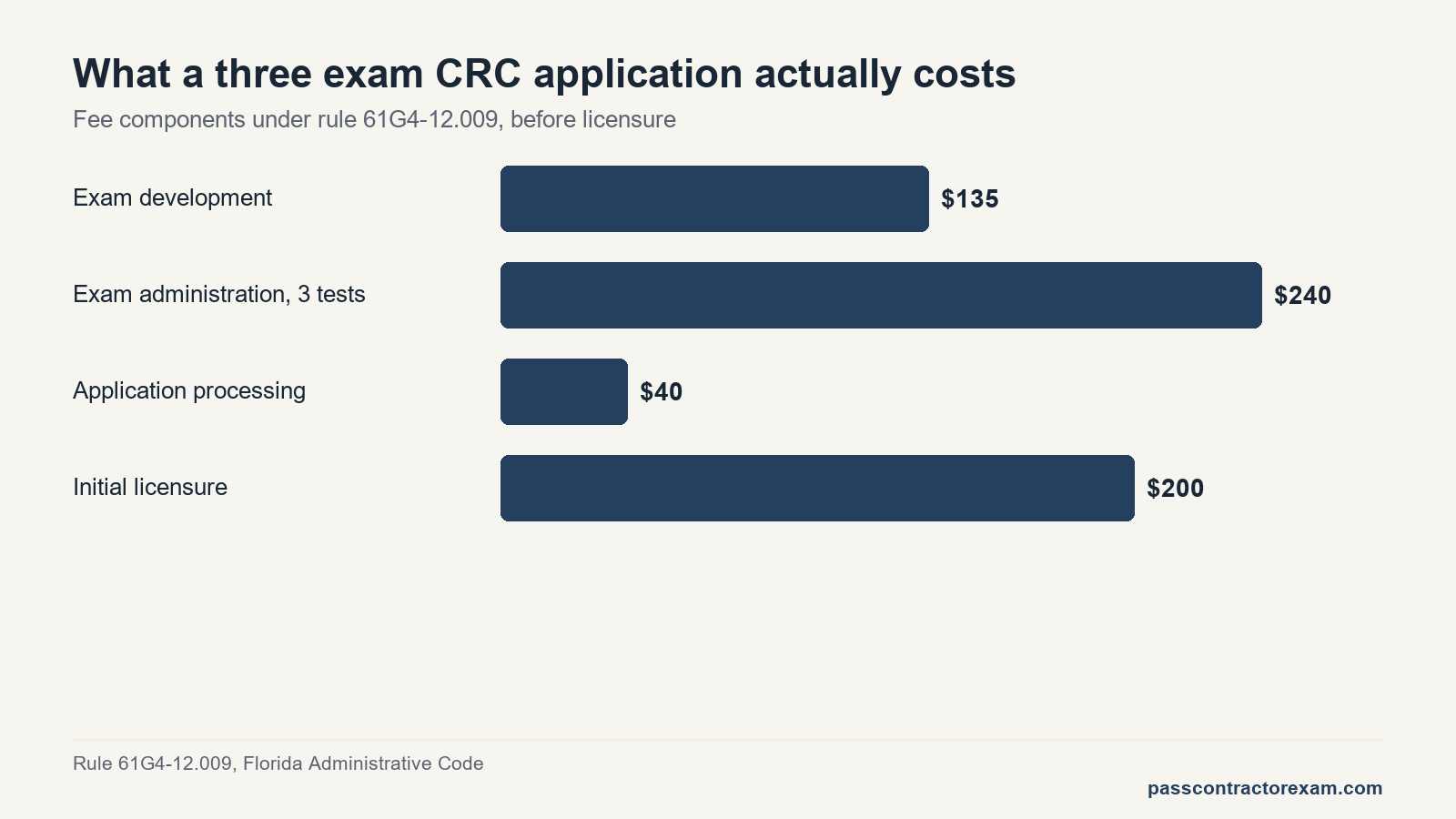
A residential applicant sits the same three Division I exams as a general or building candidate: Business and Finance, Contract Administration and Project Management, all open book and multiple choice. There is no separate, easier residential paper.
| Component | Amount | When it is paid |
|---|---|---|
| Examination development fee | $135 | On scheduling |
| Examination administration | $80 per test, three tests | On scheduling each test |
| Application processing | $40 | After you pass |
| Initial licensure | $200, or $100 in the second year of the biennium | On approval |
For the vendor side of booking the three tests, our walkthrough of Florida general contractor exam registration covers Professional Testing, Inc. and Pearson VUE step by step, and applies the same way whichever of the three Division I licences you are sitting for. If the maths on the Business and Finance paper is what worries you, what an open book will not do for you goes through the calculations that have to be done by hand.

Which license should you actually apply for?
Work out the ceiling on your actual pipeline before you pick a category, because upgrading later means qualifying again rather than filing a form. If everything you build or plan to build is a single family home, a duplex or a triplex under two habitable stories, the CRC gets you licensed on a narrower and, on the experience side, more specific test than the CGC. If a fourplex, a small commercial job or a third story is plausible within the next few years, the CBC buys that room for the same exam and a fee difference measured in tens of dollars, not hundreds. Certified is also only half the decision: our guide to registered against certified in Florida covers the local alternative, which trades statewide reach for a narrower and usually faster route in a single county.
Whichever category you choose, the category is the one the board holds you to on every job afterward. Building a fourplex on a CRC, or a commercial tenant buildout on a CBC, is unlicensed activity for that scope of work even though the licence is real, and it carries the same exposure as having no licence at all for that job.
Which of the three Division I licenses fits your work?
Pick the description closest to what you actually build. This tests only the statutory scope definitions, not your eligibility to apply.
This chooser reads the statute’s own scope tests. It does not assess your experience, your finances or your eligibility to apply.
Frequently asked questions
Can a residential contractor build a duplex or a triplex?
Yes. The CRC statute covers one, two or three family residences directly, so a duplex or triplex is inside the scope. A fourplex or larger building is not, regardless of how similar the construction looks.
Does a CRC let me take on any commercial work?
No. Section 489.105(3)(c) limits the category to residential construction, remodeling, repair and improvement plus accessory structures. Commercial work, including a small retail buildout, sits outside the scope even if the CRC exam itself never asks about it.
Can I upgrade from a CRC to a CGC later?
Rule 61G4-15.001 lists an upgrade from an existing four year license as one of the qualification paths, so the credential itself helps. You still requalify on experience and sit the exam again for the broader category, rather than converting the CRC automatically.
Does remodeling experience count toward the four years?
It can, but the board weighs it against the same structural categories as new construction, foundation, masonry, framing, demolition and column erection. A remodeling background heavy in finishes and light on structural work may not clear the bar on its own.
Is the CRC exam easier than the CGC exam?
No. Both sit the same three Division I papers, Business and Finance, Contract Administration and Project Management, at the same open book format and the same passing score. The difference between the licenses is scope, not exam difficulty.
What happens if I build outside my license’s scope?
Working outside your category’s statutory scope is treated as unlicensed activity for that job, even though your license is genuine and current. It carries the same enforcement exposure as having no license at all for that specific piece of work.
Finished the page? The same five questions from the top, to see what stuck.
Rules and fees change without notice. This page was verified on the date shown and is rechecked on the weekly refresh. If you hit something different, tell us in the comments.

Leave a Reply