
A Florida contractor exam day preparation checklist comes down to four things the state’s candidate booklet names: two signed IDs, one government issued, matching your application; only the approved references, permanently tabbed and free of notes; a silent calculator with no letter keys; and arriving 30 minutes early. Everything else goes in a locker.
Listen to this article, about 12 minutes. A synthetic voice reads the article and announces each section title as it begins; tables are read row by row and the questions at the end are left out.
Recorded 27 September 2026 from the article as published that day. Press a chapter to jump there; the highlighted line is what is playing. A play button sits beside every section heading, and once you scroll past this player a bar at the bottom of the screen keeps the controls in reach. Tap or click any sentence to hear the reading start from there.
On this page: a checklist where every line cites the rule in the state’s candidate booklet, the one place that booklet contradicts itself, and the exam times from its own table.
Think you already know this? Five questions, one minute.
Every answer is on this page. Answer from what you know now; the page fills in the rest.
-
1. Which calculator does the construction candidate booklet permit?
The What to Bring section lists those five conditions and adds that solar calculators are not recommended. DBPR construction candidate booklet Read the section
-
2. How does the booklet tell a permitted tab from a removable one?
Permanently attached tabs with normal chapter or page headings are allowed; anything that lifts off cleanly is treated as removable. DBPR construction candidate booklet Read the section
-
3. Does the computer tutorial come out of your exam time?
You may take up to 15 minutes for the tutorial, and the booklet says that time does not reduce your examination time. DBPR construction candidate booklet Read the section
-
4. How far ahead must you cancel with Pearson VUE to avoid losing the fee?
The booklet says 2 days, and the Pearson VUE Florida construction page says two full calendar days. Read the section
-
5. What score does a construction exam part need, and is it rounded?
The pass mark is 70 percent and the booklet states that construction scores are not rounded, so 69.9 is a fail. DBPR construction candidate booklet Read the section
Most pages ranking for this question are selling a course, an odd thing to sell someone the night before. What decides your morning is a 15 page PDF from the Florida Department of Business and Professional Regulation: the Candidate Information Booklet for construction licensure examinations, marked effective July 2024. This checklist is built from that booklet as it stood when the Internet Archive captured it on 17 February 2026, plus the test vendor’s check in steps, read on 27 September 2026. Where the booklet contradicts itself, and it does once, we say so. This site is independent of the DBPR and both testing vendors.
What does the candidate booklet say to bring on exam day?
Identification comes first: two forms of valid signature identification, one of them government issued, meaning a driver’s licence, state ID card, passport or military ID. Student cards, employment badges and photo credit cards do not count. Candidates without proper identification are not admitted, and your name and address must match what you submitted on your application. That last clause catches people who moved house between applying and testing.
The calculator must be silent, hand held, battery operated, non printing and without an alphabetic keypad. The booklet adds that solar calculators are not recommended, and a solar cell that sulks under office lighting is a poor companion for a six and a half hour paper. Snacks and toiletries go in a clear plastic bag no larger than 8 by 11 inches, which lives in the locker the vendor provides, not beside you. Drinks are allowed in spill proof containers, and the booklet suggests a sweater.
Then the books. Only materials on the approved reference list for your exam may come to the test centre, in their original editions, and they must remain as published. The lists are on the DBPR reference lists page, and our guide to which books you can actually take in walks through them. References that the list marks as PDF files must be printed and bound in a spiral notebook or a binder with three or more holes. And Professional Testing, Inc., which registers candidates, warns that a reference not in its original cover will not be accepted in the examination room.
| Item | What the rule says | Where it says so |
|---|---|---|
| Two IDs | Both carry your signature, one is government issued, name and address match your application | Booklet, Admission to the Examination |
| Approved references | Only books on your exam’s current list, original editions, as published | Booklet, References |
| PDF references | Printed and bound in a spiral notebook or a binder with three or more holes | Booklet, References |
| Book covers | A reference not in its original cover is refused | Professional Testing, Inc. registration notice |
| Tabs | Permanently attached, carrying only normal chapter or page headings | Booklet, References |
| Calculator | Silent, hand held, battery operated, non printing, no alphabetic keypad | Booklet, What to Bring |
| Drink | Spill proof container only; no food in the room | Booklet, Rules for the Examination |
| Snacks and toiletries | Clear bag no larger than 8 by 11 inches, kept in the locker | Booklet, What to Bring |
| Sweater or jacket | Suggested, because the room may run cool | Booklet, Apparel |
What gets a book or a bag turned away at the door?
Tabs are where good preparation goes to die. The booklet permits permanently attached book tabs with only normal chapter or page headings. Post-it notes, pull off labels and removable tabs must come out before you arrive, and it gives a test you can run at your kitchen table: if a tab can be removed without damaging the page, it is removable and will not be accepted. The tab that survives that test is the one you glued. Highlighting and underlining in pen are allowed; written notes are not, which our piece on tabs, highlighting and notes covers line by line.
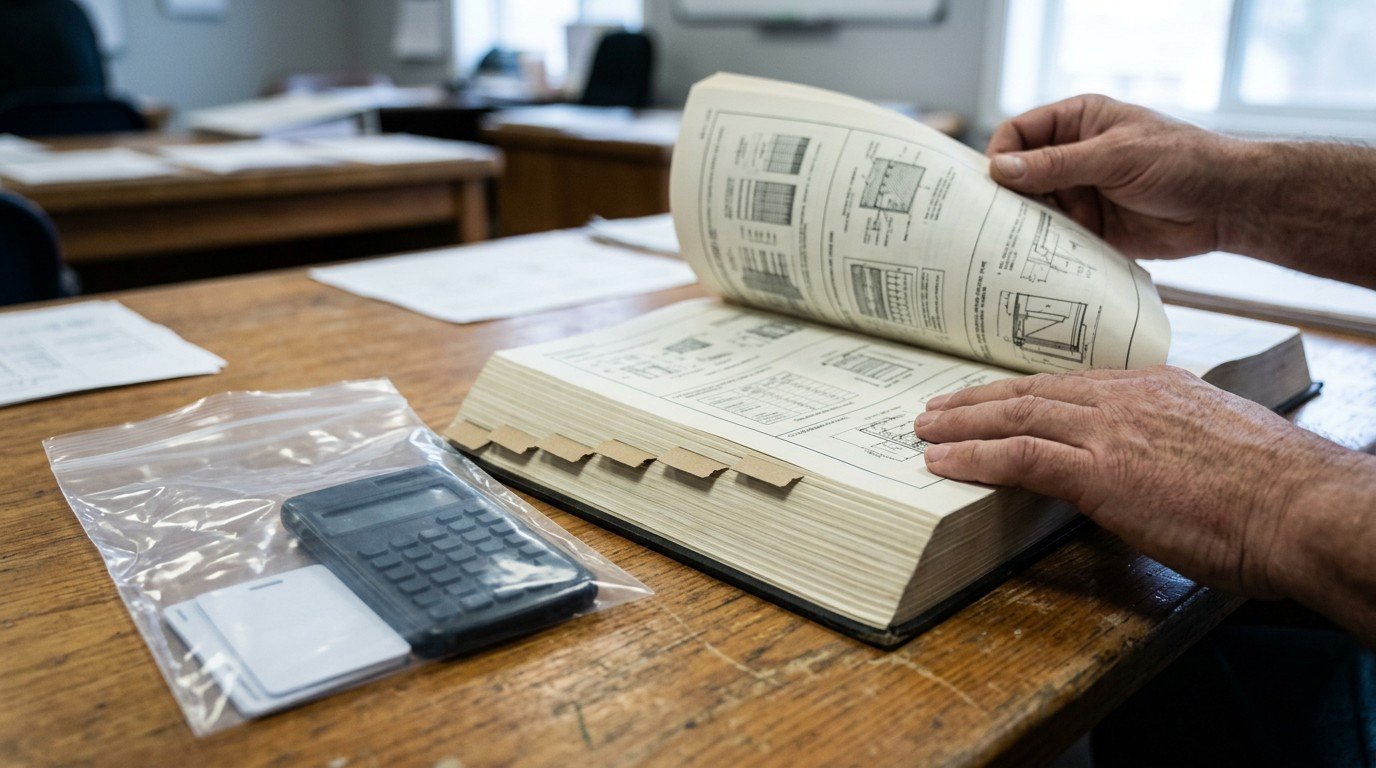
The booklet’s banned list for the examination room covers cameras, tape recorders and computers; pagers, phones and any electronic transmitting device; mace, pepper spray and other personal defence items; and purses, briefcases, portfolios, fanny packs and backpacks. Watches with alarms must be set so they do not go off. Pearson VUE’s own check in guide describes a zero tolerance policy for electronic devices: a prohibited device found during screening means you are asked to leave and may forfeit your exam fees.
Does the booklet really ban reference books and dictionaries?
Read literally, it does, and this is the one place the booklet argues with itself. Its What not to Bring list says the following are not allowed in the examination room: any bound or loose leaf reference materials and notes, and any dictionary, thesaurus or other spelling aid. Two pages earlier, the References section tells you which reference books you may bring and requires PDF references to be bound, and the What to Bring section permits one word for word translation dictionary, inspected by staff, for candidates whose first language is not English.
The sensible reading is that the specific rules govern and the ban list targets material not on your approved list, such as prep course binders. The booklet never says so in terms, though. If you are bringing a bound PDF reference or a translation dictionary, the safe step is to confirm it with Professional Testing, Inc. on 407-264-0562, or the Bureau of Education and Testing on 850-487-1395 for dictionaries, before the day rather than at the desk.
How early should you arrive, and what happens at check in?
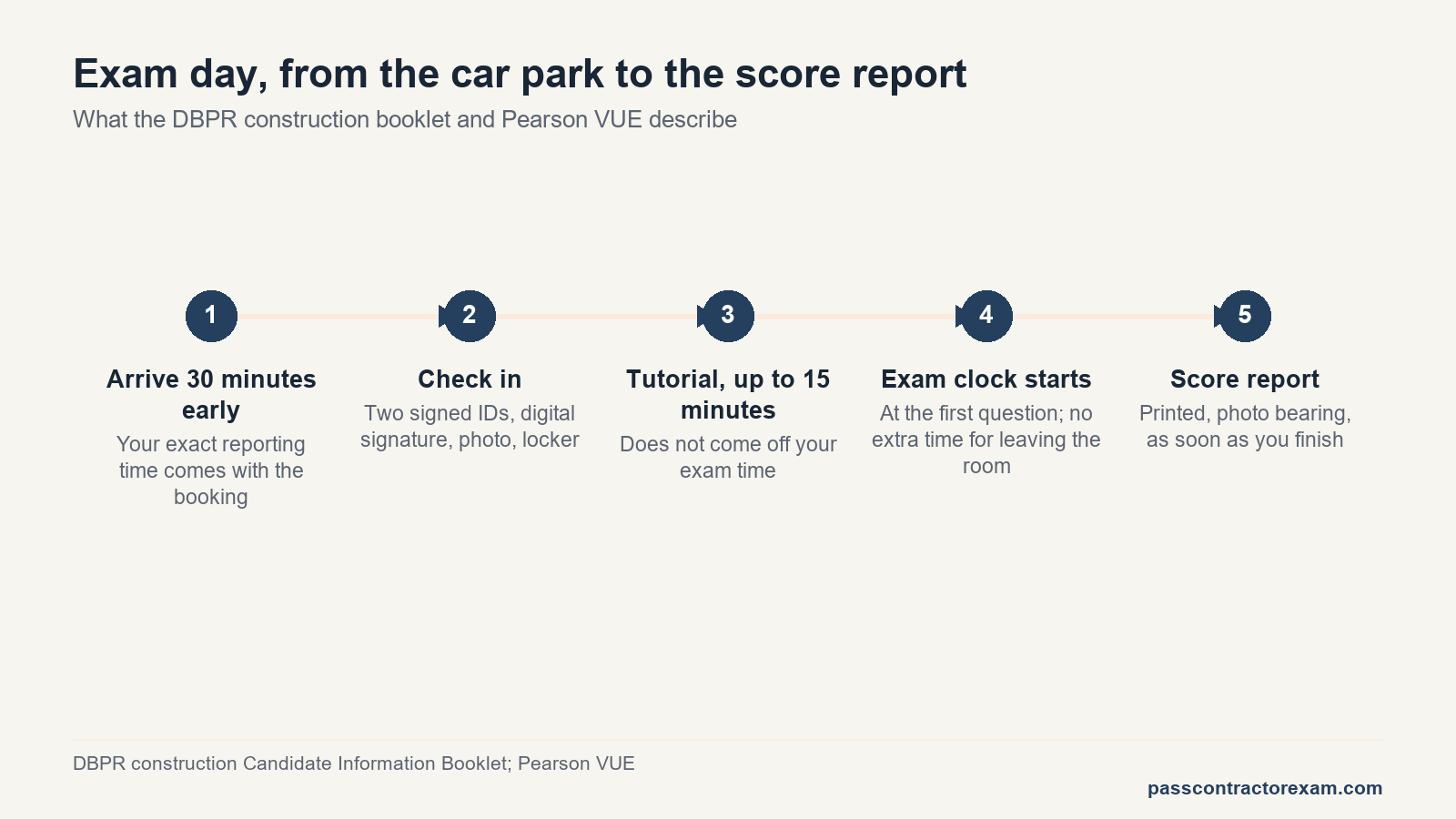
The booklet asks you to report 30 minutes before your scheduled examination; your specific reporting time comes with the reservation. The Pearson VUE Florida construction page is where the booking and the test centre details live.

Check in follows Pearson VUE’s standard process: you review and accept the testing rules, show your identification, sign a digital pad whose signature is compared with your ID, may be asked for a palm vein scan depending on the exam, and have a photograph taken. The booklet notes that this photo appears on your exam result report. Personal belongings go in the locker. You then get up to 15 minutes for the computer tutorial, which does not come off your exam: the clock starts the moment you look at the first question.
How long is each exam, and can you take a break?
The booklet’s own table gives the scored questions and hours for every construction exam. Each exam may also contain unidentified pilot questions that are not scored, and the booklet says extra time is allowed for them, which is why the questions you actually see run a few above the scored count: 125 on Business and Finance and 65 on each general contractor trade part, for example. The full breakdown of the exam format covers what each part tests.
| Exam | Scored questions | Time in the booklet |
|---|---|---|
| Business and Finance | 120 | 6.5 hours |
| General contractor, Contract Administration | 60 | 4.5 hours |
| General contractor, Project Management | 60 | 4.5 hours |
| Building contractor, each trade part | 50 | 4.5 hours |
| Residential contractor, each trade part | 45 | 4.5 hours |
| Roofing | 80 | 5 hours |
| Air Conditioning A, and Mechanical | 130 | 7.5 hours |
One figure does not reconcile. Some prep providers now quote 4.75 hours for the general contractor Contract Administration and Project Management parts, while the booklet’s table says 4.5. We could not find an official document that settles it, so treat the time printed on your own Pearson VUE confirmation as the one that counts, and plan your pacing on the shorter figure.
On breaks: you need the test centre manager’s permission to leave the room, and you will not be given extra time to make up what you lost. Food is not allowed in the room. The booklet says a lunch break will be provided if applicable, without saying which exams that covers, so do not build a plan around one. Under no circumstances may you work past the time allotted.
What happens if you are late, ill or need to cancel?
To cancel or change without penalty, the booklet says to contact Pearson VUE 2 days before the appointment; Pearson VUE’s Florida page says two full calendar days. Later than that, or not turning up, may cost you the exam fees.
Late arrival is at the test centre manager’s discretion, based on that day’s schedule. If the delay was an emergency such as car trouble or a traffic accident, you must provide documentation. If you cannot be accommodated and the lateness is unexcused, you are liable for that day’s fee plus the new one and classed as a No Show.
The booklet accepts five reasons for an excused absence: your illness or that of an immediate family member, a death in the immediate family, a disabling traffic accident, a court appearance or jury duty, and military duty. Written verification and supporting documents must reach Pearson VUE no later than four days after the original exam date, and medical documentation needs the practitioner’s original signature. A stamped signature is not accepted.
When do you get your result, and what if you fail a part?
Immediately. The booklet says every candidate receives an official, photo bearing exam result report as soon as the examination ends, and asks you to check that the details are correct before leaving the test centre. The pass mark is 70 percent, and construction scores are not rounded, so 69.9 is a fail and there is no argument to be had about it.
If you fail a part, you may review only the questions you answered incorrectly, and only on your most recent attempt. Request it within 21 days of the exam; it runs at a Pearson VUE centre with no note taking and usually half the original exam time, and any challenge is written during it, answered in about 21 days with credit or no credit. To sit again you reapply with Professional Testing, Inc. Passed parts stand, you retake only what you failed, and there is a 30 day wait, all of which our guide to failing a part of the exam sets out with the costs.
What is worth doing the night before?
The night before, confirm the reporting time and the test centre address on your Pearson VUE confirmation, and put both IDs where you will not forget them. Pull every tab gently: anything that lifts cleanly comes off tonight. Black out any old handwritten notes in second hand books, and check each book against the current list, because the edition trap catches people who tabbed the wrong printing beautifully. Pack the clear bag and the sweater. If you need testing accommodations for a disability, that application goes to the Special Testing Coordinator before each exam, through the DBPR special testing accommodations page, not on the morning.
None of this makes the questions easier. It just makes sure the only thing tested is what you know.
The night before checklist
Every line comes from the DBPR construction candidate booklet. Tick them off as you pack; it does not make the exam easier, it just stops the door being the hard part.
Built from the booklet effective July 2024. This checklist does not replace the booklet or your confirmation, and nothing on it affects your score.
Frequently asked questions
Can I bring my phone into the Florida contractor exam?
No. Phones, pagers and any electronic transmitting device are on the booklet’s banned list for the examination room, and Pearson VUE applies a zero tolerance policy to electronic devices. It goes in the locker, switched off.
Is a financial or scientific calculator allowed?
The booklet’s test is that the calculator is silent, hand held, battery operated, non printing and has no alphabetic keypad. It does not name models, so a calculator that meets all five conditions fits the rule as written. Solar calculators are not recommended.
Do I need my authorisation letter at the test centre?
The booklet’s admission list names only the two forms of identification. It also says candidates who already know their candidate ID number do not need to wait for the authorisation letter to book. Your Pearson VUE confirmation is still worth having for the reporting time and address.
What if the name on my ID differs from my application?
Your name and address must match what you submitted on your application. The booklet says a name change or correction should be sent to Professional Testing, Inc. immediately with notarised legal documentation, so do it well before the exam.
Does the plumbing contractor exam follow the same rules?
Not this booklet. The construction booklet excludes the plumbing contractor exam, which has its own candidate information booklet on the DBPR site and is not delivered in the same computer based format.
Can I get extra time or other accommodations?
Candidates who need special arrangements because of a disability apply to the DBPR Special Testing Coordinator before each exam, including each retake. The application is linked from the department’s special testing accommodations page.
Finished the page? The same five questions from the top, to see what stuck.
Rules and fees change without notice. This page was verified on the date shown and is rechecked on the weekly refresh. If you hit something different, tell us in the comments.

Leave a Reply