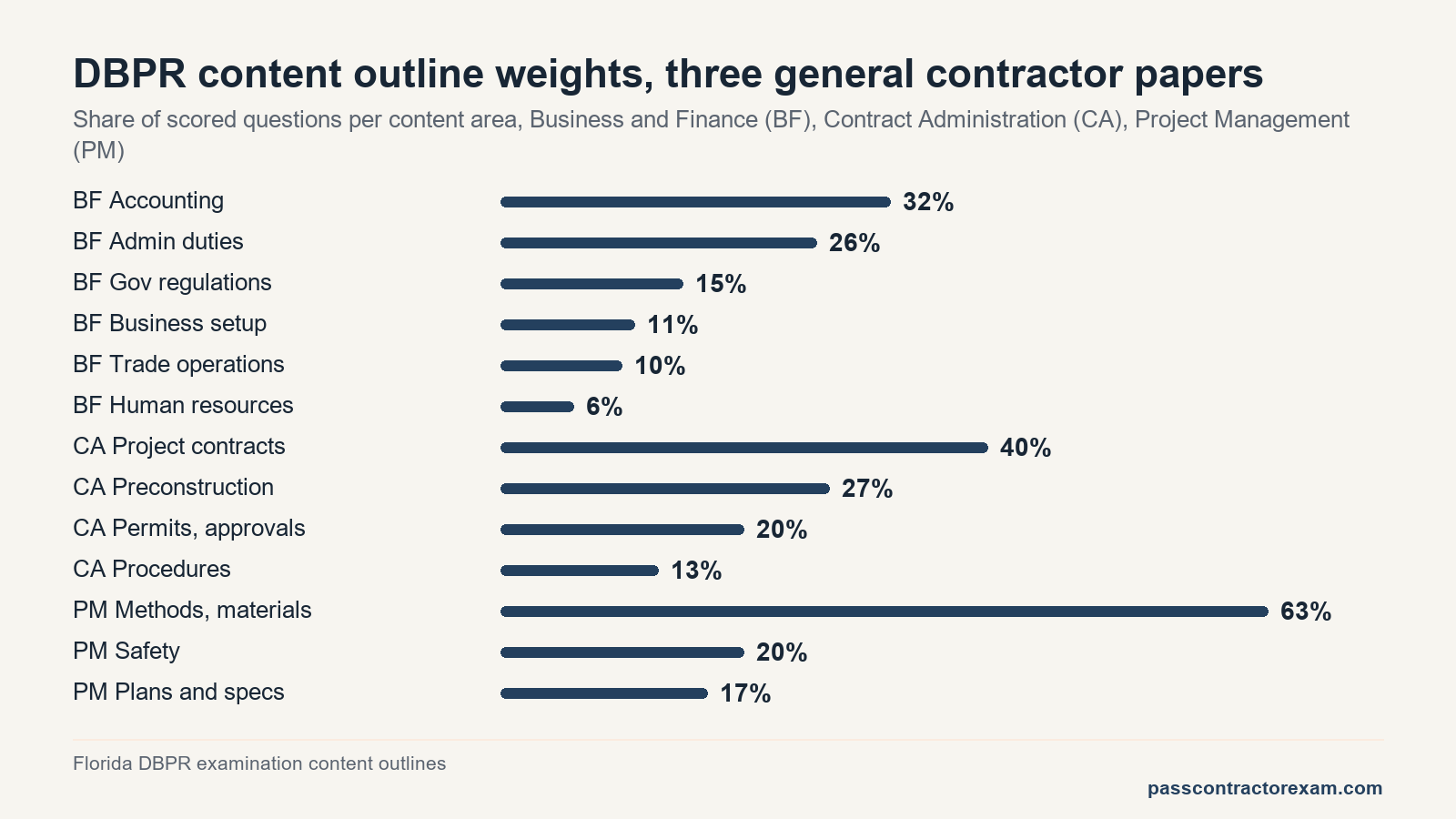
A general contractor study guide for Florida starts with the three DBPR content outlines, not a vendor syllabus. Business and Finance puts 32 percent on accounting, Contract Administration puts 40 percent on project contracts, and Project Management puts 63 percent on methods and materials. Match each area to the approved reference that covers it and study in that order.
Listen to this article, about 16 minutes. A synthetic voice reads the article and announces each section title as it begins; tables are read row by row and the questions at the end are left out.
Recorded 11 October 2026 from the article as published that day. Press a chapter to jump there; the highlighted line is what is playing. A play button sits beside every section heading, and once you scroll past this player a bar at the bottom of the screen keeps the controls in reach. Tap or click any sentence to hear the reading start from there.
On this page: the three DBPR content outlines turned into question counts, a study map pairing every content area with the approved reference that covers it, and what ten candidates in an April 2026 thread reported.
Think you already know this? Five questions, one minute.
Every answer is on this page. Answer from what you know now; the page fills in the rest.
-
1. Which Business and Finance content area carries the largest share of questions?
The DBPR Business and Financial Management outline puts accounting functions at 32 percent, about 38 of the 120 scored questions. Read the section
-
2. How much of the Contract Administration paper does the outline give to project contracts?
The General Contractors Contract Administration outline gives project contracts 40 percent, preconstruction 27, permits 20 and procedures 13. Read the section
-
3. Which approved reference covers the Project Management safety area?
The Project Management outline gives safety 20 percent and names OSHA compliance; the 2026 reference list carries 29 CFR 1926 at its 1 July 2025 printing. Read the section
-
4. Where does Walker’s Building Estimator’s Reference Book sit on the 2026 general, building and residential list?
Page three of the 2026 general, building and residential list lists it under suggested study references that may not be brought into the testing room or facility. Read the section
-
5. What did the original poster of the April 2026 thread blame for failing Business and Finance twice?
In the r/Contractor thread the poster reported scores of 66 and 64 and put both down to time, not content. That is one candidate’s account, not a statistic. Read the section
Why start a general contractor study guide with the DBPR outlines?
Because the department has already written the syllabus, and it is free. Search for a study guide and the results are course vendors, each with a banner about how nobody passes without them. The DBPR construction examination pages carry two things that quietly make most of that unnecessary: a content outline for each paper, with the percentage of questions each area carries, and the reference list naming the only books allowed in the room. Put the two side by side and you have a study map with the weights printed on it. We checked all three outlines and the lists page on 11 October 2026: the trade outlines are dated January 2020, Business and Finance October 2009, and they are still the ones linked.
There is no secret question bank, whatever the forums say, and no guide can promise a pass. What a candidate can do is stop studying by the inch and start studying by the percent. Both trade outlines warn that each share may move by three points either way on a given sitting, so treat every figure below as a centre, not a ceiling. The candidate booklet puts the three papers at 125, 65 and 65 questions, each with five unscored pilot questions, which is why the outlines speak of 120 and 60 scored questions. How the open book format changes the arithmetic is covered in our guide to why open book is not the gift it sounds like.
What does Business and Finance test, and how much of each?
Six content areas, and one of them is a third of the paper. The Business and Financial Management content outline lists them with these weights, which we have turned into rough question counts out of the 120 that are scored.
| Content area | Weight | About how many of 120 | What the outline lists under it |
|---|---|---|---|
| Conducting accounting functions | 32% | 38 | Receivables, payables, cash flow, ratios, job costing, payroll, tax returns |
| Managing administrative duties | 26% | 31 | Overhead, bids, contract law, draw requests, safety programme, insurance |
| Complying with government regulations | 15% | 18 | Chapters 455, 489 and 713, rule 61G4, workers compensation, OSHA, tax |
| Establishing the contracting business | 11% | 13 | Entity types, fiduciary duty, bonding, insurance, lease or buy |
| Managing trade operations | 10% | 12 | Scheduling, critical path, equipment costs, depreciation, inventory |
| Managing human resources | 6% | 7 | Hiring, discrimination law, drug testing, evaluations |
Accounting on its own outweighs business setup, trade operations and human resources put together. That is the most useful fact in any Florida general contractor study guide, and the vendors bury it, because start with the balance sheet sells fewer flashcards. The full breakdown of this paper, and why experienced builders fail it, is in our Business and Finance exam guide; the arithmetic it expects is worked through in the math on the Business and Finance exam.

What does Contract Administration test, and from which books?
Four areas, and the biggest is contracts. The General Contractors Contract Administration outline describes 60 equally weighted questions on the management and operation of a construction company. Project contracts carry 40 percent: contract types such as lump sum and cost plus, the primary contract documents, subcontractor agreements, change orders, payment draws and closeout. Preconstruction activities carry 27 percent: cost estimating, bidding, scope and site review, penalties and contingencies. Obtaining licences, permits and approvals carries 20 percent, and construction procedures and operations, which is scheduling and trade coordination, carries the last 13.
Read that against the reference list and the books choose themselves. The three AIA documents on the 2026 general, building and residential list, A201, A401 and A701, are the contract documents the outline names, and A701 is the one about bidding. Estimating is the awkward one: Walker’s Building Estimator’s Reference Book is on the same list, but on page three under suggested study references that may not be brought into the testing room. Study from it at home; on the day you have the Contractors Manual and the AIA documents. How the two trade papers read differently is set out in Contract Administration versus Project Management.
What does Project Management test, and from which books?
Three areas, and one of them is nearly two thirds of the paper. The General Contractors Project Management outline gives construction methods, materials, tools and equipment 63 percent, which it describes as site layout, earthwork, concrete, masonry, framing and heavy equipment. Safety carries 20 percent, naming OSHA compliance and hazards such as asbestos and lead paint. Reading plans and specifications carries 17 percent, and both outlines add that basic mathematics, area, volume, percentages, triangles and simple algebra, can appear in any area.
| Paper | Content area | Weight | About how many of 60 |
|---|---|---|---|
| Contract Administration | Project contracts | 40% | 24 |
| Contract Administration | Preconstruction activities | 27% | 16 |
| Contract Administration | Licences, permits and approvals | 20% | 12 |
| Contract Administration | Construction procedures and operations | 13% | 8 |
| Project Management | Methods, materials, tools and equipment | 63% | 38 |
| Project Management | Safety | 20% | 12 |
| Project Management | Reading plans and specifications | 17% | 10 |
The 63 percent is where the Florida Building Code volumes earn their weight, all five of them at the 2023 edition on the 2026 list, alongside Principles and Practices of Commercial Construction, the BCSI truss guide and the Energy Efficient Building Construction in Florida book. Safety is one book: OSHA 29 CFR Part 1926, at its 1 July 2025 printing on the 2026 list. Design and Control of Concrete Mixtures, Placing Reinforcing Bars and the GA 216 gypsum manual are study only and stay in the truck. Which editions sit on which list, and the three that changed during 2026, is in our approved books guide.
Which approved reference covers each content area?
This is the table nobody publishes, so we built it: the content area from the outline beside the approved reference whose subject matches the tasks listed under it. The pairing is our reading, not a department document. Prep vendors describe the Contractors Manual as reprinting the statutes and board rules the outlines cite; we could not read its contents page, so confirm that with the testing vendor before relying on it for Chapters 489 and 713.
| Paper and area | Weight | Approved reference that covers it | Study only, not in the room |
|---|---|---|---|
| B&F: Accounting functions | 32% | Builder’s Guide to Accounting (2001); Contractors Manual for payroll and tax | |
| B&F: Administrative duties | 26% | Contractors Manual; AIA A201, A401 and A701 for contract terms and bids | |
| B&F: Government regulations | 15% | Chapter 455 as a bound print; Contractors Manual for 489, 713 and 61G4 | |
| B&F: Establishing the business | 11% | Contractors Manual | |
| B&F: Trade operations | 10% | Contractors Manual; Builder’s Guide to Accounting for depreciation | |
| B&F: Human resources | 6% | Contractors Manual | |
| CA: Project contracts | 40% | AIA A201 and A401; Contractors Manual | |
| CA: Preconstruction activities | 27% | AIA A701; Contractors Manual; Principles and Practices of Commercial Construction | Walker’s Building Estimator’s Reference Book |
| CA: Licences, permits and approvals | 20% | Florida Building Code, Building, chapter 1; Contractors Manual | |
| CA: Procedures and operations | 13% | Principles and Practices of Commercial Construction; Contractors Manual | |
| PM: Methods, materials, tools, equipment | 63% | Florida Building Code, Building and Residential; Principles and Practices; BCSI truss guide; Energy Efficient Building Construction in Florida | Design and Control of Concrete Mixtures; Placing Reinforcing Bars; GA 216 |
| PM: Safety | 20% | OSHA 29 CFR Part 1926 | |
| PM: Reading plans and specifications | 17% | Principles and Practices; Florida Building Code, Accessibility, Existing Building and Energy Conservation |
One thing changed on the department page between our two readings. On 8 October it offered the 2026 list beside a 2025 one; on 11 October the reference lists page offers the 2026 list beside a set headed effective 1 January 2027. We could not open the 2027 documents, so if your test date is next year, read that list before you buy a single book. The list in force on your test date is the one that binds you, which is the whole point of our edition trap guide.
What do people who sat the Florida GC exams actually report?
We read a 39 comment r/Contractor thread from April 2026 started by a candidate with about five years running jobs who assumed Business and Finance would be easy. It carried roughly ten first hand accounts, and they are testimony, not statistics. Paraphrased, with the month each was posted:
- The original poster, April 2026, failed Business and Finance twice, scoring 66 and then 64, and put both failures down to time rather than content: studying the material instead of studying where the material sits in the books.
- One commenter, April 2026, needed three attempts at Business and Finance and passed after a course on tabbing the books, then reported finishing the trade paper in about 50 minutes with a 93.
- Another, April 2026, took seven or eight Saturdays of classes at a Central Florida school, read only the AIA documents, and reported scores above 90 on all three papers first time, crediting memorised tables of contents and knowing when the big code book applies.
- Another, April 2026, bought about $300 of books and studied for six months after work, calling it a career choice rather than a shortcut.
- A July 2026 comment described a two pass method on Business and Finance: every question once in about an hour and a half, flagging anything that took more than two or three minutes to find, then two more hours on the flagged ones. Booked in April, sat in May, Contract Administration in mid June, Project Management five days later, licence in hand by mid July.
Where they agree with the outlines: the paper people fail is Business and Finance, and the area they name is the one weighted 32 percent. Where they disagree: one voice in the same thread insists open book is for when you are stuck, not a substitute for knowing the material, and the fast trade papers were reported by people who already knew the code. None of the ten mentioned a question bank, secret or otherwise. If a sitting has already gone wrong, what you resit and what it costs is in what happens after you fail a Florida contractor exam.
How do you turn the outlines into a study plan?
Weight first, comfort last. The order below is the outlines turned into a sequence; the checklist beside it lets you tick each area off as you tab and work it, and it promises nothing, because nothing honest can.

- Book Business and Finance on its own date and give it its own block. Start with accounting, the 32 percent, working from the Builder’s Guide to Accounting until a balance sheet and an income statement read like a set of plans.
- Then the 26 percent of administrative duties and the 15 percent of government regulations, with lien law worked as a timeline, since Chapter 713 surfaces in three areas.
- Leave estimating until last on this paper. Most candidates already know it, and studying what you know feels productive while moving nothing.
- For Contract Administration, tab A201, A401 and A701 before you open anything else; 40 percent of the paper lives in them. Then estimating from Walker’s at home and the Contractors Manual at the desk.
- For Project Management, the Florida Building Code volumes and Principles and Practices carry the 63 percent; OSHA 1926 carries the 20. Plan reading is 17 percent, which one April 2026 account rightly called a small share of the points.
- Practise every paper open book and timed from the first week. The one thing ten strangers agreed on was that finding beats knowing when the clock is running.
Tabs, highlighting and the rule on notes are stricter than most people assume, and the detail is in what you may mark in your books. Registration, dates and the fee for each paper are in the step by step registration guide. This site is independent of the Florida DBPR: the outlines and lists are theirs, the pairing is ours, and the testing vendor on 407-264-0562 is the one to ask when a book or an edition is in doubt.
Study map checklist: tick each content area as you tab and work it
The thirteen content areas from the three DBPR outlines, heaviest first within each paper, each with the approved reference that covers it. This list tracks coverage, not readiness, and it says nothing about a result.
Ticks are saved on this device only. The pairings are ours; confirm every edition against the DBPR list in force on your test date.
Frequently asked questions
Does the DBPR publish an official general contractor study guide?
No. The department publishes a content outline for each paper and a reference list for each licence category, and it administers the examinations through a testing vendor. Everything sold as an official guide is a private product built from those two free documents.
Do building and residential contractor candidates use the same material?
The 2026 reference list is a single document covering general, building and residential contractors, so the books are shared. The content outlines are separate documents for each category on the same DBPR page, so check the outline for your own licence rather than assuming the weights above apply.
Can I bring the Walker’s estimating book into Contract Administration?
Not on the 2026 list. It appears under suggested study references on page three, which the list says may not be brought into the testing room or facility. The same applies to Design and Control of Concrete Mixtures, Placing Reinforcing Bars and the GA 216 gypsum manual.
How many questions actually count toward the score?
The candidate booklet gives 125 questions on Business and Finance and 65 on each trade paper, with five unscored pilot questions in each, so 120 and 60 are scored. The outlines quote the scored figures.
What score passes, and is it rounded?
Seventy percent on each paper, and the booklet does not round, so 69.9 percent is a fail. On 120 scored questions that is 84 correct; on 60 it is 42.
Can I study from an older Contractors Manual?
You can study from anything. In the room, the 2026 lists name the 2025 edition from 1 February 2026 on Business and Finance and from 1 July 2026 on the trade papers, and say other editions are carried in at your own risk. If your test date is in 2027, read the 2027 list first.
Finished the page? The same five questions from the top, to see what stuck.
Rules and fees change without notice. This page was verified on the date shown and is rechecked on the weekly refresh. If you hit something different, tell us in the comments.

Leave a Reply