The journeyman electrician test checks whether you can do electrical work safely and to Code under a licensed contractor, and in Florida it is set by counties and municipalities rather than by the state. It is heavily weighted toward the National Electrical Code, it is usually open book, and it is timed tightly enough that speed matters as much as knowledge.
Listen to this article, about 11 minutes. A synthetic voice reads the article and announces each section title as it begins; tables are read row by row and the questions at the end are left out.
Recorded 1 November 2026 from the article as published that day. Press a chapter to jump there; the highlighted line is what is playing. A play button sits beside every section heading, and once you scroll past this player a bar at the bottom of the screen keeps the controls in reach. Tap or click any sentence to hear the reading start from there.
On this page: why the journeyman electrician test in Florida is a county exam rather than a state one, the statute that makes every Florida county recognise your card, the calculation types that eat the clock, why open book is not the advantage it sounds like, and the study order that puts navigation before content.
Think you already know this? Five questions, one minute.
Every answer is on this page. Answer from what you know now; the page fills in the rest.
-
1. Who issues journeyman electrician certification in Florida?
Section 489.5335 of the Florida Statutes authorises counties and municipalities to issue journeyman licences in the electrical and alarm system trades; the state licenses contractors, which is a different exam and a different board. Read the section
-
2. Why does the page say an open book exam is not the advantage it sounds like?
The book is there so you can confirm a table value you already know how to find, which is why navigation is practised from the first day of studying rather than the last week. Read the section
-
3. Which calculation does the page say is easy to lose track of partway through?
The fix is working the same sequence every time and never improvising; none of the five types is conceptually hard, and all of them are slow if the method is assembled on the spot. Read the section
-
4. What does the page say to spend the first third of study time on?
Landing on the right table without the index is worth more than another pass through theory, and the last two weeks go only on the questions you got wrong. Read the section
-
5. What does Florida law say about a journeyman card issued by another Florida county or municipality?
Per section 489.5335, read in the 2026 statutes; the recognition applies within Florida, not across state lines, and the statute sets no fee for it. Read the section
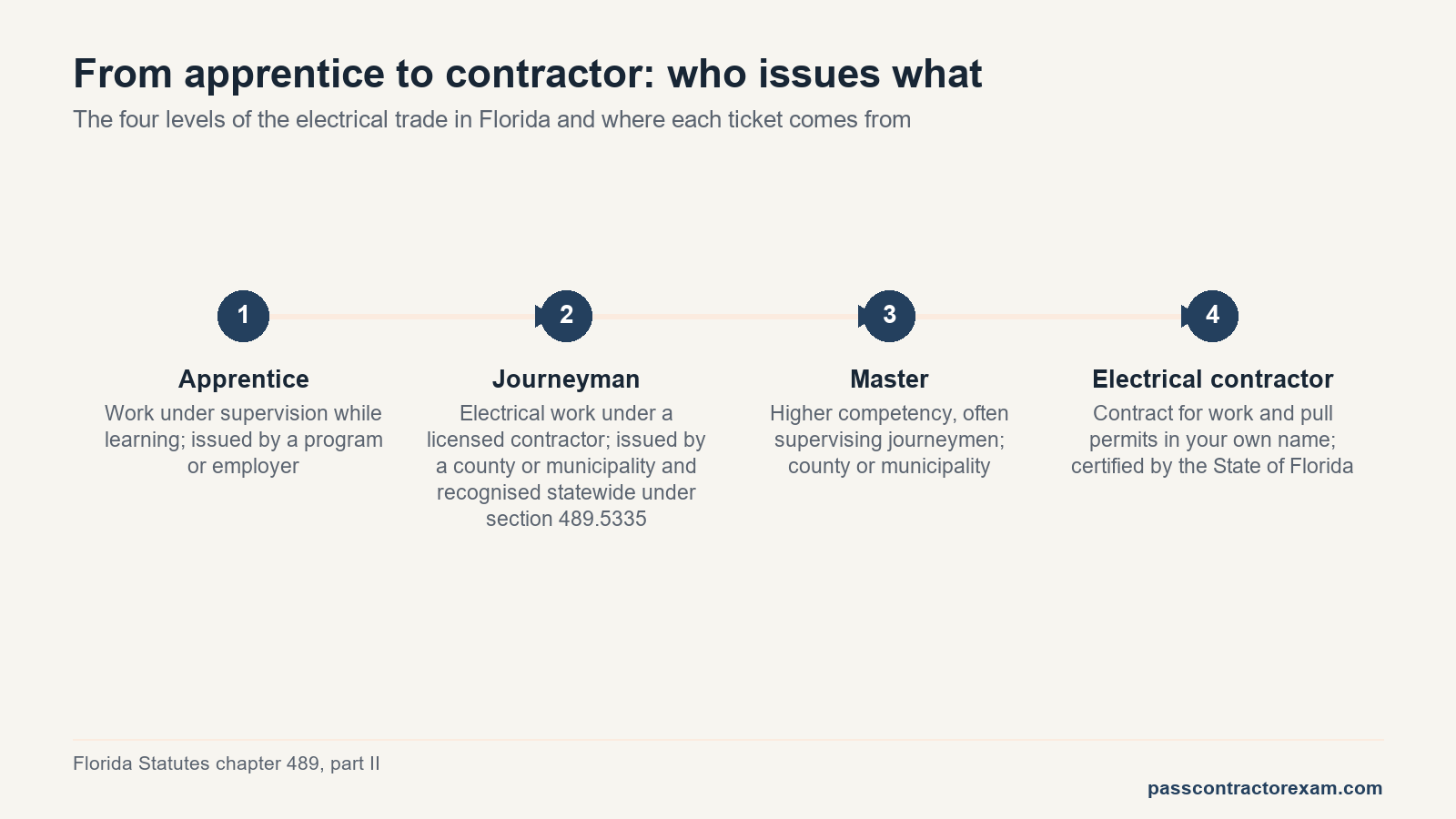
The thing to understand first, because it catches people out constantly in Florida, is that this exam is not a state exam. Florida licenses electrical contractors at state level, but journeyman certification is handled locally by counties and municipalities under section 489.5335 of the Florida Statutes, which authorises them to issue journeyman licences in the electrical and alarm system trades. Which test you sit depends on where you apply.
Where the journeyman ticket sits
| Level | What it lets you do | Who issues it |
|---|---|---|
| Apprentice | Work under supervision while learning | Program or employer |
| Journeyman | Perform electrical work under a licensed contractor | County or municipality |
| Master | Higher competency, often supervises journeymen | County or municipality |
| Electrical contractor | Contract for work and pull permits in your own name | State of Florida |
That last row is a different exam entirely, with different requirements and a different board. the electrical contractor license covers it. If your goal is to run your own electrical business rather than to work for one, that is the license you eventually want.
What is actually on the exam
Content varies by jurisdiction, but the shape is consistent almost everywhere.
- Code knowledge. The largest share. Grounding and bonding, conductor sizing, overcurrent protection, wiring methods, boxes and enclosures.
- Calculations. Load calculations, conduit fill, voltage drop, box fill, motor circuits. This is where the time pressure bites.
- Safety. Lockout and tagout, personal protective equipment, safe working practices around energized equipment.
- Theory. Ohm’s law, series and parallel circuits, power factor. Less than people expect, but it is there.
- Local amendments. Some jurisdictions test their own amendments to the Code. Find out whether yours does.
Open book is not the advantage it sounds like
Most journeyman exams permit the Code book. Candidates hear that and relax, which is the wrong response.
The exams are timed so that you cannot look up much. If you are searching for how to size a conductor, you have already lost the question and probably the two after it. The book is there so you can confirm a table value you already know how to find, not so you can learn the material during the exam.
Practice with the book from the first day of studying, not the last week. Knowing that Article 250 is grounding, and being able to land on the right table without reading the index, is a separate skill from knowing the content, and it is the one that decides whether you finish.
The same principle applies to the contractor exams, and tabbing and highlighting rules covers what you are allowed to do to your book beforehand, which is more restricted than most people assume.

How to prepare
- Get the correct Code edition. Jurisdictions adopt editions on their own timetable and sitting with the wrong one is a wasted attempt.
- Tab it, within whatever rules your jurisdiction allows. Then use those tabs every time you study, so the muscle memory is real by exam day.
- Drill calculations until they are automatic. Load calculations and conduit fill repay practice more than anything else on the paper.
- Do timed practice, not untimed practice. Untimed practice tests knowledge. The exam tests knowledge under a clock, and those produce different results.
- Find out whether your jurisdiction tests local amendments, and study them if so.
The edition question has a Florida twist this year. The code on the jobsite is set statewide through the Florida Building Code, and the Florida Building Commission’s October 2026 workplan lists the ninth edition, which adopts the 2023 National Electrical Code, as taking effect on 31 December 2026; until then the eighth edition and its 2020 NEC govern the work. The exams did not wait. Mike Holt’s Florida licensing page says testing moved to the 2023 NEC from 1 September 2025, which we could not confirm against a testing vendor’s own bulletin on 1 November 2026. If it holds for your county, you may be examined on one edition while installing to another for a few months, which is exactly as tidy as it sounds. Your county’s candidate bulletin settles it.
Before exam day
Every item comes from the preparation advice on this page. Tick each one once it is actually done, not planned.
A preparation checklist. Nothing on this page reproduces exam questions or promises a result. Ticks are saved on this device only.
What does a Florida county need from you before it issues the card?
Section 489.5335(1) sets the floor every county and municipality works from. Counties can ask for more paperwork, but a journeyman licence issued under this section rests on three things, read from the 2026 statutes on 1 November 2026.
- A passing score on a proctored exam: at least 75 percent for anyone examined after 1 October 1997, on a Block and Associates journeyman exam or another proctored exam the board has approved for the trade.
- Experience: a registered, state approved apprenticeship, or at least 12,000 hours of on the job training in the specific trade. At a forty hour week that is close to six years, which is why nobody arrives at this exam by accident.
- Coursework: specialised and advanced modules approved by the Florida Building Commission for the discipline, or, where the issuing authority allows it, proof of finishing them within 6 months after certification.
The 12,000 hour figure is the one worth checking against your own records before you pay an application fee. Hours that are not documented by an employer or a program are hours a county can decline to count.
The calculations that actually decide the result
Ask anyone who has failed and they will say they ran out of time. Ask what slowed them down and it is almost always the same handful of calculation types.
| Calculation | Why it costs time | What fixes it |
|---|---|---|
| Dwelling load calculation | Multiple steps, easy to lose track partway | Work the same sequence every time, never improvise |
| Conduit fill | Table lookups across several tables | Learn which table, not just that a table exists |
| Box fill | Fiddly counting rules for devices and conductors | Drill the counting rules until automatic |
| Voltage drop | Formula plus a lookup, under pressure | Memorize the formula so only the lookup remains |
| Motor circuits | Separate rules from general conductor sizing | Treat as its own topic, because it is |
None of these are conceptually hard. They are all slow if you are assembling the method on the spot, and fast if the method is automatic. That is the entire difference between passing and not.
A study plan that works
- Confirm which Code edition your jurisdiction has adopted. Sitting with the wrong edition is a wasted attempt and it happens more than it should.
- Tab the book in the first week, within whatever rules apply locally, then use those tabs for every practice question afterward.
- Spend the first third of your study time on navigation rather than content. Being able to land on the right table without the index is worth more than another pass through theory.
- Drill the five calculation types above until each is a reflex.
- Move to timed practice earlier than feels comfortable. Untimed practice measures knowledge, and the exam does not.
- In the last two weeks, work only on the questions you get wrong, not on the ones that feel productive.
After you pass
The certification is issued by the jurisdiction that examined you, and it authorizes work under a licensed contractor within that jurisdiction. Inside Florida the recognition is not optional: under section 489.5335 every county and municipality must recognise a journeyman licence issued by another Florida county or municipality in the electrical and alarm system trades, so working across county lines does not mean a second exam. This page used to add that the statute capped a registration fee for that recognition at $25. It does not: the text in force, last amended by chapter 2024-125, says nothing about a fee either way, so ask the receiving county what it charges before you assume a number. Across state lines it is a different story, and the receiving state’s rules apply.
Most people then either stay journeyman, which is a perfectly good career, or work toward master and eventually the state contractor license.
If your goal is your own business
The journeyman ticket is a step, not the destination. To contract in your own name you need the state electrical contractor license, which requires more experience, a different exam, and the Business and Finance exam on top. Plenty of people work journeyman for years first, which is a reasonable path.
If you are weighing that route, the full eligibility requirements covers the eligibility side and how the exam is actually formatted covers what sitting a state exam is actually like.
What has changed since this was first published?
- 1 November 2026, corrected: this page said section 489.5335 lets a county charge up to $25 to recognise another county’s journeyman licence. The current statute, last amended by chapter 2024-125, contains no fee provision. The claim is removed from the prose and from the quiz.
- 1 November 2026: the ninth edition Florida Building Code, adopting the 2023 NEC, is scheduled to take effect on 31 December 2026, per the Florida Building Commission workplan.
- 1 November 2026, added: the three licensing standards in section 489.5335(1), the 75 percent score, the 12,000 hours or apprenticeship, and the module coursework.
- Not rechecked on 1 November 2026: individual county exam fees, vendors and dates, which vary by county and change without notice.
Frequently asked questions
Is the journeyman electrician exam given by the state of Florida?
No, and this surprises people. Florida licenses electrical contractors at state level, but the journeyman certification is handled by counties and municipalities. Which exam you sit, and what it costs, depends on the jurisdiction you apply in.
What is the difference between journeyman, master and electrical contractor?
Journeyman means you are qualified to do the work under a licensed contractor. Master indicates a higher level of competency, again usually local. Electrical contractor is the state issued license that lets you contract for work and pull permits in your own name.
Is the exam open book?
Usually yes, with the National Electrical Code permitted. That is less generous than it sounds. The exams are timed tightly enough that anyone who has to look up basics will not finish, so the book is for confirming, not for learning.
How much experience do I need before I can sit it?
Typically several years of documented work under a licensed electrician, with the exact number set by the local jurisdiction. Apprenticeship program completion is commonly accepted. Check the specific requirement where you plan to apply rather than assuming.
What is the hardest part of the exam?
Calculations under time pressure, particularly load calculations and conduit fill. People fail on speed rather than on knowledge. Knowing the Code and being able to find the right table inside thirty seconds are different skills.
Finished the page? The same five questions from the top, to see what stuck.
Rules and fees change without notice. This page was verified on the date shown and is rechecked regularly. If you hit something different, tell us in the comments.

Leave a Reply